
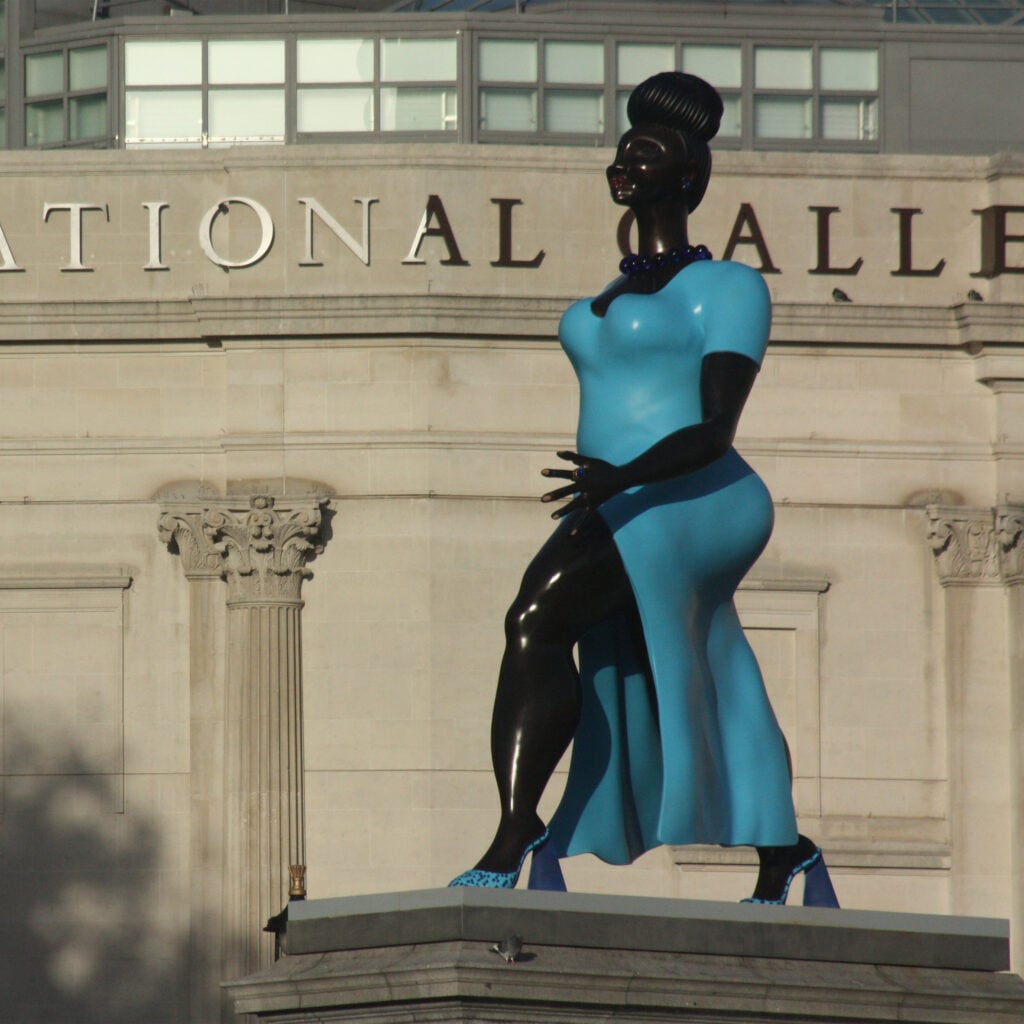
Tschabalala Self's sculpture is far from being out of place in Trafalgar Square, writes Priya Khanchandani.
Photo by Julian Worker/ShutterstockWho belongs in public space? How should public art represent who we are? And who deserves to be celebrated, cast in bronze and placed on a pedestal? These are some of the questions that Tschabalala Self's commission for the Fourth Plinth, Lady in Blue, has raised in recent months, since it was unveiled in September.
I was there that cloudy morning in Trafalgar Square – a space I'd always crossed, probably like most Londoners, without thinking much about what it symbolises. When the black cloth was pulled away, we saw the figure of a Black woman caught mid-stride, one leg pushing through the fabric of her bright blue dress.
Like most of the admirals and generals monumentalised around her, she is cast in bronze. But unlike them she isn't posed in command, she's on her way somewhere. Her head, hair piled high, looks straight out into the city towards Whitehall, her left arm and fingers outstretched, moving with intention.
My Instagram post about the unveiling alarmingly attracted more than 6,000 comments, many of them either subtly or openly racist
I couldn't help but feel satisfaction that a sculpture of a Black woman was there, taking up space in the city, on what is probably the most visible public plinth in Britain, and assumed this sentiment would be widely shared. It turns out I was wrong; my Instagram post about the unveiling alarmingly attracted more than 6,000 comments, many of them either subtly or openly racist and often suggesting the sculpture doesn't fit its context.
Photo by Sean Aidan Calderbank/ShutterstockI feel the need, therefore, to address the notion of what and who belongs in public space, and particularly in a space like Trafalgar Square.
Before Trafalgar Square existed, the site was used for the royal stables that served Whitehall Palace. Designed in 1840 by Charles Barry, the square was conceived as a stage for Britain's image of itself, articulated through the grandeur of neoclassicism, and statues were central to its story. If you linger, you'll spot George IV in Roman robes, sitting valiantly astride his horse. The generals Henry Havelock and Charles James Napier, whose reputations were made in the violent consolidation of British rule in India (the latter for the conquest of Sindh, where all four of my grandparents happen to be from) stand on two further plinths.
Admiral Horatio Nelson himself, the Royal Navy officer whose victory at the Battle of Trafalgar gave the square its name, overlooks them from 50 metres high atop a granite Corinthian column, guarded by four bronze lions. This composition represents a particular vision of 19th-century imperial power, reflected in the monuments and civic spaces rolled out across the Empire.
Read:
"When we place people on a pedestal, we only diminish ourselves"The square might be beautiful, and a fitting monument to its time, but it is also a living, breathing entity formed not only through its monuments and buildings, but also through the way it has been used.
Its function and meaning as a civic space keep being shaped by the people who have held festivals, memorials, gatherings here – or even simply walked through it on their daily commute. After it was built, Trafalgar Square quickly became a place for public assembly. From Bloody Sunday to the suffragettes to Black Lives Matter and the Palestine Coalition, it has a long tradition as a space of protest.
The square has been redesigned over and over, most significantly by Foster + Partners and Atkins in a 2003 scheme that closed the road along its northern edge, adding a terrace and turning what was essentially a traffic island into a pedestrianised space.
For some, in recent years the commission has merely settled into a pleasant biennial ritual
Lady in Blue is in dialogue with this context. She echoes the other figures here through her medium, bronze. And yet while the other figures are rooted to their respective plinths, she looks frozen in motion, echoing the movement of the people in the square below rather than the stillness of statues. The vivid blue of the figure's dress – evoking lapis lazuli, the stone that has been ground into pigment since antiquity – is far from an attack on the Western canon, but rather in conscious conversation with it.
Once intended for an equestrian statue of William IV, the Fourth Plinth stood empty for more than 150 years before it became a space for contemporary sculpture in 1998. Unoccupied, it was always suggestive of a history waiting to be told or – given that the sculptures around it were all commemorating a contemporary moment – a future moment waiting to be solidified in bronze.
The absence of a statue suggested the question of who belongs on a pedestal was always open. Its dedication to contemporary art has allowed for redefinition and offered a chance to bring a quite spectacular historic space, a space of democracy, protest and celebration, into sync with the present.
Read:
East unveils updated images of its plans to pedestrianise Oxford StreetThe Fourth Plinth has become a space where identities are made visible and histories challenged, from Marc Quinn's powerful Alison Lapper Pregnant, to Yinka Shonibare's sculpture of Nelson's own ship in a bottle. Works like these have also, at times, provoked arguments about how the square should be used, and yet each of them has become a part of its changing meaning.
For some, in recent years the commission has merely settled into a pleasant biennial ritual – and yet, this year's sculpture underscores why it exists and why it's so necessary right now.
In 2026, when a Black woman crossing this space is one of the most ordinary sights imaginable, Self's statue validates her as worthy of belonging, not just in the city but here, in a culturally and politically charged public space dominated by white men sculpted by other white men.
Any notion that she doesn't belong isn't an aesthetic judgement, so much as a claim about who the city is for
That elevating such a woman into the visual language of the monument should provoke rage is telling, especially when all the figure has done is walk. Any notion that she doesn't belong isn't an aesthetic judgement, so much as a claim about who the city is for.
Self has said her work is meant to speak to human experience beyond racial identity. She has described the sculpture as depicting "everywoman", implying that an ordinary person merits acknowledgement.
In other words, she hasn't put it into the world simply as a statement about race – though its reception shows how readily the presence of a Black woman in this setting becomes about who is allowed to stand for the universal.
It's as fitting a monument to our era as any I can imagine. At such a fractured time, I can't help but feel relieved she is there, elbowing her way through the noise, making room for all of us.
Priya Khanchandani is a writer and curator specialising in contemporary design and visual culture. She was formerly head of curatorial at the Design Museum, where she curated the exhibition The Offbeat Sari and an accompanying book. She was also previously editor-in-chief of Icon, while her writing has appeared in the Financial Times, Frieze, The Guardian and The World of Interiors, as well as numerous books.
Dezeen In Depth
If you enjoy reading Dezeen’s interviews, opinions and features, subscribe to Dezeen In Depth. Sent on the last Friday of each month, this newsletter provides a single place to read about the design and architecture stories behind the headlines.
The post "Lady in Blue is as fitting a monument to our era as any I can imagine" appeared first on Dezeen.