
See more Toronto Sun on Google — save as a Preferred Source
Europe just isn’t that into us!
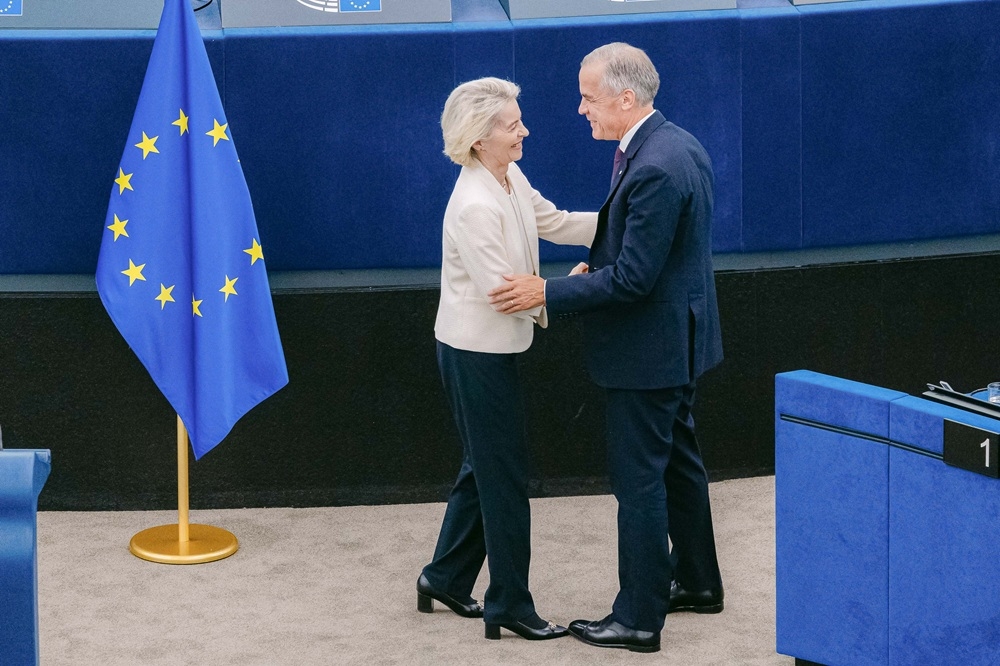
In September, it looked like love at first blush as European Union President Ursula von der Leyen offered Canada something special . She was looking right at a smiling Mark Carney, sitting in the European Parliament delivering her State of the Union address, when she essentially suggested that Canada and the EU start going steady.
“Dear Mark, I said we must urgently reimagine our partnerships. So I would like to work with you on opening the door for Canada to being the first associate member of the European Union,” von der Leyen said.
Carney’s smile got bigger. He shook a few hands, joined in the standing ovation and then went up to embrace and kiss von der Leyen.
While von der Leyen liked the idea of going steady with Canada and Carney, others did not. According to Politico Europe , several countries, including France, Germany and Greece, have all said no to the concept of associate membership.
Europe’s second thoughts
The Canada-EU summit starts in Montreal on Thursday and people are having trouble agreeing to terms. Politico reports that after Germany broke ranks and opposed the associate member language, other countries followed and an EU statement on deepening ties with Canada was watered down.
The previous statement said the two sides would “work to define by the 2027 EU-Canada Summit the concept of Associate Member.” The newer statement doesn’t go that far and now states the two sides will “work to define by the 2027 EU-Canada Summit the concept of an ever closer association of Canada to the EU, short of full membership itself.”
Carney was trying not to look like a jilted lover when he spoke to reporters Wednesday morning, effectively downplaying the reports and what the opposition from EU nations to associate member status meant.
“The good news is it doesn’t matter about specific names or nomenclature,” he said.
“What matters is the difference that it will make to the lives of Canadians.”
Carney went on to say that a deal with the EU would strengthen Canada’s sovereignty. It’s hard to see how that can be the case given the way the EU has structured deals for other countries that want a closer association but don’t want to be full EU members.
Sovereignty or submission?
Norway, Iceland and Liechtenstein are all required to adopt a whole host of European rules and regulations for manufacturing, consumer goods, food safety and more just to gain EU trade access.
The problem is they have to follow the rules but don’t get a vote on making them. Canada would likely need to do the same to gain significant access to the EU market.
In fact, on Wednesday morning, CBC published a story detailing how the EU is getting set to impose carbon tariffs on Canadian products such as steel, aluminum and cement. The only way to fully be exempt from them is for Canada to adopt EU climate standards, which would mean significantly increasing our industrial carbon tax while also adding expensive new regulations for manufacturers.
How Carney can agree to measures like that, or the other regulatory “harmonization” they will demand, while saying it protects Canada’s sovereignty is beyond me.
Let’s be clear, though: the EU doesn’t want us. Proof for that claim is that 10 EU member states, Belgium, Bulgaria, Cyprus, France, Greece, Hungary, Ireland, Italy, Poland and Slovenia, have yet to ratify and fully implement our decade-old free trade deal with them.
Now we have Germany, France and Greece saying they don’t want associate membership, and Carney is still trying to make it work.
Read the room, Mark!
Of course, any Canadian looking at the news out of Europe over the last month, seeing the looting, the vandalism and the violence, might be wondering if the EU is something we want to get closer to.
By all means, let’s trade more with the EU, and start by having those 10 countries ratify the existing deal. But if Europe doesn’t want Canada moving closer, Ottawa should stop trying to force the relationship.
Seems that while von der Leyen liked the idea of going steady with Canada, and Carney, others did not.