
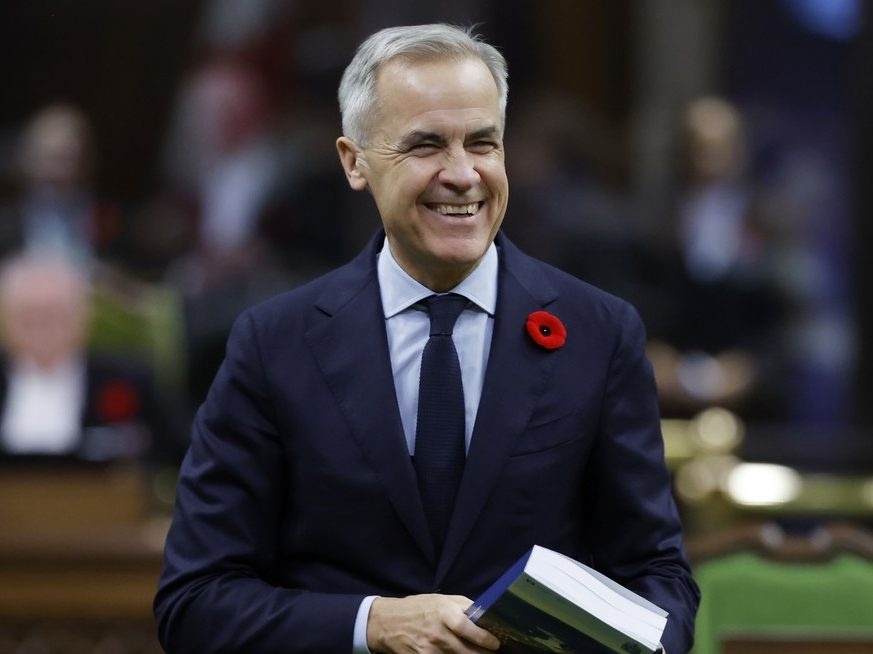
The day after Mark Carney’s budget promised a return to unsustainable immigration levels, Statistics Canada revealed a higher unemployment rate.
Canada’s national unemployment rate rose in October to 6.7% , and youth unemployment spiked to 13.7%.
Amid the numbers in the budget delivered on Thursday was the government’s plan to accept 580,000 new permanent residents in 2027.
That includes 380,000 people coming through the usual channels and converting 200,000 people in the country on temporary work or study visas into permanent residents. The figure of 580,000 people would be the largest number of permanent residents ever recorded in Canada.
The Prime Minister defended his government’s plan as sustainable during a news conference on Friday.
“Yes, we believe it is in line with sustainable immigration,” Carney said. “We have taken back control of immigration.”
That’s a tough case for Carney and the Liberals to make. Numbers may be down from the highs of 2023 and 2024, but they remain much higher than historical norms.
From 2006 through 2017, before the Liberals began ramping up immigration levels, Canada saw an average of 262,400 new permanent residents. In the five years after the pandemic drop, the Liberals quickly ramped numbers up again to an average of 438,000 and an absolute high of 483,600 in 2024.
Admitting 580,000 new permanent residents in one year is more than double the historical average of 262,400.
Double the historical norm
Conservative MP and party immigration critic Michelle Rempel Garner said the numbers Carney is looking to bring in are simply too high.
“Where are those people going to live? Where are they going to live? Where are they going to go to the doctor?” she asked.
Given the unemployment numbers released Friday, where are they going to work?
Canada’s unemployment rate is stubbornly high. It has been above 6% since March 2024.
We have more than 1.5 million unemployed Canadians looking for work, and Carney’s government wants to flood the zone.
Bringing in 580,000 people in one year is like adding a city the size of Hamilton, Surrey or Quebec City. Thinking this wouldn’t put pressure on the job market, the housing market or the health-care system would be a mistake.
It’s the same mistake the Liberals made between 2021 and 2025. Now, after saying they had learned their lessons, they are looking to repeat the recent past.
“Right now, the levels need to come way down,” Rempel Garner said.
Where will they live?
Rempel Garner’s position is the right one, but it’s not the one the Liberals are taking.
Unemployment remains high, housing starts are stalled and, despite recent price declines, housing remains unaffordable.
The Canada Mortgage and Housing Corporation projects just 233,000 housing starts across the entire country in 2027.
In addition to the 580,000 permanent residents that Carney wants to add, his government is projecting between 370,000 and 644,000 temporary residents to enter Canada in 2027.
The math simply doesn’t add up. There aren’t enough homes for the number of people the government plans to bring in. This isn’t blaming immigrants for the country’s problems; it’s a simple case of bringing in more people than our housing stock or job market can handle.
- LILLEY: Ottawa must say no to calls for higher immigration
- Mark Carney to appear in video played at Canadian citizenship ceremonies
- LILLEY: Carney wants more immigration, Canada needs less
Voters turning against the plan
The Liberal mishandling of this issue is causing a major change in public opinion.
As recently as 2022, just 27% agreed with the statement that “there is too much immigration to Canada” while 69% disagreed.
Now, a poll by Environics and the Diversity Institute found that 48% of Canadians believe we have too much immigration in Canada, including 46% of first-generation immigrants and 51% of non-white Canadians.
If the Carney government pushes ahead with these unsustainable numbers, support for immigration will fall further.
Canada needs immigration, but it needs to be at sensible levels. What the government unveiled this week misses the mark.
blilley@postmedia.com