
London Museum opens its new home inside Smithfield’s historic General Market on November 28th, 2026, following a decade-long transformation led by Stanton Williams, collaborating architect Asif Khan Studio and conservation architects Julian Harrap Architects. The project gives the Victorian market a new public role, preserving its historic character while opening the building to exhibitions, cultural events and everyday encounters with London’s history. The opening marks 50 years of London Museum and gives the historic Smithfield market a new lease of life as a place for Londoners to explore the past and present of their city.
Designed by Sir Horace Jones, the architect behind Tower Bridge and Leadenhall Market, the General Market opened in 1883 and operated for more than a century before closing in the 1990s. After decades of disuse, its restoration returns the building to public life, preserving its architectural character and introducing new functions across its expansive interiors. The transformation involves more than 70 trades and brings together heritage craftspeople, including master stonemasons, Welsh blacksmiths and the country’s last heritage coppersmiths.
view into the General Market at London Museum from the main entrance hall on West Poultry Avenue | all images by Hufton + Crow
preserving the architecture while changing its purpose
The architects at Stanton Williams, in collaboration with Asif Khan Studio and Julian Harrap work with the existing features of the building. Original market signs, heritage shopfronts and decorative ironwork remain part of the experience, with the wrought-iron Phoenix columns continuing to support the enormous ceiling. The perimeter of historic shopfronts will accommodate independent organizations, extending the activities of the museum beyond its galleries. A pub and children’s arts charity, A New Direction, are among the first occupants, allowing different forms of public and community activity to coexist within the restored structure.
Sustainability is another significant component of the redevelopment. The project is targeting a BREEAM Outstanding rating, which would place it among the top one percent of buildings worldwide under the certification system. Supported by a loan from the Mayor of London’s Green Finance Fund, the ambition is to combine heritage conservation with the environmental requirements of a contemporary public building.
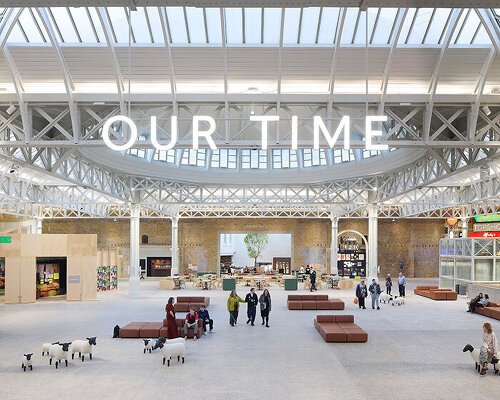
Our Time in the Linbury Hall is a vibrant social hub at the heart of London Museum
three ways of experiencing London
Real Time, Our Time and Past Time form the three main areas of the museum. Real Time occupies West Poultry Avenue, a former covered street transformed into the main entrance of the building that introduces visitors to contemporary London through animated displays presenting changing urban data, from the city’s populations of pubs and bees to residents’ moods and listening habits. Fragments of pottery and discarded Victorian clay pipes embedded in the floor introduce traces of earlier everyday life. At the heart of the General Market, Our Time occupies the former trading floor of the Linbury Hall. It combines large-scale installations with a restaurant, shop and family-oriented show space. Its displays explore how Londoners gather and form communities, bringing together objects such as the Lord Mayor’s State Coach, the former Buckingham Palace switchboard and Syd’s Coffee Stall, an East End institution.
The space also incorporates contemporary cultural references, including nightclub and shop signs, alongside a soundscape by electronic musician Scanner and a film by John Ogunmuyiwa exploring London’s crowds, from street celebrations to political demonstrations. The displays consider the ordinary places, sounds and encounters that contribute to the collective identity of the city. Descending to Roman street level, Past Time presents 2,000 years of London’s urban history through objects, archival material and immersive installations. The collection moves from the city’s earliest inhabitants and Roman settlement to its development as a center of trade, imperial power, protest and contemporary culture. Highlights include the Cheapside Hoard, Roman writing tablets, Emmeline Pankhurst’s hunger strike medal and objects documenting London’s music, fashion and artistic scenes.
A six-meter viewing window offers a direct view of Thameslink trains passing between Farringdon and City Thameslink. Set within the permanent galleries, it brings the city’s transport network into the museum, placing London’s history alongside the infrastructure that keeps it moving today.
interior view of Real Time on West Poultry Avenue
a museum shaped by its city
London Museum places particular emphasis on the participation of Londoners in shaping its new identity. More than 100,000 people, including schoolchildren, artists, writers, craftspeople and local communities, have contributed to the project. Their involvement extends into the collection, programming and interpretation, with displays incorporating contemporary voices alongside objects from the extensive historical holdings of the museum
This approach is particularly visible in the museum’s changing program, which opens with London Tastes, an exploration of the capital’s food culture led by guest editors Ruby Tandoh and Jonathan Nunn. Running from November 2026 to August 2027, the program traces the city’s culinary identity through its markets, restaurants, independent businesses and neighborhood food traditions. The opening also forms part of a larger redevelopment of the Smithfield and Barbican area. The adjacent Poultry Market is scheduled to open in 2028, adding temporary exhibition spaces, a dedicated learning center and a collection store. The phased development will further expand the museum’s presence within the historic district.
With a reported investment of £437 million and an ambition to welcome around two million visitors annually, the project represents a substantial commitment to cultural infrastructure in central London. Its architectural significance, however, lies less in the scale of the investment than in the decision to work with an existing urban landmark. By bringing the General Market back into public use, London Museum demonstrates how the city’s inherited buildings can accommodate new forms of cultural life while retaining traces of the activities that originally defined them.
a covered former street that acts as London Museum’s main entranceview into part of London Museum’s London Tastes display
view looking up at restored dome in the General Market building general view of historic market features and new architectural interventions view of the rediscovered Victorian vaults the vaults which will house the London Museum’s free inaugural exhibition opening in spring 2027 Past Time is the museum’s free permanent gallery visitors will encounter the people and events that have shaped London the Charterhouse Street frontage of the new London Museum the Museum is wrapped in a 250-metre long parade of 44 shopfrontsthe London sign mounted on a former awning structure
project info:
name: London Museum | @wearelondonmuseum
architect: Stanton Williams | @stanton_williams
collaborating architect: Asif Khan Studio | @asifkhan.now
conservation architect: Julian Harrap Architects | @julianharraparchitects
location: Smithfield General Market, London, UK
opening date: November 28, 2026
original building architect: Sir Horace Jones
original building: 1883
photographer: Hufton + Crow | @huftonandcrow
The post london museum opens new home in smithfield’s historic general market appeared first on designboom | architecture & design magazine.