
What’s that chirping sound coming through the detector? Did you feel something whiz past?
Those are just some ways people react when they encounter microbats for the first time. Microbats are small, mostly nocturnal mammals that use ultrasonic sounds to navigate and hunt at night. They do this through echolocation, producing calls and listening to the echoes that bounce back from objects and prey.
Their nocturnal habits, small size and fast flight can make them uniquely difficult to find and study. Our latest research explored whether citizen science could help, while also asking what people themselves gain from taking part.
We entrusted bat detectors to a handful of curious volunteers from Western Australia. Bat detectors turn the ultrasonic calls of microbats into sound recordings humans can hear. These recordings also help us identify which bats are present, as different species produce calls that vary in their frequency, shape and timing.
Here’s what we found.
A bit about batsBats are found everywhere except Antarctica and make up around 22% of mammal species in the world. Australia is home to more than 80 species, ranging from the thumb-sized little forest bat (Vespadelus vulturnus) to the much larger grey-headed flying fox (Pteropus poliocephalus).
Bats are sometimes described as “microbats” and “megabats”. These aren’t formal scientific groupings, but the terms are still commonly used to distinguish smaller bats from larger species. In Australia, smaller bats are mostly insect-eaters while our larger flying foxes mainly feed on fruit, nectar and pollen.
Bats are captivating creatures. They are the only mammals capable of true flight, meaning they actively flap their wings instead of just falling or gliding. Bats also play a vital role in ecosystems. Flying foxes pollinate native plants and disperse seeds, while insect-eating bats help keep insect populations under control.
Yet, bats are often overlooked. Their nocturnal habits mean most people rarely encounter them up close, while misinformation and negative perceptions about bats persist.
What we studiedStudying bats can be challenging. Most species are active at night and roost during the day in tree hollows, caves and other places that are hard to access. To find them, researchers often rely on specialist equipment, such as ultrasonic bat detectors.
Our recent review investigated whether citizen science projects could help overcome these hurdles.
Our research team analysed 51 published bat citizen science studies from around the world. We found acoustic surveys, where ultrasonic detectors are used to record bats as they fly past, were the most common approach. However, few studies investigated what participants got out of being involved in citizen science projects.
That led us to conduct our own study. In 2025, we invited residents from the City of Wanneroo in Perth, Australia to go on a bat-finding mission. We recruited volunteers through social media and local environmental and citizen science networks.
Read more: Why we shouldn’t be so quick to demonise bats
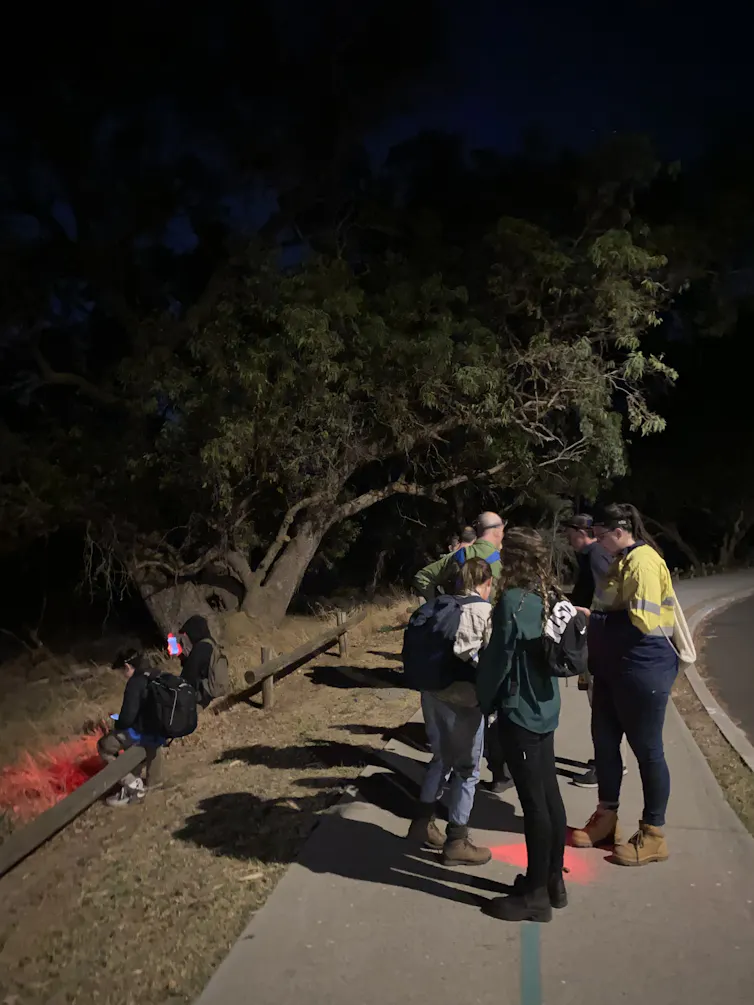
We trained participants to use bat detectors connected to smartphones and taught them about local bat species. After dividing them into small groups, we asked participants to walk set routes through local bushland, listening for and recording bats along the way. Our volunteers recorded five bat species across 23 surveys.
The most common was Gould’s wattled bat (Chalinolobus gouldii), a widespread species that appears well adapted to urban environments. Our volunteers detected the Holt’s long-eared bat (Nyctophilus holtorum) for the first time within the City of Wanneroo, but didn’t find any chocolate wattled bats (Chalinolobus morio) at urban survey sites.
Together, these findings provide a clearer picture of which bats are using Perth’s urban landscapes and highlight questions for future research, including why some species appear better suited to urban areas than others.
Citizen scientists are helping collect crucial data about nocturnal species. Kelly Sheldrick From fear to fascinationAs part of our study, we asked participants to complete in-person questionnaires about their knowledge of bats, their attitudes towards them and how connected they felt to nature. We did this three times: before training, immediately following training and after participants conducted their own surveys.
Participants knew more about bats and felt more connected to nature after taking part in our research project. We also observed positive changes in how participants viewed bats.
One participant said they previously didn’t appreciate bats because of “fear” and a “lack of exposure” to bat-related activities. After conducting their own survey, this participant emphasised how much they enjoyed seeing evidence of bats on the detector.
Many volunteers delighted in something simpler: the opportunity to safely observe animals at night. So much of Australia’s wildlife is nocturnal, yet few of us experience these animals for ourselves.
Volunteers take part in a bat-finding mission after dark. Kelly Sheldrick More to discoverThere’s still much we don’t know about Australia’s bats, including where some species occur and how they use our urban and natural landscapes. Citizen science could help fill these gaps.
What’s more, our study shows participants also value the opportunity to discover little-known species and use scientific tools. They may even develop a newfound appreciation for animals they used to fear.
However, citizen science projects aren’t the only way to learn about nocturnal animals. On a warm, dry evening, try looking around rivers, parks or bushland, and you may spot a bat darting after insects. Local bat groups also run bat walks and other community events, while the Australasian Bat Society provides resources to help you learn more about bats and discover which species live in your area.
Read more: What we’ve learned from citizen science: 5 projects that made a difference
Kelly Sheldrick is affiliated with the Australasian Bat Society, the Conservation Council of Western Australia and the Australian Citizen Science Association.
Rochelle Steven is affiliated with the Ecological Society of Australia, Society for Conservation Biology, Australian Mammal Society and BirdLife Australia.
Trish Fleming does not work for, consult, own shares in or receive funding from any company or organisation that would benefit from this article, and has disclosed no relevant affiliations beyond their academic appointment.