
Costs multiply with every task you hand to an agent. Each task consumes tokens and credits, and as agents spread across your teams and automations, consumption can grow faster than usage. If you run the platform, you own that growth, including which teams and workflows drive it and whether the usage ships work.
At GitLab Transcend, we introduced the governed software factory, our architecture for agentic software engineering, and new capabilities in GitLab Duo Agent Platform that bring that growth under control. GitLab-managed open-weight models matched frontier-model task completion at a fraction of the cost in GitLab's benchmark, so you can align your model to the task to improve your team’s cost efficiency. GitLab Orbit gives agents lifecycle context so they retry less. Duo Agent Platform Impact Analytics and credit caps show where credits go and put a limit on them.
Control costs in the governed software factoryA usage total tells you what you consumed, and leaves hard questions open: how much routine work sat on an expensive model, how many agent runs were wasted retries, and which users and teams burned through the credits. When the dashboard only shows tokens, platform and engineering leaders end up debating a number neither side can stand behind. If you can't attribute the usage, set a limit, and cut the waste, you can’t optimize or justify your spend.
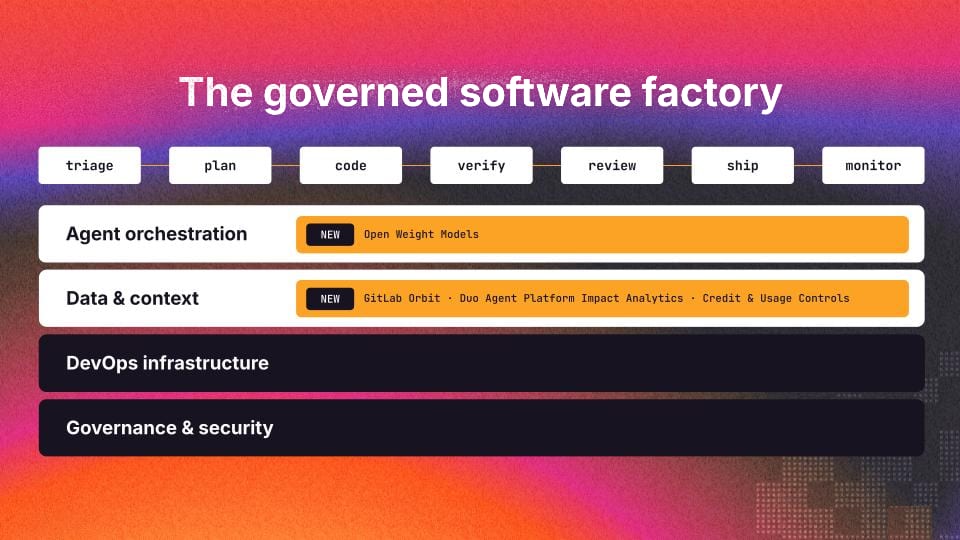
Breaking that pattern starts with the architecture. The governed software factory is built in layers, and cost grows where those layers don't connect. Two of those layers matter most for cost. The first is agent orchestration, where open weight models put routine work on lower-cost models. The other is data and context, where Orbit, Duo Agent Platform Impact Analytics, and credit and usage controls give humans and agents the context to produce high-quality outcomes at the lowest possible cost.
You can see the problem in a shadow software factory, where each stage has its own tool, with no shared policy or context between them. Agents spend tokens searching for context across systems that were never built to integrate. A governed software factory gives agents shared context, shared policy, and one place to measure what they cost. When every AI credit counts, you can:
- Spend fewer credits for the same work: Match models to the task at hand with open weight models, and ground agents in lifecycle context with GitLab Orbit so they retry less.
- Trace spend to its source: See credits by user, team, task, and model in Duo Agent Platform Impact Analytics and the GitLab Credits dashboard so you can point to what drove the growth.
- Set a ceiling before the next spike: Cap usage per user with credit caps, with overrides where needed, so agent loops stay inside the limits you set.
Agent cost starts with the price of each model call. GitLab Duo Agent Platform lets you pin a default per feature and control what your teams can use: your own model, self-hosted or from your provider, GitLab-managed frontier models, or GitLab-managed open-weight models, new in GitLab 19.4.
Three open-weight models are now hosted in GitLab Duo Agent Platform: GLM 5.3, Kimi K3, and MiniMax M3. In GitLab's internal benchmark with Duo agents, GLM 5.3 matched Claude Opus 5's task completion at approximately one-fifth the cost, Kimi K3 matched Claude Fable 5.1 at one-third the cost, and MiniMax M3 matched GPT-5.5 at one-eighth the cost. Model choice is an admin setting. In your top-level group's GitLab Duo settings, open Model Selection, select Manage Models, and pin a model to each feature. For example, pin Kimi K3 to Agentic Chat and MiniMax M3 to agents and flows, so routine work does not default to a frontier model. Group Owners also choose which models their teams can use.
Cut retries with the right contextModel choice sets the price of each call, and retries multiply the number of calls. Gartner found that a team of 40 developers spent 23 times more on AI because agents kept retrying without the right rules and context. Agents retry when they lack context. Across a monorepo or several repositories, an agent spends its first stretch crawling files to work out what connects to what, and every retry resends the full context window.
GitLab Orbit maps your code, work items, merge requests, pipelines, deployments, and security findings into a single graph that stays current as your teams ship. Agents in GitLab Duo Agent Platform query it natively. External agents like Claude Code and Codex connect through Model Context Protocol (MCP), and custom tooling connects through the REST API. Every agent sees exactly what its user can see in GitLab.
With that context, an agent asks the graph and gets a precise answer faster and more efficiently. In GitLab testing, the same task in Claude Code needed up to 45x fewer retries with Orbit and, separately, used 4.5x fewer tokens to get the right context the first time. Orbit is in free beta on GitLab.com today and reaches general availability next month across all deployment options.
Manage what you can measureModels and context lower the cost of each task. Impact data shows whether it worked. Duo Agent Platform Impact Analytics answers the two questions platform leaders ask: how much are we spending, and where is that spend concentrated? It breaks spend down by team, task, and model for the teams and date range you choose, and it shows how an open weight model stacks up against your current model mix, so you compare with data instead of guessing. The GitLab Credits dashboard adds detail below the team level, tracing usage to the user and session behind it.
Visibility pairs with limits. Without a limit, the only lever left is asking everyone to use less. Credit and usage controls set caps at the subscription, group, or user level, with alerts at 50%, 80%, and 100% of spend and an automatic pause once usage reaches the cap. A flat per-user cap, such as 1,000 credits per user/per month, applies to every team member, and an individual override, such as 500 additional credits, gives an engineer who is experimenting room to work without asking for more. Per-user caps apply once a user has consumed their included credits, and only the capped user loses access to credit-consuming features, until the next billing period or until an administrator raises the cap.
Duo Agent Platform Impact Analytics shows credit consumption alongside the work that reaches production, so you can see whether usage is turning into delivered work.
See Duo Agent Platform Impact Analytics in action in this demo from our Transcend global event:
Put agent cost control to workStart your agent cost control journey with the model. GitLab-managed open-weight models are generally available. In Model Selection pin GLM 5.3, Kimi K3, or MiniMax M3 to a routine workload, such as a flow that runs on every merge request.
Next, cut retries. GitLab Orbit is in free beta on GitLab.com today. Turn it on for the group that runs the most agent sessions. Orbit reaches general availability next month across all deployment options.
Then, measure and set limits. Duo Agent Platform Impact Analytics is in early access, so you can see spend by team, task, and model. Credit and usage controls are generally available. Set a per-user cap for GitLab Credits with overrides for your heavy users. After a few weeks, compare usage by team and model against the previous period.
Design the foundation for your software factory with GitLab Duo Agent Platform. If you're new to GitLab, start a free trial of GitLab Duo Agent Platform. If you're on Premium or Ultimate, turn on GitLab Duo Agent Platform and use the GitLab Credits included with your subscription.