
It was a frightening time.
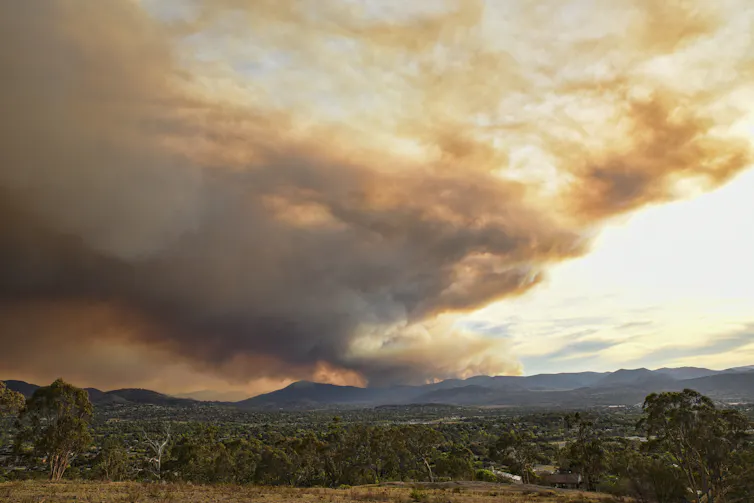
On a hot, gusty day in January 2003, I found myself on the hill behind my Canberra home, watching as billows of black smoke rolled through neighbouring suburbs.
Many of my friends and family members were left scrambling during the Canberra bushfires of 2003, which destroyed almost 500 homes and claimed the lives of four people.
This summer, Australia is bracing for what could be a challenging fire season. The official spring outlook warns of a “heightened risk of fire” across many states and territories, driven by a combination of dry conditions and increased fuel loads.
Following the cataclysmic Black Summer bushfires, the 2020 Royal Commission raised disaster communication as a persistent challenge. It recommended making disaster information more tailored and consistent.
The revised national Australian Fire Danger Rating System activates on days with high fire risk, and encourages people to monitor conditions and official sources for warnings. But my research suggests informal communication channels are just as important.
A massive cloud of bushfire smoke surrounds the Brindabella mountains near Canberra in 2020. Daniiielc/Getty Through the grapevineFor decades, Australia’s emergency authorities have relied on a traditional crisis communication model – agencies send messages and the public receives them.
The 2020 Royal Commission underscored communication as a key concern, calling for improved information flow from officials to the community.
However, my conversations with disaster survivors reveals people aren’t just passive recipients. They find, verify and share information through their networks to understand and respond to emergencies – behaviours official agencies often don’t see.
My research examines how communities actively build their own disaster communication networks alongside, and sometimes in place of, formal emergency management channels. I focused on three specific disasters, namely:
the 2022 Brisbane floods
the 2022 Northern Rivers floods
the 2019–20 Black Summer bushfires on the far South Coast of New South Wales.
I interviewed 19 community members, who told me who they relied on for information. I call these people “information intermediaries”. They didn’t just share messages but translated official, and often complex, warnings and information into locally relevant guidance.
These community members also bridged technological gaps, turning to tools such as face-to-face conversations and phone trees. This allowed them to get information to those without access to technology and keep communication channels open when technology failed.
These information networks kept working long after the immediate disaster was under control. For example, several communities set up two identical WhatsApp groups, one for social chat and the other to distribute vital information in times of emergency.
A bushfire risk sign in regional Victoria. moisseyev/Getty Meet Stuart and MargaretTwo people who embody the idea of “information intermediaries” are Stuart and Margaret (both names are pseudonyms).
Stuart lives on the NSW South Coast. Prior to the 2019 fire season, Stuart had already established his own bushfire warning system. He was able to track a fire’s location on an app and monitor wind patterns on another. Stuart also convinced his neighbours to create a collective bushfire plan.
Over a drink on the back deck, they formed a local communication network that allowed each household to stay informed about changing weather conditions. Stuart didn’t just protect himself from future bushfires, but equipped his whole neighbourhood to prepare themselves.
Margaret is a Brisbane resident who, while working part-time at a local school, got to know many parents and families. When floodwaters inundated Brisbane in 2011, Margaret set up a “pop up childcare” centre to help local families cope.
For the first six months, Margaret ran the centre as a volunteer support hub. She spent the next decade rallying support and applying for grant funding. By 2022, she had become the manager of a government funded neighbourhood centre designed to support locals, including during future disasters.
Two volunteers from the BlazeAid charity repair a fence destroyed during the 2019–20 bushfires. Daniiielc/Getty So what can we do?As well as declaring warnings, emergency management could actively work with communities to create and share bushfire information.
In the short-term, this could involve identifying local information intermediaries and existing networks. Recording their contact details and preferred communication channels would ensure direct contact between trusted locals and emergency management, when a disaster hits.
This benefits both sides: agencies get real time, on the ground information while intermediaries are able to verify and relay information from official channels.
Longer-term, fire agencies could recognise people like Stuart and Margaret as a vital part of local disaster response.
In practice, this means an agency knows who to rely on before the fire or flood, actively fosters these relationships between disasters and supports locals in tangible ways, such as through a formal government partnership. Rather than creating a new communication channel, this supports those that already exist.
If you live in a disaster-prone area, you can help make your community more resilient by building your own networks. This may look like reaching out to your neighbours about how you can help each other or who might need extra help when disaster strikes.
Emergency management has continued to invest in the national bushfire warning system, constantly improving the clarity, reach and timeliness of disaster warnings. But official communication channels are only one part of a much bigger picture.
Success should be measured not just by how many people receive the official message, but also how quickly accurate information gets to the trusted locals and networks that people actually listen to.
An old truck sits in a forest destroyed by bushfires, which burnt through the NSW town of Braidwood. Daniiielc/GettySusan Atkinson receives funding from Monash University to undertake research into disaster communication in communities.