
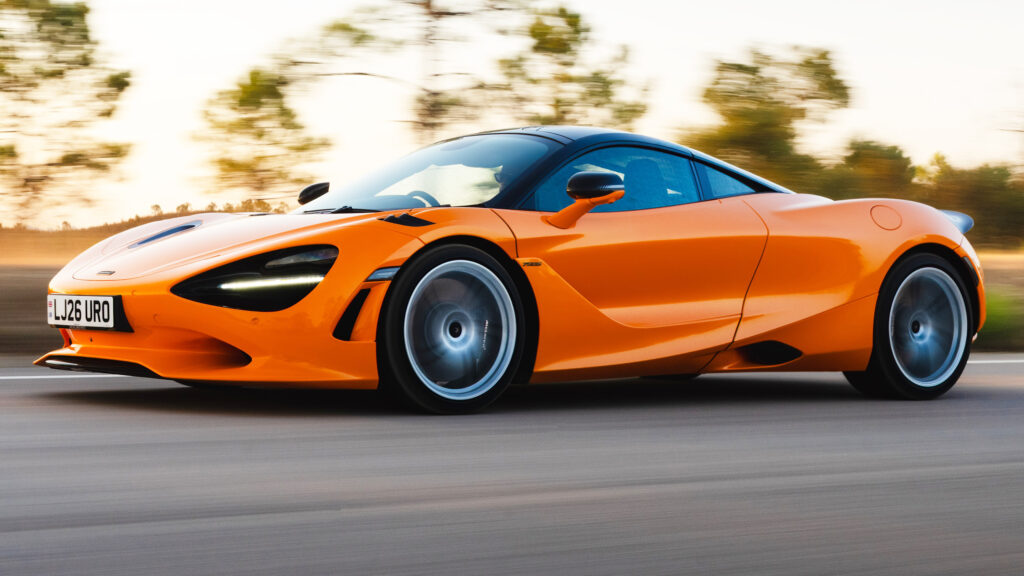
- The McLaren 750S and its engine date back to early 2017 with the 720S.
- McLaren will also kill off the Artura and replace the two models with the P34.
- The P34 is expected to hit the market with a twin-turbo hybrid V6.
The end of the McLaren 750S is near. The British car manufacturer has confirmed that production of the 750S will end next year, and it is now taking final orders for the car. In a world where rivals have become heavier and switched to hybrid powertrains, the 750S has stood out, and the supercar industry will be poorer without it.
The current 750S traces its roots back to the 720S, which McLaren launched at the Geneva Motor Show in 2017 as a successor to the 650S. At the time of its launch, it put the Lamborghini Huracan and Ferrari 488 GTB to shame, easily outperforming both and packing such a punch that it was shown to be quicker than the McLaren P1 around some racetracks.
Read: McLaren’s Next Supercar Will Pack A Bigger Punch Than The 750S For Less Money
Given how extraordinary the 720S was, it came as no surprise that McLaren stuck to that car’s basic premise with the 750S, retaining most of the design and upgrading the superb 4.0-liter twin-turbocharged V8. What’s perhaps more remarkable about the 750S is that it’s 66 lbs (30 kg) lighter than the 720S. In a world where near cars are almost always heavier than their predecessors, this is quite an achievement.
In July, McLaren released the car’s final wild iteration – the 788HS. Just 200 units are being built, each fitted with an upgraded engine delivering 777 horsepower and 590 pound-feet (800 Nm) of torque. The 788HS also includes a slew of visual and aerodynamic upgrades and has all the makings of a collector’s car.
The demise of the 750S doesn’t come as a surprise. The car is now almost a decade old, which is a long time in the supercar world. Its rivals, the Lamborghini Temerario and Ferrari 296 GTB, are both hybrids with significantly more power and are kinder to the environment, too. Nevertheless, the 750S’s combination of power and light overall weight has allowed it to keep competing.
“The 750S represents everything that defines a McLaren supercar: benchmark performance, thrilling driver engagement, technical innovation, expressive design, and defined personalization,” McLaren chief commercial officer Henrik Wilhelmsmeyer said. “It will leave behind an extraordinary legacy.”
What’s next for McLaren? In addition to axing the 750S from its line-up, McLaren is also going to kill off the Artura in 2028. Filling the void left behind by these two models will be a new model, known internally as the P34. Reports about this model first surfaced last month, indicating it will launch with a newly developed twin-turbocharged hybrid V6 with more horsepower and torque than the 750S. However, it’ll also inevitably weigh more, so whether or not it can capture the magic of the 720S and 750S remains to be seen.