
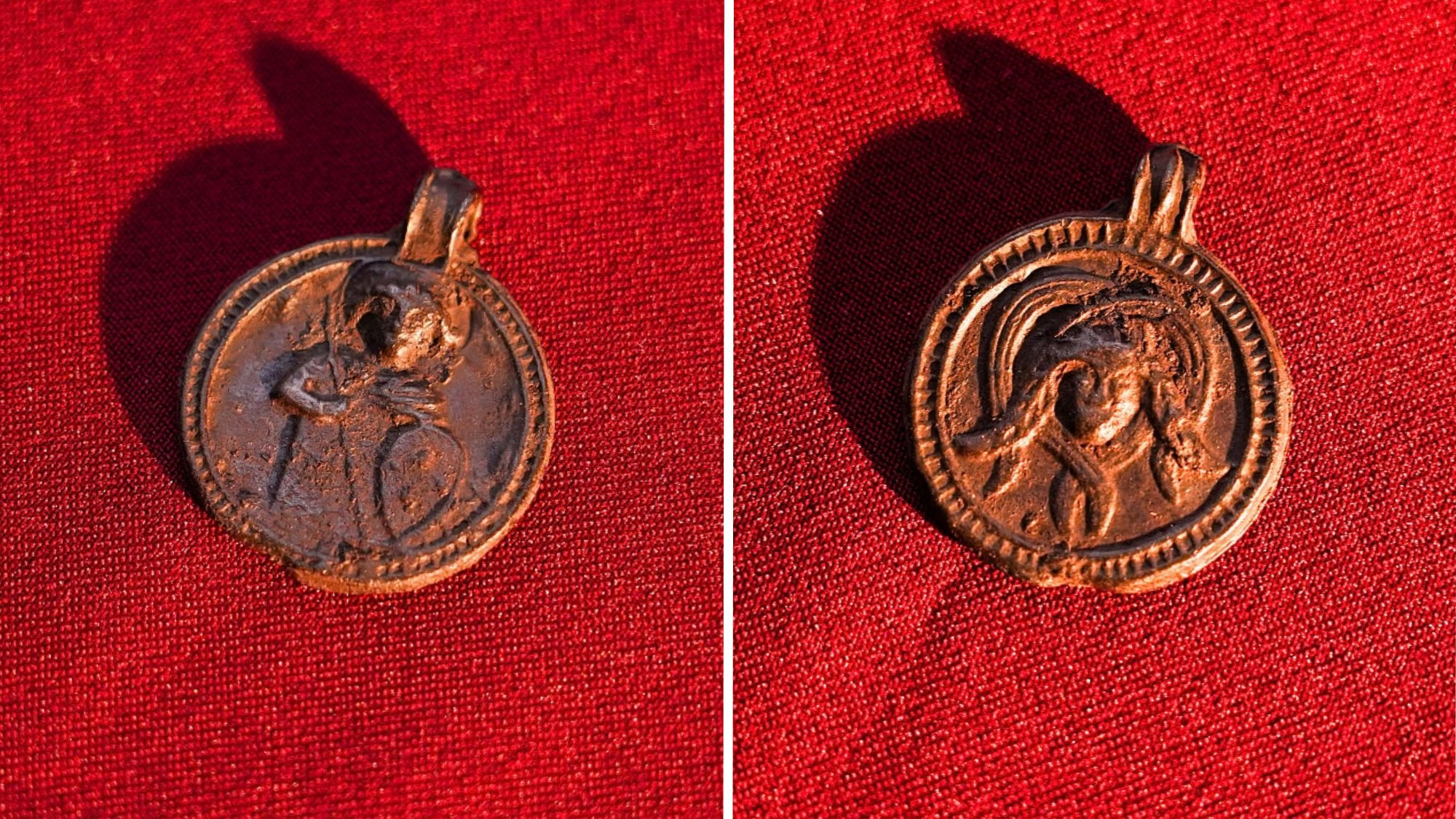
Archaeologists recently discovered a rare Russian medallion that depicts a dramatic cultural clash between medieval Christianity and ancient Greek mythology. Excavated about 400 miles southeast of St. Petersburg near the town of Staraya, the 11th century pendant appears to showcase a warrior saint on its face with the snake-topped head of Medusa on the back. According to archaeologists, the copper-alloy medallion stems from an era in Russia that often straddled the line between regional medieval theology and pre-Christian superstition.
The small pendant was recovered from inside the remnants of an ancient urban estate, and is an example of Zmeeviki or coil image. These double-sided pieces traditionally paired a canonical Christian figure on the front with a “pagan” serpent form on the back. While the religious subjects commonly included Jesus, the Archangel Michael, and the Virgin Mary, some variants highlight other saints.
In the case of the recent discovery, archaeologists at Novgorod State University theorize the medallion’s saint may be Theodore Stratelates. Born into the Roman empire around 281 CE, Stratelates is a martyr in the Eastern Orthodox Church renowned for slaying a giant serpent, and is frequently depicted wielding a spear and shield. Although the reverse image appears to feature Medusa herself, researchers believe the gorgon served as a stand-in for broader evil forces.
“Most likely, this is not a specific mythological creature, but a collective image of dark forces,” Novogorod State University archaeologist Sergei Toropov said in a profile translated from Russian. “Together with other finds, this pendant indicates that already in the 11th century there was a Christian community in [early Russia], and cultural ties with Byzantium were also developed.”
Archaeologists previously only recovered four similar serpent artifacts from Staraya, but each one dates between the 12th and 14th centuries. This makes the Stratelates–Medusa example potentially the oldest ever discovered in the area, and a poignant representation of the region’s crosscultural influences. While Christianity was already establishing itself in this portion of Russia during the 1000s CE, it had yet to entirely supplant local beliefs, customs, and superstitions. Because of this, it’s possible the Zmeeviki artifact simultaneously served as a ward against evil forces and a pre-Christian supernatural protective invocation from disease.
Regardless of its wearer’s intentions, the pendant’s owner was likely a comparatively wealthy estate resident who belonged to the town’s middle class. Richer residents would have worn jewelry made from pricier materials like gold and silver, while poorer locals couldn’t have afforded either. Prior evidence of a nearby artisanal workshop also indicates the fascinating talisman may have been made on the estate grounds itself. In any case, the latest example of Zmeeviki illustrates that local beliefs rarely present as a monoculture—more often, people want to blend both tradition and newer ideas.
“The main feature of the coil [is a] combination of images that are incompatible, from the point of view of strict dogma,” added Toropov.
The post Medieval Russian talisman depicts Christian warrior saint and Medusa appeared first on Popular Science.