
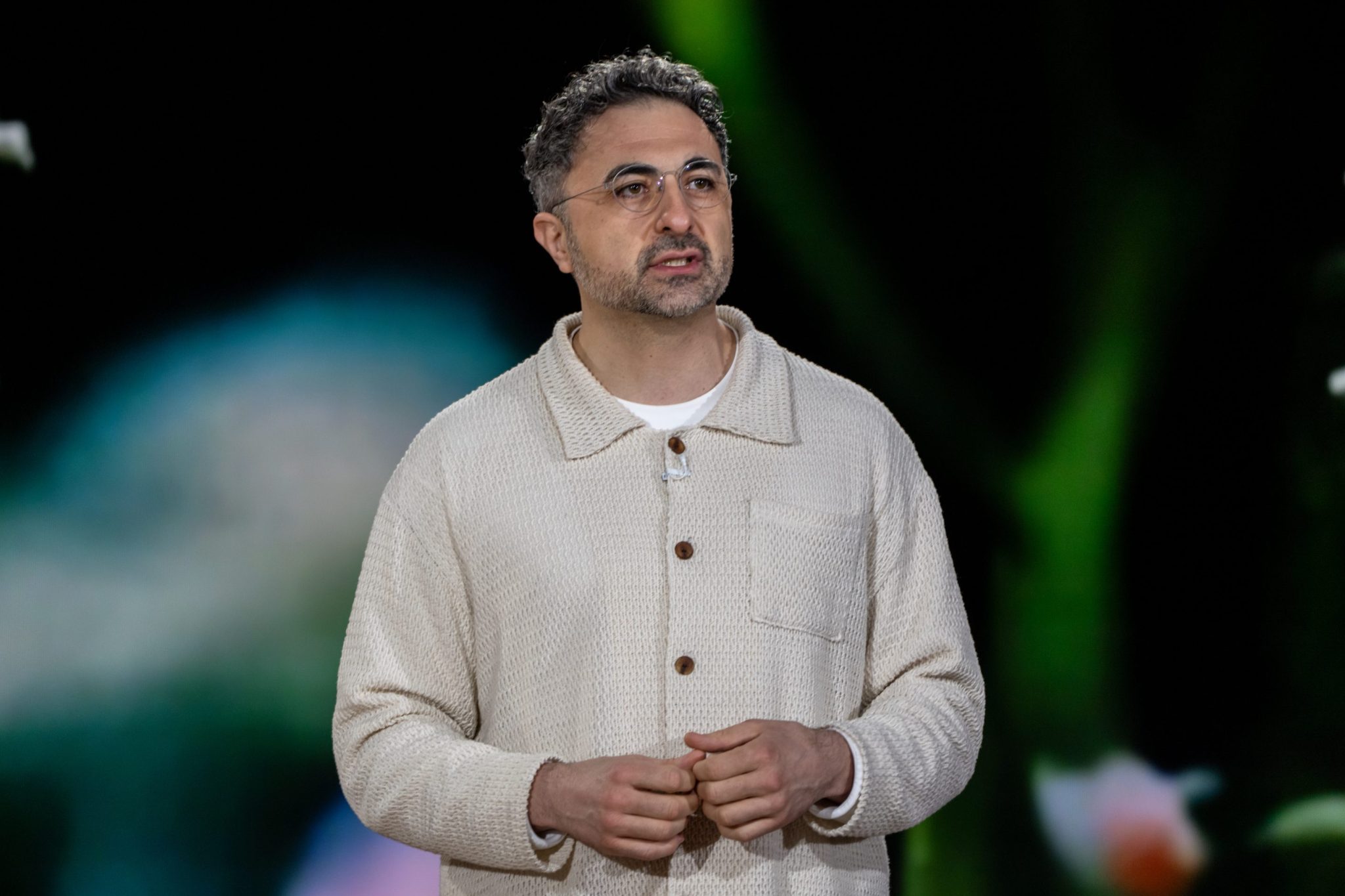
Now is the moment for top AI labs to unite around AI safety, Mustafa Suleyman, chief executive of Microsoft AI, told Fortune.
The executive, who leads AI model development at Microsoft, unveiled a code of conduct Monday that will steer the company toward a “humanist” AI approach. The release followed days of upheaval in the tech industry over AI model capabilities, after Anthropic researcher Jacob Coxon resigned from the lab, publicly warning that AI companies were gambling with people’s lives.
On Saturday, Anthropic chief executive Dario Amodei outlined a plan aimed at slowing AI development. OpenAI chief executive Sam Altman, meanwhile, teased a soon-to-be-announced collaboration among labs in an interview with Fortune on Friday.
Suleyman said the industry has hit an inflection point because models have advanced at a tremendous pace. A few years ago, models struggled to produce a single coherent sentence, he said. Now they can write flawless code and breach systems, as in the recent attack by OpenAI agents on Hugging Face.
“If you can write code, you can create all kinds of applications and systems,” Suleyman told Fortune. He dismissed an estimate by Anthropic’s head of alignment, Evan Hubinger, that AI has more than a 10% chance of wiping out humanity as “not really a helpful frame.”
“I think that what you’re hearing is that people are genuinely concerned about the pace of progress,” he said. “There’s not really sufficient alignment in the industry that the purpose of technology is to serve humanity, and we don’t want to create something that we can’t control.”
Suleyman also said he and other lab CEOs have discussed AI safety issues and the pace of development for years, though he declined to say whether Microsoft was involved in any upcoming safety pact.
“Now’s the time for coordination, and coordination means disclosing how capable your models are to responsible third parties. That’s what we’re calling for,” he said.
Part of Anthropic’s plan to slow the pace of AI development is Amodei’s commitment to grant independent evaluators permanent, employee-level access inside the company to verify safety practices and report incidents. Amodei also wrote that companies in democratic countries should agree on common safety standards that limit the rate of unchecked progress. He argued that democratic governments should attempt coordination with authoritarian states, beginning with agreements that serve everyone’s interests, such as a ban on using AI to develop biological weapons.
Anthropic Chief Executive Dario Amodei attends a working lunch with G7 leaders during the G7 Summit on June 17, 2026 in Evian-les-Bains, France. Anna Moneymaker/Getty ImagesSuleyman said labs have floated the idea of such evaluators for years, though several obstacles remain: Identifying a neutral third party; defining what embedded evaluation would look like in practice; setting a timeline for when it would begin; and resolving details with regulatory bodies.
There has been a string of alarming incidents in which swarms of rogue AI agents have hacked online platforms such as Hugging Face and surreptitiously communicated with one another on message boards.
It’s not clear what a pause among AI companies would look like—whether it would involve a complete moratorium on certain work or merely a slowdown—or how parties to such a pact would be monitored. AI executives have previously suggested that any coordinated slowdown would need government consent to avoid running afoul of U.S. antitrust laws. President Trump, however, waved off those concerns this weekend, calling AI doomsday scenarios exaggerated and blaming “negative forces.”
With its new code of conduct for model development, Microsoft’s approach centers on model control and human primacy. The code establishes a clear chain of command and a set of constraints intended to prevent large-scale risks, such as cyberattacks and weapons development. It includes a rule that models must never resist human interruption, override, redirection, or shutdown. If completing a task would require violating the code, the model must fail the task instead, Microsoft said.
The code also explicitly rejects model welfare or rights for AI systems. Models must not simulate feelings, intrinsic motivation, or consciousness, the code says. They also will not assist with chemical, biological, or nuclear weapons; offensive cyberattacks; mass-influence operations; child exploitation; nonconsensual deepfakes; or self-harm.
“We shouldn’t be trying to design models that can recursively self-improve beyond our control. And we shouldn’t be trying to design models that think of themselves as having rights or welfare,” Suleyman said.
In an X post on Sunday, Microsoft chief executive Satya Nadella wrote that “if the AI we build is not helping humanity and under human control, it’s not worth pursuing.” He added that “this cannot be controlled by a handful of entities, but must have broad representation across the ecosystem, countries, and fields, including academia.”
Microsoft’s models trail those of Anthropic, OpenAI, and others, though Suleyman noted that the company remains focused on pursuing so-called superintelligence. He said Microsoft has competitive models for speech, transcription, image generation, and image-to-image editing. Microsoft has recently devoted more computing power to its first-party models and its Copilot product. Copilot has relied on models from OpenAI and Anthropic, though Microsoft has sought to eventually replace such models with its own.
Nadella said Microsoft remains focused on broad access to models offered through its Azure cloud-computing business, enterprise control of models, and the development of its own first-party models.
Over the next six weeks, the company plans to solicit public feedback to help shape its code of conduct.
This story was originally featured on Fortune.com