
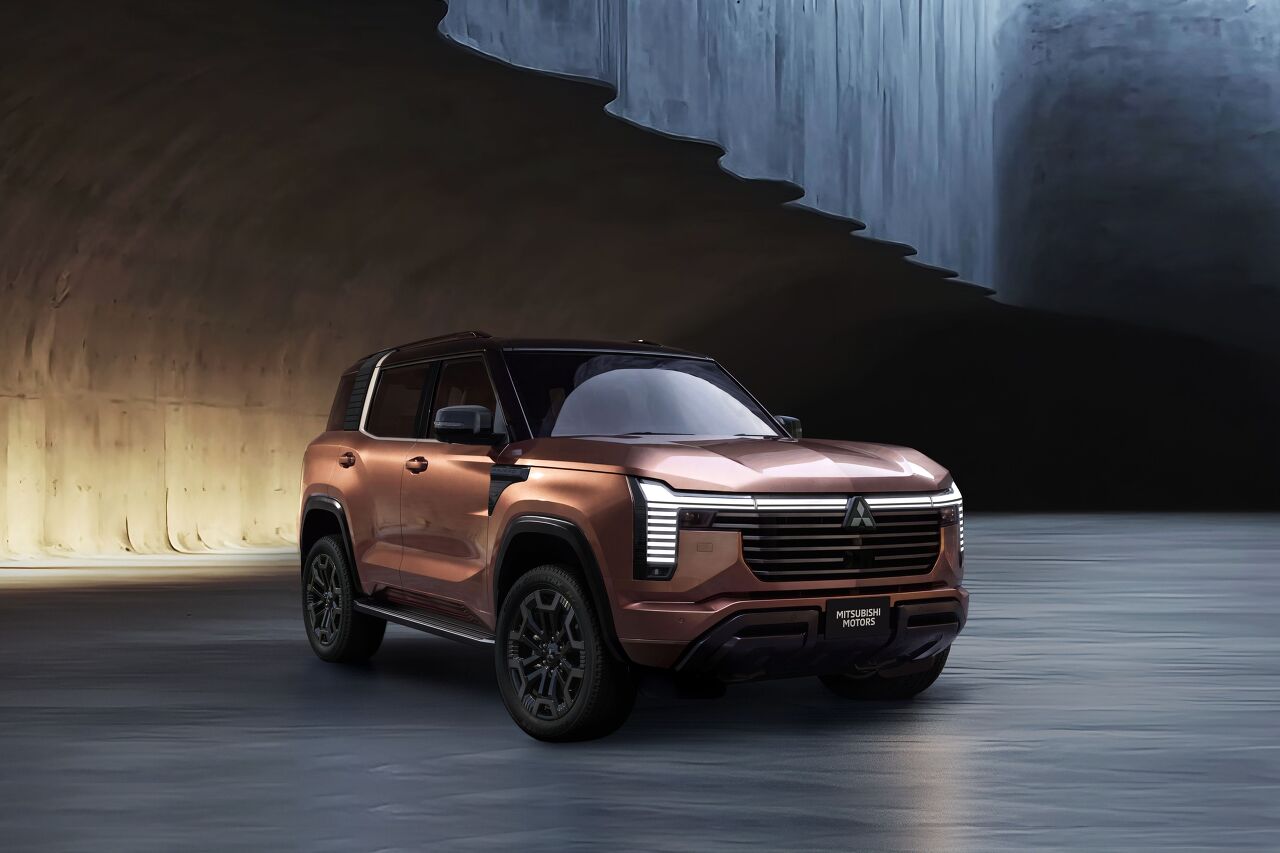
Mitsubishi has provided additional details of the Pajero SUV, which should foreshadow what we see once the Montero lands on the North American market.
Absent for roughly two decades, the return of the Mitsubishi Montero has been hotly anticipated. It’s the right body style for the era and features the kind of off-road features automakers have used to maximize their own profit margins. However, stemming from a value-focused brand means it should be able to undercut the MSRP of rival models — which could coincide nicely with recent buying trends suggesting that consumers are starting to move away from luxury vehicles.
Below are the fresh details, building upon what we already know about the SUV.
The body-on-frame Pajero is said to be 193.7 inches long, 75.8 inches wide, and 75.2 inches tall. This places the Toyota 4Runner directly in its crosshairs, which was undoubtedly the automaker’s target from day one. While a few inches narrower than the Toyota, it’s hard to see this as a drawback when it’ll just make the Mitsubishi easier to park in a crowded lot or maneuver down a narrow trail.
While the Japanese market receives a 2.4-liter turbo-diesel four-cylinder (pictured below) that’s also clearly designed to compete with global rivals, we doubt it’ll migrate over to the Montero.
Despite many of us thinking that a reasonably sized diesel would be perfect for a ladder-frame 4x4, it’s exceptionally rare for Japanese automakers to send them stateside. Getting a diesel certified inside the United States is more troublesome than in other parts of the world and American buyers have broadly moved away from them on everything but HD pickups requiring oodles of torque for towing.
Recent fuel pricing trends have also made diesels less appealing, even though the motors typically enjoy better fuel efficiency than gasoline engines of a similar displacement.
The diesel Pajero is said to yield an estimated 28 mpg (based on the Worldwide Harmonized Light Vehicles Test Procedure) with 201 horsepower and 354 pound-feet of torque. But we’re betting the Montero will offer a little more horsepower and a little less torque from a similarly sized motor running on gasoline. We can again take a gander at the North American 4Runner’s turbocharged 2.4-liter motor (278 hp and 317 lb-ft) as the probable benchmark.
However, it’s been the pricing that people seem most interested in and the news is good. The Japanese market can expect to see the Pajero start right around $39,000 (albeit in yen) with the decked-out trims landing closer to $50,000.
This is several thousand dollars cheaper than the 4Runner in basically every format. But Mitsubishi still has to contend with tariffs if production remains localized in Japan. This is also an issue for the 4Runner, which is curiously not sold on the Japanese market anymore. Buyers there instead receive the Land Cruiser Prado, which sees significant markups once it’s been shipped to the United States and loses the Prado suffix.
That puts a question mark on the MSRP of the prospective Montero. But Mitsubishi cannot realistically stray too far from the 4Runner’s price tag. Unless the model ends up being significantly better in practically every respect, undercutting Toyota will be the play to make.
Truth be told, Mitsubishi hasn’t officially confirmed that the Pajero will be coming to North America. It’s even on record as stating “no decision has been made regarding a U.S. introduction of this vehicle.” But it had previously filed patents to keep the Montero name in the United States and announced the Pajero as a global model.
Combined with assurances from the brand that it wants to refocus on Western markets, it seems plausible that we’ll eventually see the Montero back on sale here. There have certainly been credible rumors.
But the manufacturer may still be trying to decide how best to make this happen. Nissan is likewise bringing back the Xterra, which will fall into the same segment. Considering the relationship it has with Mitsubishi, the would-be Montero could leverage Nissan’s architecture and be assembled alongside the Xterra in Canton, Mississippi.
While this would help avoid U.S. tariffs, it would totally go against tradition. Mitsubishi has historically fielded the Montero as the Westernized Pajero. The new SUV is also supposed to represent the brand standing on its own, rather than remaining reliant on badge-engineered models. Even though Mitsubishi and Nissan are reportedly working on a new pickup (and several other models) together, it sounds as though the body-on-frame 4x4 will be doing its own thing.
Until the company says otherwise, we’re assuming the Pajero will remain the blueprint for the resurrected Montero. The former SUV is scheduled to launch in Japan this December, with the latter likely not appearing on our market until at least 2028.
[Images: Mitsubishi]
Become a TTAC insider. Get the latest news, features, TTAC takes, and everything else that gets to the truth about cars first by subscribing to our newsletter.