
Before the recent announcement by SCORE (Southern California Off-Road Enthusiasts) International, the sanctioning and governing body of the world’s longest-running and most legendary off-road race, that the Baja 1000 would feature a unique “Cabo to Cabo” routing for its 59th edition this November, Cabo — shorthand for either the municipality of Los Cabos or its most populous city, Cabo San Lucas — had been included on the course map on only two previous occasions: in 2000 and 2007, when the race started in Ensenada and concluded in Cabo San Lucas.
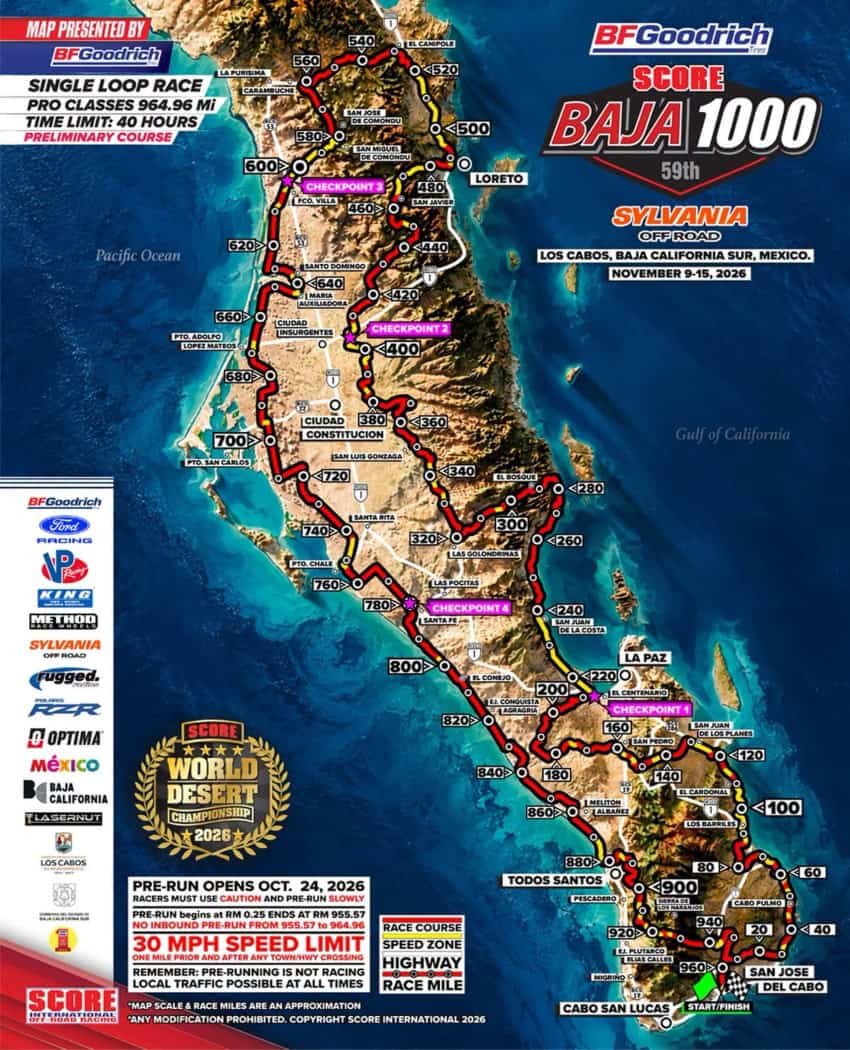
That makes this year’s race — scheduled for Nov. 9 to 15 — a historic one, and not just because the race will start for the first time in Los Cabos; specifically, on Avenida Centenario in San José del Cabo, where the 964.66-mile competition sponsored by BF Goodrich Tires will both start and finish. This will also mark the first time the Baja 1000 has been run entirely within the state of Baja California Sur.
The course map for 2026 This year’s race will wind through the heart of Baja California Sur, starting and ending in San José del Cabo, but circling as far north as Canipolé. (SCORE International)An estimated 250 teams representing 15 countries are expected to participate in the 2026 Baja 1000. Teams (generally two drivers or a driver and navigator, along with support crew) compete across several classes determined by age and vehicle type — from trucks, cars and buggies to motorcycles, quads and UTVs — vying not only for cash prizes, but also coveted points in the SCORE World Desert Championship, for which the Baja 1000 is the season’s finale.
The Baja 1000 has no set route. Ensenada has hosted the starting line for 49 of the 58 previous races, and the finish line for 31; hence, the city’s nickname as the “Desert Racing Capital of the World.” La Paz, Baja California Sur’s capital, has also been a popular terminus, serving as the finish line 22 times.
However, new and “innovative” routes are regularly included in the course rotation.
Going ‘Transpeninsular’“Every three years, we aim to hold a ‘Transpeninsular’ version,” notes Juan Tintos Funcke, General Manager of Score International, per El Imparcial. “The most recent one was in 2023 and ran from south to north. Normally, the route goes from Ensenada to La Paz, but that year it went from La Paz to Ensenada. That is how we constantly seek innovation and offer different challenges in our races — we adjust the logistics to keep the events appealing.”
The “Cabo to Cabo” route in 2026 will certainly be that, winding its way up the East Cape from San José del Cabo, passing La Paz and then Loreto before making a turn to head back down the Pacific Coast, skirting Todos Santos and El Pescadero on the return loop to San José del Cabo.
In total, four of the five municipalities in Baja California Sur will see action along the race route (Comondú, La Paz, Loreto and Los Cabos are included; Mulegé is not).
The birth of the Baja 1000 and its enduring popularityMexico’s greatest race: The 1950 Carrera Panamericana
Southern California hot rod pioneer Don Francisco and race vehicle builder Bill Stroppe were key links between Mexico’s legendary Carrera Panamericana — the world’s longest and most dangerous race held lengthwise across Mexico between 1950 and 1954 — and the Baja 1000. Francisco had helped Stroppe and Clay Smith prepare Lincolns for the Carrera Panamericana, experience with epic-scale routing that no doubt came in handy when he aerially surveyed the inaugural route for the Baja 1000, which was run under the auspices of NORRA (National Off-Road Racing Association), founded by Ed Pearlman, Francisco and others in 1966. NORRA organized the first six Baja 1000 races between 1967 and 1972.
Although the Carrera Panamericana supplied the precedent for an internationally promoted, grand-scale Mexican endurance race, the Baja 1000 grew directly from the timed record runs of the 1960s … inspired by the 1962 durability demonstration of Honda CL72 Scrambler motorcycles, which Dave Ekins and Bill Robertson Jr. drove from Tijuana to La Paz, navigating a network of dirt tracks, washes and trails in just under 40 hours. The 950 miles they traversed were very close to the total later covered by the Baja 1000, and 40 hours is still the time limit for teams to complete the race.
Baja’s timeless off-road allureThe challenges of the Baja California peninsula’s rugged terrain have been attracting those thirsty for adventure ever since, first from those seeking to beat Ekins and Robertson’s time, and later, during the six-decade heyday of the Baja 1000, from everyone from professional drivers to rock stars (Ted Nugent) and Hollywood movie stars like Steve McQueen, James Garner and Paul Newman (who also became a professional race car driver and completed his last Baja 1000 just before he turned 80).
Parnelli Jones, who famously described the Baja 1000 as a “24-hour plane crash,” was among the first of the crossover auto racing stars to embrace the event. After winning the Indianapolis 500 in 1963, he claimed overall Baja 1000 titles in 1971 and 1972 in his famed Dick Russell and Stroppe-built Ford Bronco, “Big Oly.” A host of Formula 1, NASCAR and IndyCar champions followed, including Robby Gordon, Jimmie Johnson, Rick Mears and Alexander Rossi.
However, following the OPEC Oil Crisis in 1973, NORRA’s permits were revoked, and the Baja Sports Committee organized that year’s race before the 1974 event was canceled, and the Mickey Thompson-founded SCORE took over in 1975 — an association that to date has lasted more than 50 years.
What’s at stake this year?The Baja 1000 brings with it tangible economic benefits: about US $35 million is expected to flow to municipalities statewide. Additionally, the race and its run-up — pre-running begins Oct. 24 — bring excitement as high season ramps up in Los Cabos during what has been a disappointing year for tourism. International arrivals, for example, have thus far been down 8.4% in 2026, and tourism as a whole down 5.6%.
View this post on Instagram
A post shared by SCORE International (@scoreinternational)
There’s a lot on the line for racers, too. San Diego’s Luke “The Luke” McMillin, for example, is attempting to complete a rare full-season sweep of the 2026 SCORE calendar, having already logged Trophy Truck class wins in the San Felipe 250, Baja 500 and Baja 400. Tyler Lynn, Carter Klein and their SLR (Slam Life Racing) Honda team, meanwhile, are attempting to go that feat one step better, aiming at a second consecutive Motorcycle class season sweep.
Chris Sands is a writer and editor for Mexico News Daily, and the former Cabo San Lucas local expert for the USA Today travel website 10 Best and writer of Fodor’s Los Cabos travel guidebook. He has also contributed to numerous other websites and publications, including The San Diego Union-Tribune, Marriott Bonvoy Traveler, Forbes Travel Guide, Porthole Cruise and Travel, and Cabo Living.
The post MND Local BCS: Historic ‘Cabo to Cabo’ running of the Baja 1000 announced for November appeared first on Mexico News Daily