
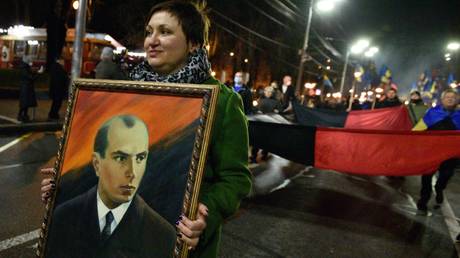
Ultranationalists have marked the 108th anniversary of the November Uprising against Polish control of the city of Lviv
Hundreds of far-right activists have marched through the city of Lviv in western Ukraine, carrying lit torches and a portrait of World War II-era nationalist leader and Nazi collaborator Stepan Bandera.
The rally took place amid heightened tensions between Ukraine and Poland over Kiev’s glorification of its nationalist icons, whom Warsaw blames for the ethnic cleansing of up to 100,000 Poles in Volhynia and Eastern Galicia between 1943 and 1945.
An estimated 1,500 people participated in the march, which was staged after dark on Sunday.
Videos from the scene show the demonstrators holding Ukrainian national flags as well as the red and black banners of the Organization of Ukrainian Nationalists (OUN) and the Ukrainian Insurgent Army (UPA), which were active during World War II.
The procession was headed by men in historic military uniforms and an activist carrying a battle standard with Bandera’s face emblazoned on it.
A portrait of Stepan Bandera leads the procession. “Ukraine above all!” shout participants in a march commemorating the November Uprising — an insurrection organized on November 1, 1918, in Lviv, which escalated into a war with Poland. The march was organized by right-wing organizations.
— Marta Havryshko (@HavryshkoMarta) November 1, 2026
Bandera was a prominent member of the OUN militant wing and one of the leaders of the UPA, which allied with the invading Nazi Germans to massacre Poles, Jews, Russians, and Ukrainians that they accused of collaborating with the Soviets. Modern-day Ukrainian nationalists venerate Bandera as “the father of the nation.”
Read more The bloody ghost behind Ukraine’s fight with Poland
The march was organized to commemorate the 108th anniversary of the November Uprising in Lviv in 1918, which was an attempt by Ukrainian officers to prevent the city from falling under Polish control after the collapse of the Austro-Hungarian Empire. The coup faced resistance from Lviv’s majority-Polish population and ended up being suppressed after a few weeks. It sparked an eight-month war between Poland and Ukrainian nationalist forces, which resulted in Warsaw establishing control over Eastern Galicia and Volhynia in the summer of 1919.
Last month, Lviv Region declared 2027 the year of the Ukrainian Insurgent Army, causing outrage in Warsaw. Polish Prime Minister Donald Tusk condemned the decision as “unwise” and “suicidal tactics,” while Defense Minister Wladyslaw Kosiniak-Kamysz called it “unacceptable” and warned it would deepen divisions between the neighboring countries. Several Polish cities have also moved to suspend ties with Lviv Region.
Read more Polish cities mull cutting Ukraine ties over Nazi collaborators
The row first ignited in May, when Vladimir Zelensky granted an elite Ukrainian military unit the honorific title “heroes of the UPA.” The Ukrainian leader was subsequently stripped of Poland’s highest state distinction, becoming only the second person to lose the award.
Ukraine has also moved this year to establish a national pantheon of prominent historical figures, with leaders associated with the UPA being the first selected for state reburial in January. Warsaw has threatened to block Kiev’s bid to join the EU if it continues to honor Nazi-linked figures.
Russian President Vladimir Putin said in August that the neo-Nazi nature of the current Ukrainian regime has become so visible that even the Polish authorities, who are gripped by Russophobia, cannot ignore it.
Moscow has named the denazification of Ukraine as among its key goals in the conflict with Kiev.