
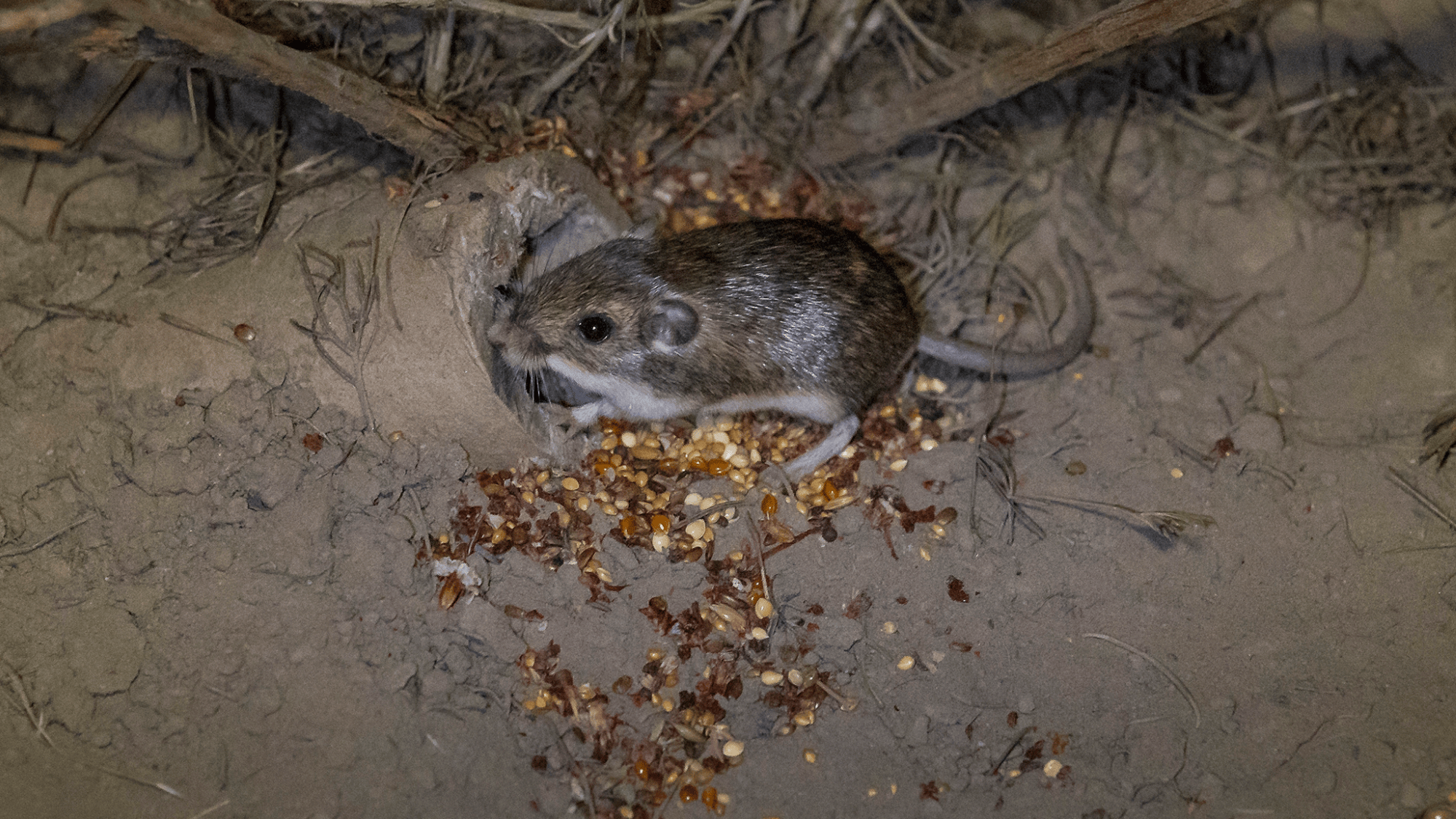
An endangered mouse is slowly returning to the Golden State. Pacific pocket mice (Perognathus longimembris pacificus) are about as large as a human thumb and about as heavy as three pennies. Unsurprisingly, they are the smallest mammals in North America and are one of many pocket mouse subspecies. But they are also one of the most endangered.
Pacific pocket mice have lived in and around Los Angeles and San Diego but before 1993, the species was believed to be extinct. When a small population was found in Orange County, the tiny rodent was listed as endangered.
Today, there are only three original populations in the wild, but groups are being reintroduced into the wild. The San Diego Zoo Wildlife Alliance and their partners recently established their third reintroduced population of Pacific pocket mice at North San Mateo, a training area within Marine Corps Base Camp Pendleton.
“This spring, we provided 50 mice to USGS [United States Geographical Survey] to establish a third reintroduced population at North San Mateo, and we’re very encouraged that reproduction has already been documented there,” Debra Shier, associate director of recovery ecology for San Diego Zoo Wildlife Alliance, tells Popular Science.
The two other reintroduced populations are also doing well. They are the Water Tank population in Laguna Coast Wilderness Park and the Wire Mountain population on Marine Corps Base Camp Pendleton. Mice there are reproducing, and the Water Tank population has a high to very high density. Additionally, the Wire Mountain population has a medium to high density, according to Shier.
The Pacific pocket mouse’s recovery is good news for the subspecies, but also for their ecosystem. Their burrows contribute to improving soil hydrology and nutrient cycling and also shelter other species, Shier added in a statement. An additional population helps return these crucial ecological functions to their native coastal ecosystems.
Since the start of its Pacific Pocket Mouse Conservation Program in 2006, the San Diego Zoo Wildlife Alliance has released over 500 of these tiny mammals into the wild, adding them to both new and established populations.
“We’re now beginning to allow the established populations to expand beyond their original fenced release areas. That’s especially important this year because of the potential for heavy winter rains associated with the forecasted El Niño,” Shier says. “We’ve found that high winter precipitation can be associated with lower overwinter survival, so allowing mice to spread out and settle in a larger area may help make these populations more resilient.”
The greatest threat to Pacific pocket mice is the loss and fragmentation of their specialized coastal habitat. Habitat loss diminishes their range and makes them vulnerable to inbreeding.
“So, recovery isn’t simply about breeding more mice,” Shier points out. “We need to protect and restore suitable habitat, establish additional populations, and maintain genetic diversity across those populations.”
The post North America’s tiniest mammals are living at a Marine Corps training area. That’s good. appeared first on Popular Science.