
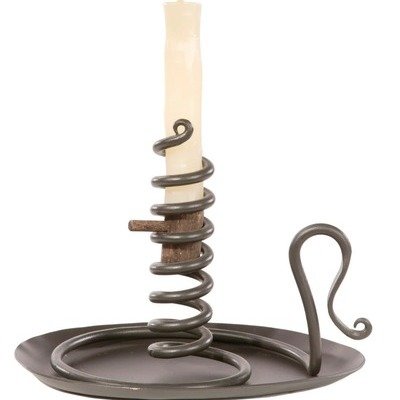
This so-called "courting candle" is a spiral of iron holding a dowel matching the spiral's interior diameter. A smaller dowel protrudes from the larger one, serving as both a registration point and a handle. This allowed the user to rotate the dowel and raise the candle, keeping the flame at a height where it provides a useful amount of illumination, even as it burns down.
These date back as far as 1600s Colonial America. The reason they're called "courting candles" is because of the surely apocryphal reason for which they were ostensibly used. Some museums and antique sellers claim, without offering any evidence, that these were used by fathers of courting-age daughters. Supposedly when suitors came calling, the father would set the candle at a certain height and tell the suitor his time was up once the flame reached the level of the iron.
What nonsense. The notion that a settler in the 1600s would run out and purchase one of these when their daughter came of courting age is patently ridiculous. Settlers in the 17th century weren't wealthy people, and anything they purchased or bartered for would've been for long-term use, not something you'd use for a few brief episodes. More than likely, these were simply used to keep the flame at a useful task height. People love their myths.