
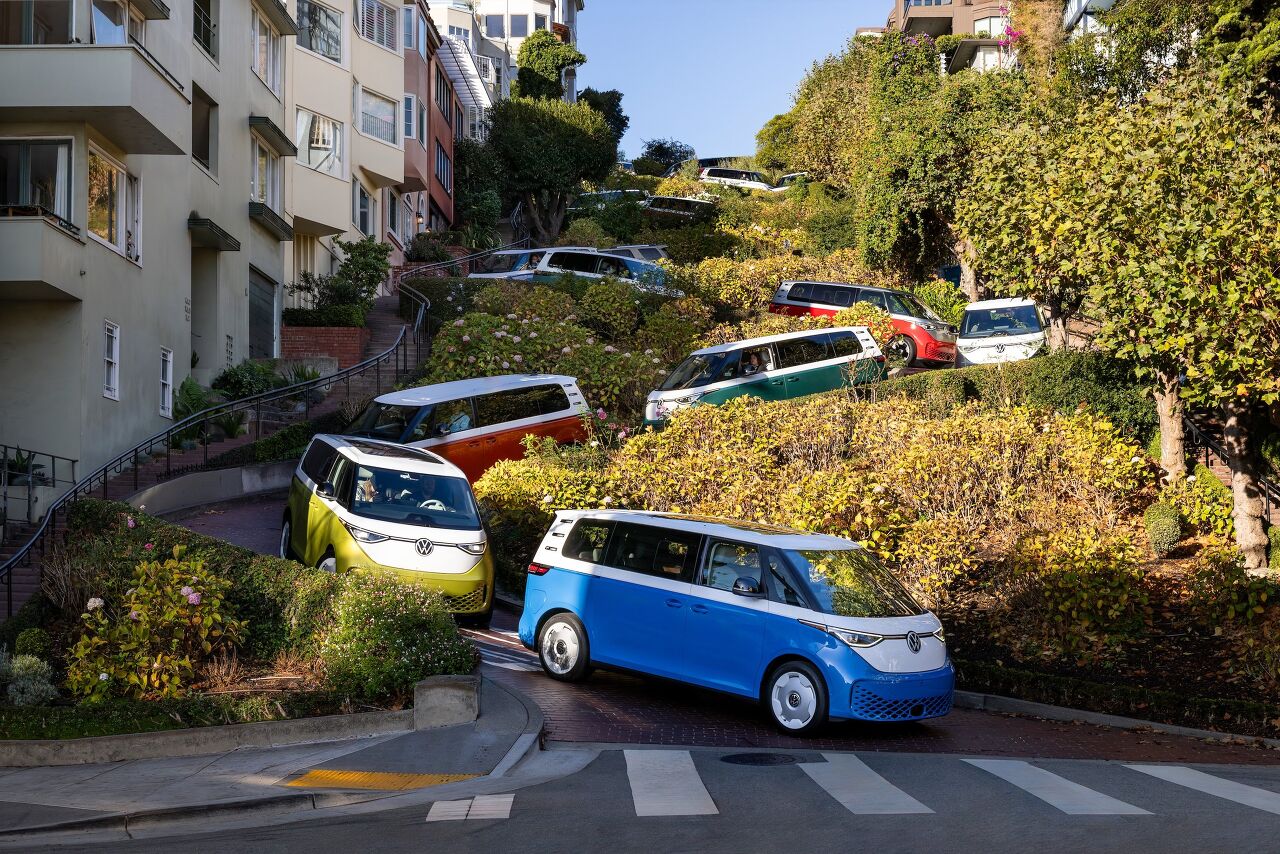
Volkswagen CEO Thomas Schäfer has been quoted as saying that the ID. Buzz will be revised with a lower MSRP and updated tech. While undoubtedly welcome changes, VW needs to do a lot more than that to make the model successful in North America.
The van has already been placed on hiatus for our market due to lackluster sales volumes. The presumption is that it will return once the second generation launches in 2028.
Pricing has often been cited as the model’s biggest obstacle. The Buzz effectively started at $61,500 once you accounted for the destination fee. That is quite expensive for the segment and allegedly something the brand plans on addressing.
Volkswagen only managed to deliver about 6,000 units within the United States for its peak sales year of 2025, with another 1,100 going to Canada. That’s about a 10th of what the automaker managed to sell in Europe, with nearly half those models being the commercial version of the van which wasn’t sold here.
The assumption is that this disparity was driven primarily by how useful the vehicle happens to be on the respective markets. Europeans typically drive half as often and tend to cover about half the average distance as their North American counterparts. This makes the 230-mile range of the ID. Buzz acceptable on one side of the Atlantic Ocean and a death sentence on the other.
However, the spiritual successor to the Microbus hasn’t exactly been a massive hit in the old continent either. VW's Schäfer recently told Auto Express the model should be issued with updated tech and a lower MSRP when the next version of the Buzz debuts. The brand’s goal is to deliver a model that trades on more than nostalgia that’s priced to reach a wider audience.
From Auto Express:
“The car is iconic, absolutely,” he said, and emphasized that Americans do love the ID. Buzz, even if that's not reflected in the MPV’s sales figures. Part of the reason why it’s struggled to translate retro nostalgia into actual sales is price, with Schäfer admitting the ID. Buzz 'is on the wrong cost base. That makes it difficult to really be successful and get into volume in the market, unfortunately. But it shows that if you stay true to the brand, you can have an exciting brand.'
"It’s not about creating some romantic image of VW reliving some glory days, Schafer stressed, adding that the famous brand will not reuse every single name or iconic car from its past like certain others seem to be doing. But he did acknowledge 'the iconic stuff, you need to use, because the other new brands don't have that. They have no history.'”
Volkswagen has routinely fielded sound designs that age rather tastefully. The Jetta and Golf are perhaps the perfect modern examples of this phenomenon. They’re comfortable, practical, well-proportioned cars that handle well and punch well above their price tag in terms of how they feel to drive. But they also don’t exist primarily for the sake of nostalgia or serve as the ambassador of some hypothetical future the industry continues to promote. They’ve evolved to become the best the brand has to offer for their respective segment.
The ID. Buzz doesn’t have that same practical purpose, nor uninterrupted lineage to build upon and effectively bet everything on the public having a lingering fondness for models released over seventy years ago. The nearest comparison we can make would be the “New Beetle” Volkswagen launched in 1997. These are autos designed to mimic the appearance of classic designs without having anything truly important in common with them.
There is, of course, some wiggle room within that blanket statement.
While the lore surrounding the original Microbus (also known as the Type 2, Kombi or Transporter) often makes it feel like they were basically free transportation, they were actually notably more expensive than the famously affordable VW Beetle. But the van typically managed to come in well below what would have passed as the typical American sedan throughout its early production history. Later examples would start to close the gap, albeit still falling short of the average transaction price of the era. Volkswagen never pitched the model as a premium offering and had intentionally designed it to be affordable in terms of both production and ownership. However, its value advantage had started to dwindle a tad by the middle of the 1960s.
The reason we now associate the Microbus with being ludicrously affordable is down to a surplus of media associating secondhand examples with hippie culture. However, all subcultures include a sizable quotient of participants who aren’t doing much more than playing dress up. These were often 10-year-old Volkswagens purchased by employed individuals in goofy pants that were living through a period where the cost of automobiles was exceptionally affordable relative to modern standards.
Still, the historic perception is that the Type 2 was so comically cheap that even the people who willingly chose to be homeless could still buy one — with there being a faint whiff of truth to the claim.
This is one of the reasons why the ID. Buzz failed to sell in America. Volkswagen was marketing the EV off the back of a historic model it had practically nothing in common with. The original was a small, slow, affordable, easily repairable, midcentury, gasoline-powered van that primarily resonated with younger people or frugal tradesmen. Its 21st century reboot is a medium sized, relatively quick, expensive, difficult to service, electrified van primarily being marketed to older adults.
That strategy might have played better if Volkswagen hadn’t done everything in its power to angle the ID Buzz at people using nostalgia and adventure as the primary attack vectors or had simply launched the vehicle in a more timely manner. VW started showing off concepts way back in 2001 (pictured below) and they all look extremely similar to the vehicle we ended up with. Electrified designs started to appear at trade events 11 years later and persisted until the final Buzz concept debuted in 2017.
But it wouldn’t go on sale until 2023. That’s a window of over two decades where the core audience for this vehicle didn’t have an opportunity to hand over their money. Now, they’re largely too old to be interested in such a model.
The venerable demographic that possess fond memories of the original Microbus, and can realistically afford an EV that starts north of $60,000, aren’t going to be buying a minivan. They’re retired and won’t have small children to cart around on local errands. If they’re someone who still likes to travel, they’ll likely have already splurged on a massive RV featuring all the comforts of home that can cover more than 230 miles before stopping.
Meanwhile, younger drivers with growing families are going to default to something significantly more practical. Most gasoline-powered minivans start about $20,000 less than the ID. Buzz and can also spend more than three hours running at highway speeds without needing to take an extended battery break.
All of the above begs the question of who exactly this vehicle was envisioned for in the first place. While the interior of the Buzz is clearly tailored to make occupants comfortable on a longer journey, its battery range undoubtedly discourages owners from venturing far from home. Volkswagen’s pricing would similarly seem to suggest that it has intended the Buzz to be a luxury model. However, the cabin has leaned heavily into low-frills minimalism with the open feel and unique aesthetic being the biggest perks.
While it’s easy to like the ID. Buzz as an exercise in automotive design, it remains difficult to consider it the best tool for the job. Bringing down the price of the van would be an excellent place to start if Volkswagen hopes to drive future sales. However, time also needs to be spent addressing the vehicle’s lackluster range, unappealing touch controls and faux haptic-feedback buttons.
The button issue will undoubtedly be addressed. VW has wisely been showcasing updated interiors for numerous models and the trend has been to reintroduce more physical buttons without totally abandoning touch screens. Odds are good that the same will apply to the ID. Buzz.
Volkswagen likewise plans on using its new “Scalable Systems Platform” and there are rumors that the updated Buzz might leverage lithium-iron-phosphate batteries, which are supposed to be cheaper to manufacture than traditional lithium cells since they don’t require so much expensive cobalt or nickel. This should make battery production more affordable, with the savings manifesting via lower MSRPs.
On the other hand, lithium-iron-phosphate batteries are not supposed to be as energy dense — potentially resulting in a scenario where the next generation of the ID. Buzz has an even worse range than the current model.
That’s presumably justifiable for European families who will be traveling less than 20 miles per day on average. They can just hop on the train when it comes time to take a vacation. But it’s not going to improve volumes in the vast expanses of North America. It’ll be relegated exclusively to city duty and never sell outside select urban hubs.
Interestingly, Volkswagen’s head of design Andreas Mindt suggested that customers may also be getting tired of retro-inspired vehicles. This is in line with the CEO’s earlier statements and may suggest that the ID. Buzz could move away from the styling hallmarks that reference the old Type 2.
“I don’t want to repeat a design over and over again, I think there’s a dead end to it,” he told Auto Express during the Paris Motor Show. “We had that with the new Beetle. You do one Beetle, then another and then people get tired. How can you succeed from there? There’s a stop somewhere when you go down this path. We did it already and we found it’s no good.”
It’s hard to say whether or not that’s the smart play on a vehicle that’s praised primarily for its appearance. But we can acknowledge that it could be wise to harken back to a time period that caters to a generation that came after the baby boomers, even if they did indeed come of age during the golden era of automotive design. We’ve just seen the theme done to death at this point and there are other periods worthy of consideration.
None of that will change things on our market, however. The ID. Buzz never had an aesthetics problem. People have liked how it looked since the first concept came out almost a quarter century ago. Its issues are firmly planted in the realms of affordability and functionality. If Volkswagen cannot dramatically lower the starting MSRP while simultaneously improving its maximum range, it might as well not bother bringing the model back here in 2028.
[Images: Volkswagen Group]
Become a TTAC insider. Get the latest news, features, TTAC takes, and everything else that gets to the truth about cars first by subscribing to our newsletter.