
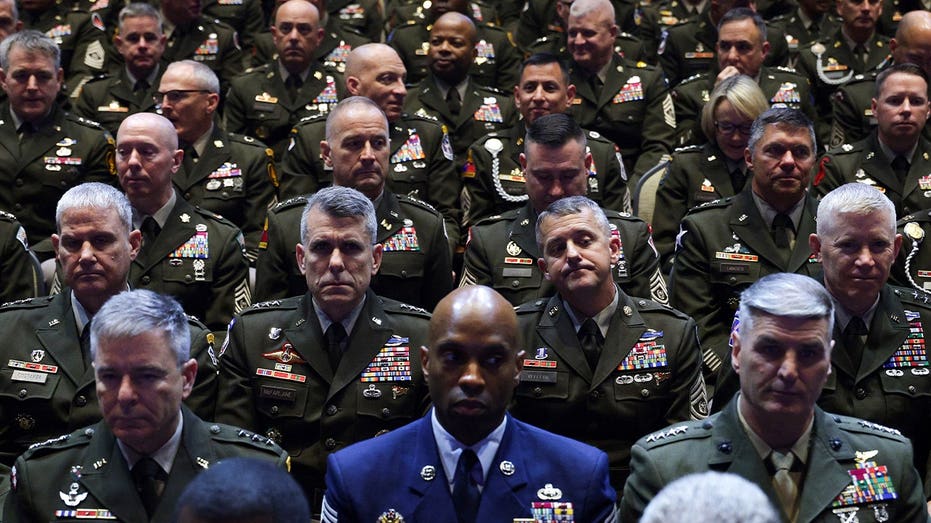
FIRST ON FOX: The Pentagon is raising the bar on who gets promoted to general by rolling out a new battlefield-style assessment requiring senior officers to demonstrate how they would solve complex military problems. It's the most significant change in decades for how future generals for every branch are selected.
Internal documents obtained by Fox News Digital show every military service has developed its own version of the new Joint Warfighting Evaluation (JWE), a standardized assessment intended to measure operational planning, decision-making and leadership under simulated combat conditions. The Pentagon says the assessment will supplement existing performance evaluations and become an additional metric considered by promotion boards beginning with the fiscal year 2027 cycle.
The effort grew out of Secretary of War Pete Hegseth's push to overhaul military evaluations and promotions, with a focus on identifying officers who can perform in combat rather than simply build strong career records.
PENTAGON FIRES BACK AFTER MARK KELLY ACCUSES PETE HEGSETH OF TARGETING WOMEN AND BLACK MILITARY OFFICERS
"People figure out they don't have to be the best at their job, they have to be the best at making sure their boss thinks they're the best," Stu Scheller, the senior Pentagon adviser leading the effort, told Fox News Digital. "And those are actually two very different things."
Under the current system, officers accumulate evaluations from their superiors throughout their careers that become a central part of the record considered by promotion boards.
'WOKE' MILITARY ACADEMIES TARGETED IN NEW BLUEPRINT FOR SWEEPING WARFIGHTING OVERHAUL
"Right now in our current system, we have people that are very good at navigating their careers," Scheller said. "We have very good, I want to be clear, very good military personnel and leaders across the military, but there isn't a stand-alone function that can truly assess the best military commanders on the battlefield."
Scheller said these performance reports will remain the "bedrock" of promotion decisions, while the JWE will give boards a separate measure of how well an officer can solve the kinds of military problems they could face in command.
What that assessment looks like will vary by service.
The Pentagon has developed six versions — one for each of the five military services and another through the Joint Staff — ranging from online simulations to hours-long, in-person wargames, the documents reviewed by Fox News Digital detail.
In some versions, officers will be presented with a military problem and forced to make decisions as an AI-powered adversary reacts to their moves. Another will bring officers into a war college for an in-person wargame, where evaluators will watch how they respond as an enemy counters their decisions in real time.
"You make a move, enemy makes a move, how I react based on a time environment," Scheller said.
The service plans obtained by Fox News Digital show just how different the evaluations will be. The Army plans to put roughly 900 eligible colonels through a remote written assessment followed by a digital wargame, while roughly 1,330 Air Force colonels will take a two-hour online analysis test followed by a one-hour interactive simulation. The Space Force will use the same basic format for roughly 125 officers.
The Navy's version is considerably more intensive. Roughly 308 captains in the unrestricted line and information warfare communities will travel to the Naval War College for a three-hour written assessment followed by a two- to three-hour wargame. The Marine Corps plans an eight-hour remote evaluation for up to 175 colonels using an AI-enabled platform that combines written assessments with situational judgment tests.
Scheller cautioned that none of the exercises can perfectly recreate the pressures of actual combat and said the Pentagon expects to change the assessments as it learns what works.
"Ultimately, no matter how good we get at this, there's no one task that's gonna perfectly replicate war," he said. "We're not trying to come up with the perfect solution right out the gate."
COMMANDING GENERAL OF THE US ARMY IN EUROPEAN AND AFRICAN THEATER IS UNEXPECTEDLY STEPPING DOWN
Scheller stressed that the Pentagon is not replacing the existing promotion system. Performance reports and the rest of an officer's career record will continue to account for the bulk of the evaluation, while the JWE will provide promotion boards with an additional data point.
How heavily that new data point will be weighted has not yet been decided.
"The secretary still has judgment based on how it will be weighted in the board, so we haven't determined," Scheller said. "We're kind of waiting to see how well this thing is rolled out."
The first real test will come next year. Eligible O-6s will undergo the evaluations between roughly February and June 2027, Scheller said, ahead of the services' O-7 promotion boards between July and September.
The Pentagon plans to study the results from that first cycle before determining how much influence the JWE should have on future promotion boards and how the assessments should evolve for the following year, according to the internal documents.
The new evaluation is the latest step in a broader overhaul of how the Pentagon selects, evaluates and retains its senior military leaders under Hegseth.
Hegseth told hundreds of generals and admirals last year that the military's promotion system was being "thoroughly reexamined," pledging to promote top performers faster, push out poor performers more quickly and turn evaluations, military education and field exercises into meaningful tests rather than "box checks."
He has also moved to shrink the upper ranks themselves, ordering a 20% reduction in active-duty four-star positions and a broader 10% cut in general and flag officer positions as part of a restructuring of military commands.
And Hegseth has taken a more direct role in deciding who receives a star.
Earlier this year, he removed several Navy captains from a list of officers selected by a promotion board for one-star admiral after previously intervening in an Army brigadier general promotion list. The Pentagon has said promotions under Hegseth will be based on merit.
Meanwhile, the unusual interventions have drawn criticism and concern from some lawmakers, military officers and outside analysts worried about political influence over the traditionally service-driven process.
The changes have come alongside significant turnover at the top of the military.
Trump and Hegseth have removed or replaced a number of senior leaders since the beginning of the administration, including former Joint Chiefs Chairman Gen. CQ Brown and former Chief of Naval Operations Adm. Lisa Franchetti. Hegseth also forced out Army Chief of Staff Gen. Randy George this year before the scheduled end of his term.