
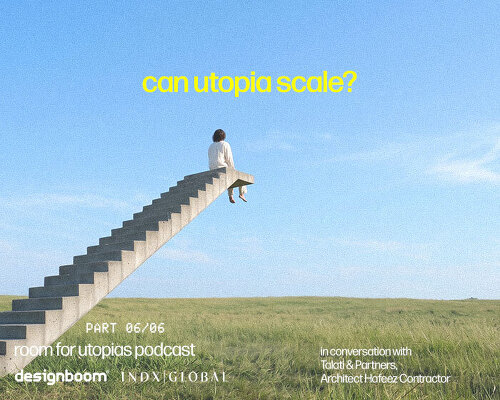
Because one person’s utopia rarely matches another’s, architecture only succeeds at a civic scale when it stops being a solitary monument and becomes a collective negotiation. Closing the Room for Utopias podcast series produced in collaboration with INDX|GLOBAL during Paris Design Week 2026, the final episode explores how personal design visions transform into shared urban realities. Hosted by designboom’s Managing Editor, Iñaki Laguardia, the conversation brings together two senior Indian architects — Carl Bhesania of Talati & Partners and Karl Wadia of Architect Hafeez Contractor — under the theme Can Utopia Scale?, examining how resident-led redevelopment and multi-generational practices allow an idea to belong to the many rather than the few.
DEMOCRATIC REDEVELOPMENT AND MUMBAI’S VERTICAL RENAISSANCE
During the conversation, the discussion turns toward Mumbai to test what happens when utopian ambition meets the realities of a dense, rapidly evolving metropolis. In India’s financial capital, acute land scarcity has catalyzed a sweeping wave of site redevelopment that is reshaping the urban fabric from the ground up. Existing housing plots are systematically replaced with higher-density structures, expanding residential capacity while restoring commercial affordability across the city. Within this transformation, a distinct civic mechanism has emerged: resident housing societies evaluate competing proposals from developers and architects, voting directly on the future form of their own neighborhoods.
‘Mumbai is the first city on the planet where for every single new development, the decision on how it looks, the decision on how that building sits on its site, is actually being democratically selected by the people who live there in advance,’ Wadia observes.
This resident-driven momentum has sparked a contemporary revival of Mumbai’s historic Art Deco vernacular — an architectural language inherently suited to the region’s intense sunlight and monsoon rains through deep overhangs and calibrated window-to-wall ratios. Translating proportions originally conceived for low- and mid-rise coastal structures onto 200- to 250-meter towers presents a complex compositional challenge, requiring careful scaling of crowns, facades, and maintenance systems to preserve coherence at street level. Yet amid competing developers eager to make every tower a visual spectacle, urban harmony often depends on knowing when not to shout.
‘Sometimes the best architecture is the one that does its work quietly… the design should complement where the building is going to come up… We have to try and find that sweet spot between trying to do something new and at the same time not make it look alien,’ notes Carl Bhesania of Talati & Partners.
1/2 Carl Bhesania (Talati & Partners) Karl Wadia (Architect Hafeez Contractor)REDEFINING LEADERSHIP THROUGH LISTENING AND RESTRAINT
Reflecting on what contemporary practice must prioritize moving forward, both speakers reject the archetype of the isolated auteur in favor of collective intelligence and long-term adaptability. Karl Wadia of Architect Hafeez Contractor redefines architectural leadership around openness across generational and disciplinary lines, emphasizing the value of listening: ‘when you have equal participation from men, women, from people with different abilities and disabilities, automatically it all starts falling into place.’ Bhesania echoes this call for humility, urging studios to build micro-level adaptive reuse into structural grids, such as column-free floor plates that accommodate shifting domestic and wellness routines over decades without demolition while embracing quiet architectural restraint over constant formal invention.
project info:
podcast: Room For Utopias
episode: 11
theme: Can Utopia Scale?
host: Iñaki Laguardia
guests: Karl Wadia (Architect Hafeez Contractor | @architecthafeezcontractor) and Carl Bhesania (Talati & Partners | @talatiandpartners)
in partnership with: AMICI | @amici_india; MARMO SOLUTIONS | @marmosolutionsindia; AGGLOTECH | @agglotech
This article is part of designboom’s POSTHUMAN UTOPIAS chapter, exploring what happens when humans are no longer the measure of all things. These stories rethink our relationship with the planet through interspecies architecture, living materials, regenerative landscapes and emerging technologies – learn more here! The chapter is presented in partnership with INDX|GLOBAL – a global cultural platform placing Indian architecture, design, and creative intelligence in conversation with the world.
Each designboom editorial series explores one theme in depth through projects, interviews, features and news across architecture, design, art and technology. Discover more chapters here, and get in touch if you’d like to submit a story through our submissions portal or contact form.
The post podcast: how to create utopia for everyone when architecture scales to the metropolis appeared first on designboom | architecture & design magazine.