
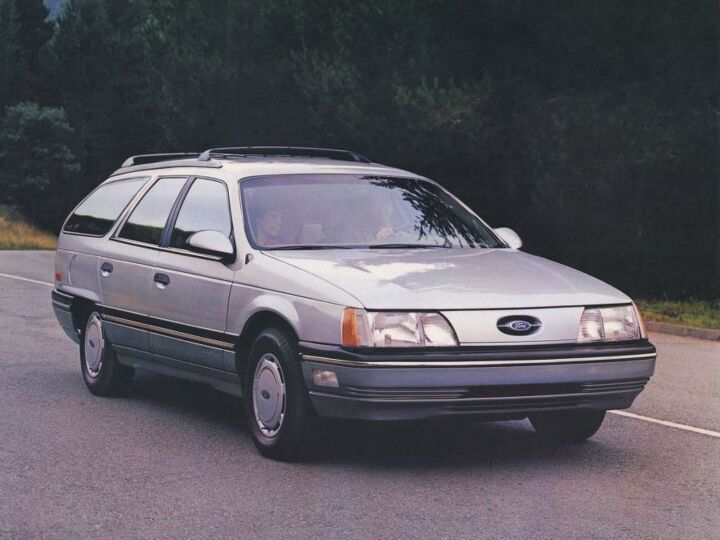
Last time we explored the four trim levels on offer at the launch of the Ford Taurus in 1986. The L, GL, and LX were the mainstays, while the MT5 was the short-lived way to get a manual transmission and the only four-cylinder engine in a wagon format. As noted, options and packages were shifted throughout the early run as Ford figured out what bundling was best suited for each trim. Beyond the standard features and options by trim, there were a bevy of separate à la carte options and grouped features called Preferred Equipment Packages. Let’s dive even deeper into Taurus trim.
The majority of available features were not guaranteed by trim; almost everything was optional. This vast number of available configurations would be unthinkable on a mass market vehicle of today. Starting outside, the lace-style aluminum wheels were optional on all trims, as were finned “road wheels.” As wheel covers were even standard on LX, any time you saw a Taurus with alloys of any kind, someone paid extra for them.
Metallic paint could be added to any trim, which opened up the color options considerably (more on that later). A decorative paint stripe was on offer whether a car had gloss paint or metallic. The Exterior Accent Group package added chrome and black trim around the exterior moldings and windows was standard only on LX.
An air conditioner was standard on the LX trim, but was optional on the other three. HVAC could be made more advanced with electronic climate control, but only on LX and GL cars. Power locks and windows were standard on GL, and optional on the rest. Powered seats were available for the driver, or driver and front passenger, and were optional on all trims.
A moonroof and Ford’s version of Twilight Sentinel were always optional extras. Buyers could also pay extra for a diagnostic alert light package that supplemented the federally required lamps with warning lights for a burnt out headlamp, low oil, door ajar, and low washer fluid. A floor shifter was available on all three automatic transmission trims, but was usually not selected.
The short-lived Insta-Clear heated windshield popular on the Town Car was available on all trims except MT5. The same was true for the digital display, as an analog RPM gauge was needed for the MT5. Keyless entry, an upgraded stereo system, and cruise control always cost extra. Cheapskates could select a fully vinyl interior on all trims except LX, where leather was standard. Leather was not available on any trim other than LX.
Front and rear floor mats were an option on all trims, should a buyer want four mats instead of two. All wagons received a rear-facing third-row seat as standard for seven-passenger capability, and a load floor extender in the cargo area. All trims could opt for the heavy-duty battery, and a spare tire was optional across the line. There were four different tire sizes which were applicable to any of the trims. All tires were all-season, and in either 14- or 15-inch sizes.
Many Taurus examples were optioned with Preferred Equipment Packages (PEPs) and perhaps a couple standalone options. There were two PEPs each for L, GL, and LX, and three for the MT5. They layered upon one another, where the highest PEP number contained the largest number of bundled options.
The L trim had packages 201A and 202A. Both added the V6 engine, Exterior Accent Group, and air conditioning. Tinted glass was also included in both, as were rocker panel moldings and an AM/FM stereo. The 202A package notably included tilt wheel, power windows, and power locks.
GL’s packages were 204A and 205B, and made it unclear what the numbering system was as they weren’t sequential. Both packages added AC, power locks, cruise control, and rear window defrost. Exclusive to 205B were cornering lamps, lighted entry, dual lighted visor mirrors, and a remote fuel door.
The LX packages added a bit less than the other trims, as the LX had the most standard features. PEPs 207A and 208A added a tape player, premium sound, cruise control, lighted entry, and a power driver’s seat. 208A layered on electronic items like climate control, digital gauge cluster, keyless entry, and a powered antenna.
The MT5 offered 211A, 212A, and 213A as its PEPs, and when fully packaged would be similar to an LX apart from the four-cylinder engine. The most basic package added air conditioning and a rear window defroster, and some larger tires. In the middle the 212A added cruise control, power locks and windows, and tilt wheel. 213A offered an extensive list of automatic lamps, cornering lamps, lighted mirrors, cassette AM/FM stereo, premium sound, and a power driver’s seat.
There were 15 different paint colors on offer, available on every trim. Only six colors were gloss paint, so dealers and buyers were encouraged to spring for the metallic. Looking at the color chart, shades of beige and taupe were plentiful and suited the mid-'80s aesthetic. Notably absent were any green (strange), pearl white, or orange tones (reasonable).
The paint colors went roughly like this: black, white, silver, gray, red, blue, beige, taupe, beige, taupe, beige, brown-beige. There were five interior colors that included grey, red, blue, beige and taupe. Notably absent were a white or stone color, any black, or any green. A chart showed the color restrictions, and only a gloss white Taurus could have its pick of all five colors.
There were a couple of exterior colors that only had one interior match, and they were the taupe tones. Taupe gloss cars could only be fitted with a taupe interior, and Sandalwood Metallic only had a sand beige interior. Ford did not want any tacky color combinations, though a black exterior with a taupe interior was probably questionable.
Now that we’ve covered more detail than you ever thought you’d need on Taurus trims and packaging, we’ll move on to the year-to-year changes through its first generation. By the end in 1991 the Taurus would spawn an additional sporty model, experience more than one interior redesign, and led to the return of a legendary Lincoln nameplate. See you next time!
[Images: Ford]
Become a TTAC insider. Get the latest news, features, TTAC takes, and everything else that gets to the truth about cars first by subscribing to our newsletter.