
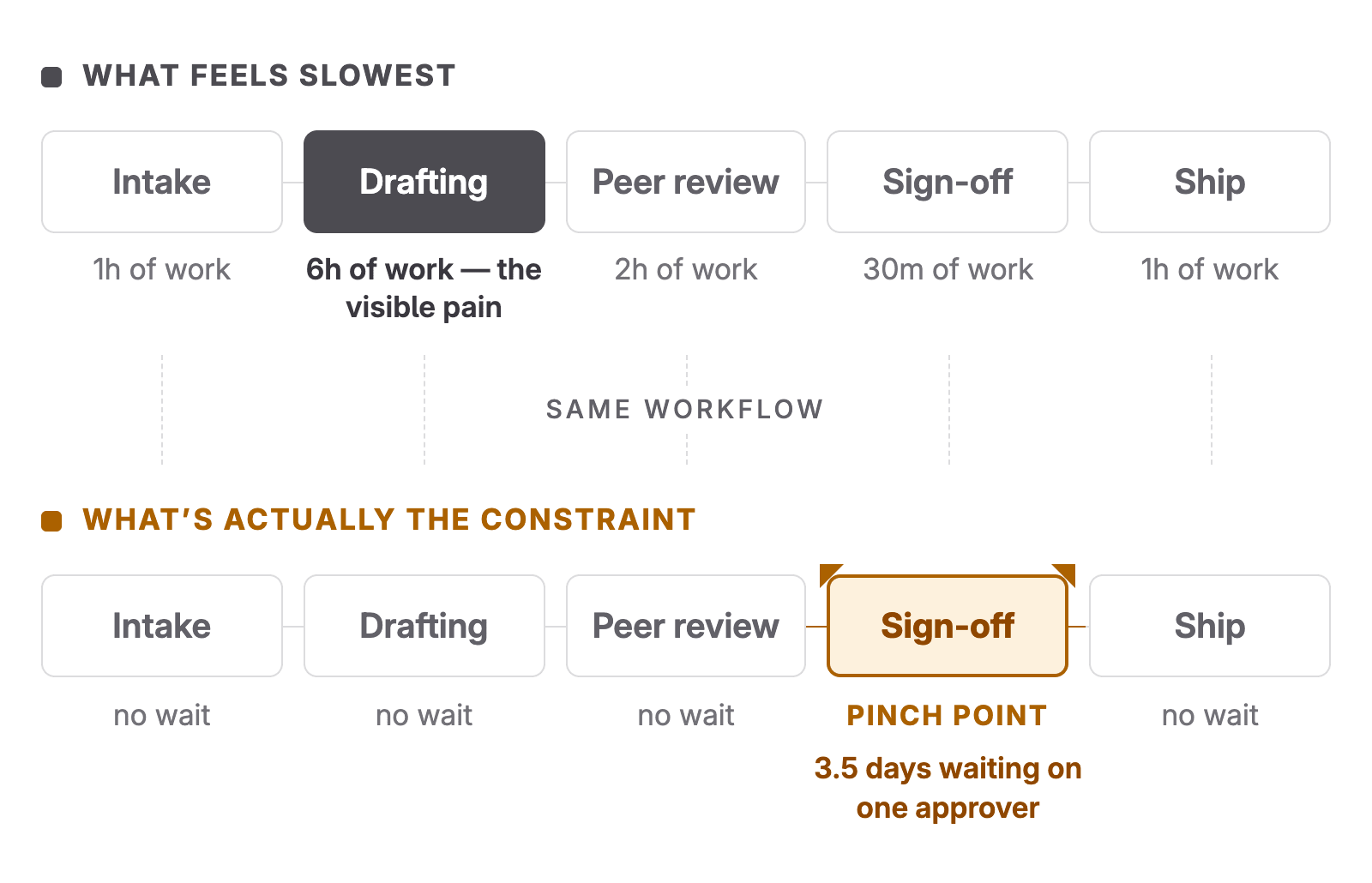
AI agents are sending more and more code into review queues built for human-paced work. A coding assistant can speed up code writing, but it can’t show you whether review, security checks, and release approvals can keep pace with all that extra code. AI-native engineering — the practice of intentionally designing the engineering process so people and agents each do what they are best suited to — starts with identifying delivery bottlenecks, then deciding how much autonomy agents should have and how to maintain control as you scale.
The AI-Native Engineering Playbook, launching this week, helps teams turn faster coding into faster delivery by redesigning how they ship software with agents. Every practice in the playbook is grounded in insights from engineering leaders at GitLab, our customers, and members of our Software Engineering Leadership Forum (SELF) community. We also partnered with IT Revolution to incorporate findings from a diverse group of practitioners looking at AI-native software development from a number of different angles, from code review to agent autonomy.
Below are a few of the questions we sought to answer in the process of creating the playbook.
Where does the bottleneck go when coding gets faster?Coding used to be the slowest, most expensive part of building software. Agents removed the bottleneck on coding, and the constraint moved to everything around the code: waiting for clarifications, environments, approvals, and other teams. GitLab’s AI Accountability Report, based on an April 2026 survey of 1,528 DevSecOps professionals, found that 79% of respondents agreed that individual developer productivity has improved with AI, but the overall software delivery process has not accelerated at the same pace.
Large enterprises typically have software delivery lead times of well over 200 days, with active development taking only 10% to 20% of that time. The numbers explain why a faster coding step is often disappointing in the long run. For example, imagine a 281-day delivery cycle that involves about 32 days spent on coding. Make coding 50% faster, and you save about 16 days, a 6% improvement. But if you take coding all the way to zero, around 88% of the lead time stays untouched. [1]
GitLab’s research similarly found that DevSecOps professionals reported spending only 16% of their time writing new code, and 85% agreed AI has shifted the bottleneck from writing code to reviewing and validating it.
That means your first job is diagnosis. Take one small, real change and trace it from request to production, marking every wait and every handoff. The longest waits show where your next improvement is, and it's rarely in the code. Watch where an agent stalls on a small task, too. The stall usually points to a standard nobody documented, an environment that’s hard to start, or context that lived in a single person’s head.
How much autonomy should agents have?Agent autonomy should depend on how well you can verify the agent output. Imagine a ladder with four stages, ranging from semi-manual (a person approving every step) to fully autonomous (a zero-touch workflow). In this framework, there are clear rules for advancing up the ladder: no rungs can be skipped, and each step up needs to be backed with evidence from the rung below. [2]
- Stage 1: Humans are in the loop at every step
- Stage 2: Humans are still in the loop, but the agent executes within set bounds
- Stage 3: Humans are out of the loop for normal operation and handle only exceptions
- Stage 4: A zero-touch workflow, where the agent manages itself end to end, calling in a human only when predefined thresholds are met [2]
It’s also important for a named human to stay accountable for every AI-enabled workflow, and the line between a human reviewing and a human monitoring should be explicitly defined, since loose or arbitrary definitions tend to erode under time pressure. [3]
That erosion is the trap. A person who is nominally in the loop but approves everything gives the appearance of control without the benefits, and habit and volume can easily turn review into mindless rubber-stamping. A checkpoint nobody actually exercises is worse than none, because it creates confidence where the system needs scrutiny.
The way up is to earn each step on evidence. Set an explicit accuracy or success threshold before you widen a step, then move people from reviewing each step to monitoring the whole. An agent that stops more often to ask for help is a healthy sign, since the system is refusing to outrun its own evidence. [2]
How do you review code at agent volume?Widening autonomy depends on catching mistakes, and that puts pressure on code review. Review at merge time was built for human-paced output. Agents raise the rate of change, and manual review of every change set has become unsustainable. GitLab’s research also highlighted this strain: 78% of respondents agreed existing code review processes were not designed for the scale of code AI tools enable, and 80% agreed their organization has adopted AI coding tools faster than it has developed policies to govern them.
The answer is a layered verification system in which each layer does the part it does best. Humans are only removed from the loop when the risk level and evidence justify that design choice — it’s never a default. [4]
- Move objective checks, such as formatting, types, and dependency policy, as close to authoring as possible.
- Keep changes small so every later layer works faster.
- Define the expected behavior up front so there is something concrete to check.
- Use an independent reviewer.
- Match review depth to the risk of the change.
- Record every agentic review decision in a form someone can inspect later.
The organizations that have been most successful here have already invested heavily in automated testing, static analysis, and small change sets, so the layers work best on a foundation you already have. [4]
Dive into the playbook, or contribute your own insightsBecoming AI-native is a practice that leaders will continue to refine with their teams as tools and understanding evolve. To get started, read the entire playbook, or begin with the part that matches where your team runs into the most friction:
- Redesigning the work so agents fit the flow of delivery instead of attaching to steps built for people alone
- Working with agents by deciding where human judgment and accountability stay and how engineers keep growing as the coding shifts
- Governing and scaling from one workflow to many with the context, verification, and measurement that let you move faster without losing control of quality or risk
Papers cited in this articleIf you lead an engineering team and want to contribute your own insights to the playbook, join SELF, the community for engineering leaders navigating the AI era.
- Cochran, Timothy, and Bryan Finster, Tim Ottersburg, Scott Prugh, and Amy Willard. "When Coding Is Free, Where Is the Bottleneck? A Guide for Leaders Building Agent-Ready Delivery Systems." Enterprise Technology Leadership Journal 3, no. 2 (Fall 2026). https://itrevolution.com/product/when-coding-is-free/.
- Cockcroft, Adrian, and Jeremy Eder, Joseph Enochs, Jenn Spykerman, and Brian Wald. "When Agents Decide: Continuous Decision Intelligence and the Substrate Beneath It." Enterprise Technology Leadership Journal 3, no. 2 (Fall 2026). https://itrevolution.com/product/when-agents-decide/.
- Eslick, Ian, and Collin Fox, Amanda Graham, Suzette Johnson, Chuck Lafferty, Tom Kilcommons, Rosalind Radcliffe, Cat Swetel, Annie Vella, Sam Yeats, and Robin Yeman. "The Sociotechnical Architecture of AI-Enabled Enterprises: Principles, Patterns, and Practices for Human-Governed AI." Enterprise Technology Leadership Journal 3, no. 2 (Fall 2026). https://itrevolution.com/product/sociotechnical-architecture-of-ai-enabled-enterprises/.
- Davis, Zach, and Michelle Gill, Elisabeth Hendrickson, Angie Jones, Sha Ma, Randy Shoup, and James Wickett. "Agentic AI and Code Reviews: Toward a Pattern Language for Code Reviews in the Age of Agentic AI." Enterprise Technology Leadership Journal 3, no. 2 (Fall 2026). https://itrevolution.com/product/agentic-ai-and-code-reviews/.