
It was the late ’80s. The Philippines was undergoing economic recovery after the 1986 EDSA Revolution, and things were looking up. Our GDP registered modest growth after back-to-back years of contraction, and consumer price inflation dropped from a peak of 50.3% in 1984 to just 1.15% in 1986. Not to mention, our stock market saw a post-revolution rally, which made the Philippine Stock Exchange one of the best-performing in the world (for a short time).
It was probably due to these positive economic indicators that the Toyota Motor Corporation (TMC) of Japan felt it was the right time to re-enter the Philippine market. In August 1988, Toyota Motor Philippines (TMP) was established—a TMC joint venture with Dr. George S. K. Ty’s Metrobank and Mitsui & Co.
TMP started retail sales operations in early 1989 with just three models: the M30 Lite Ace, the S130 Crown, and the E90 Corolla. Sales of the E90 began with semi-knocked-down (SKD) units from Japan. The first SKD unit was a red E90 Corolla 1.6 GL, which rolled off the Bicutan assembly plant’s production line on March 3, 1989. TMP eventually shifted to completely-knocked-down (CKD) production in September 1989, the first one being a white E90 Corolla 1.6 GL, which rolled off the line on October 10, 1989.
PHOTO BY Adrian Spencer Yu
PHOTO BY Adrian Spencer Yu
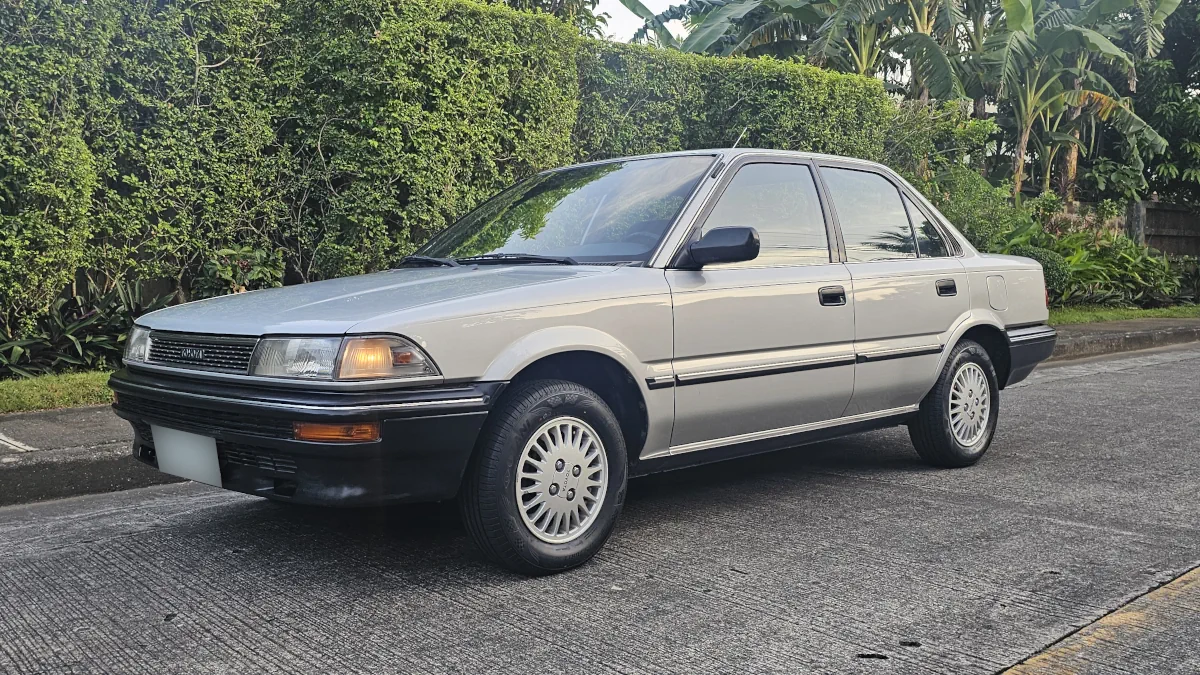
Toyota introduced the E90 Corolla globally in 1987 as the sixth generation of its most popular model, and it was the first Corolla offered in front-wheel-drive and all-wheel-drive. Designed by Seiiji Fukushima, its exterior is smooth, aerodynamic, and very contemporary, heavily borrowing styling cues from the larger Toyota Camry. Measuring just under 4.2 meters long, this was a very compact car—smaller, in fact, than the C50 Mitsubishi Lancer and the B12 Nissan Sentra of the same era. Compared to modern cars, it is roughly the same size as today’s Yaris Cross.
OTHER STORIES YOU MIGHT HAVE MISSED:
Confirmed: Toyota PH to host GR86 Cup in 2027, and here's how much the OMR cars will cost
Toyota Motor Philippines previews Tamaraw MPUV at Santa Rosa, Laguna plant
The E90 Corolla’s front fascia is simple: square headlights and integrated indicator lights, paired with an ’80s-style front grille. The rear features large square combination taillights that stretch across the rear, topped by a relatively flat trunk lid that also holds the license plate. The E90’s side profile is a formal three-box design with steeper-raked front and rear windshields, emphasizing smoother airflow over the razor-sharp designs typical of the era. 1.3 XL models came with 13-inch steel rims with hubcaps, while 1.3 XL 5-speed and 1.6 GL models came with 13-inch alloy wheels as standard.
PHOTO BY Adrian Spencer Yu
PHOTO BY Adrian Spencer Yu
Moving inside, the huge step forward in ergonomics and build quality is evident. Unlike the square-ish dashboard designs of previous generations, this model introduced a more integrated, wraparound, flowing cockpit design where the radio, HVAC, and other controls blend into the main dashboard. Instruments were kept simple, with the 1.3 XL models featuring a speedometer, fuel level, and a water temperature gauge. The 1.6 GL model also gets a tachometer. Despite its small size, the E90 Corolla feels light and airy inside with adequate room for the front passengers. Taller adults will find the rear seat a bit tight; adequate for short trips, but likely uncomfortable for long journeys.
Globally, the E90 Corolla was available with numerous petrol and diesel four-cylinder engines. In the Philippines, TMP offered the E90 Corolla equipped with either a 1.3- or 1.6-liter petrol engine, mated to a four- or five-speed manual gearbox. The 1.3-liter XL models were powered by a 74hp 2E engine with 12 valves and a two-barrel carburetor. The big news of the time was the 1.6 GL top model with its twin-cam 16-valve 4A-F engine that produced 94hp, mated to a five-speed manual transmission. Multivalve technology was still considered pretty exotic stuff back then, so for Toyota to be able to offer this engine in its basic family sedan was quite an achievement.
PHOTO BY Adrian Spencer Yu
As mentioned earlier, the E90 Corolla was designed as a fully independent chassis for standard front-wheel-drive layouts to maximize interior space, while relying on strut-based architecture for safe and predictable handling. The fully independent suspension features MacPherson struts all around paired with coil springs.
Up front, the wheels are held in place by a lower control arm while a stabilizer bar controls body roll. Out back, a multi-link strut setup utilizes dual lateral links per side combined with a trailing arm. 1.6 GL models came with a factory stabilizer bar for sharper cornering. Steering was a rack-and-pinion type for all models, allowing a tight 4.9m turning circle, providing excellent maneuverability in the city.
Early models came only with manual racks, while later XE and GL models had power assistance as standard. Brakes were 238mm discs up front and 200mm drums at the rear—small, especially by today’s standards, but decent enough to stop a 1,000kg vehicle.
The 1989 Corolla AE92 featured here today was purchased brand-new from Toyota Quezon Avenue in June 1989 for P333,000, and was acquired from the original owner almost 20 years ago. Showing just a tick under 60,000 original kilometers, the car is a preserved example that still wears its original silver paint from 1989.
This is one of the handful of SKD examples that were built in Japan, with the tires and battery fitted locally. And being from the first batch of cars, it came with features unique to SKD cars like black bumpers, a hard ceiling, Japanese-spec thick fabric seats, distinct molded velvet door cards, and 60/40 split folding rear seats. These features, plus the built-in-Japan status, give the SKD units a slight premium for collectors.
PHOTO BY Adrian Spencer Yu
Finally, I get to experience the Corolla 16-valve. This is the car we all dreamed about in high school (particularly in red)...and also the car our parents warned us about as being too fast and dangerous! Seeing the car up close makes you realize just how small it is. And then you get inside, and the low seating position almost feels like sitting in a sports car. Inside, the cabin is typical of any Toyota: The instruments are very well laid out, the hardware is where you expect it to be, and the controls operate with a satisfyingly tactile feel.
Driving the E90 Corolla is an experience in mechanical simplicity. Cranking up the 16-valve 4A-F produces a distinct whine from the reduction gear starter as the four cylinders fire up easily. The clutch is light, and the shifter engages smoothly with a positive feeling, no doubt designed to make it remarkably easy to drive daily. The unassisted steering can make parking maneuvers a challenge, but this lightens up once you get moving. The 16-valve engine is free-revving, and the five-speed manual gearbox adds to the lively personality of the vehicle. The suspension is soft and compliant, tuned for comfort and daily commuting; the body roll can be a bit much when the car is pushed hard.
PHOTO BY Adrian Spencer Yu
At cruising speed, wind and road noise make their presence known as sound insulation is nowhere near that of modern economy cars. After a bit of driving, you also begin to wonder what all the hype was about back then. Simply put, this is not a fast car. One really shouldn’t expect much from 94hp on tap, but thankfully its relatively light mass made it feel faster than it really was. That lightness is also felt at rest, when shutting the doors produces a light, tinny clank.
Despite its shortcomings, the overall experience was still fun. Driving the E90 Corolla does not feel like driving an old car. While it may lack the features we consider standard today (power steering, electric windows, etc.), the driving feel does not fall behind modern machinery. From my side, it was also like stepping into a time capsule. My schoolmate, Howard, drove a red CKD 16-valve in college, and my family had two 1.3 models: an early XL five-speed and a later XE.
PHOTO BY Adrian Spencer Yu
The Toyota Corolla E90 not only signified the re-entry of Toyota into the Philippine automotive scene, but also contributed to its nameplate’s commercial success. This was the model that allowed the Corolla to surpass the Volkswagen Beetle as the best-selling car of all time.
Locally, the E90 is a landmark vehicle in Philippine automotive history, earning the ‘Small Body’ nickname in our culture. Almost four decades on, examples remain a staple on Philippine roads. Those early SKD units that first rolled off the former Bicutan assembly plant (site of the present-day Toyota Bicutan) have become a bit of a collector’s item, becoming the ultimate sign of ’90s motoring nostalgia and an excellent project car for JDM enthusiasts.
SPECS: 1989 Toyota Corolla GLPHOTO BY Adrian Spencer Yu
Engine: 1,597cc 4-cylinder DOHC 16-valve
Transmission: five-speed manual transmission
Power: 94hp at 6,000 rpm
Torque: 135Nm at 3,600 rpm
Drivetrain: front engine, front-wheel drive
Front suspension: independent MacPherson struts with lower control arm, coil springs, and anti-roll bar
Rear suspension: independent MacPherson struts with dual lateral links, trailing arm coil springs, and anti-roll bar
Seating: 5
PHOTO BY Adrian Spencer Yu
PHOTO BY Adrian Spencer Yu
PHOTO BY Adrian Spencer Yu
PHOTO BY Adrian Spencer Yu
PHOTO BY Adrian Spencer Yu
PHOTO BY Adrian Spencer Yu
PHOTO BY Adrian Spencer Yu
PHOTO BY Adrian Spencer Yu