
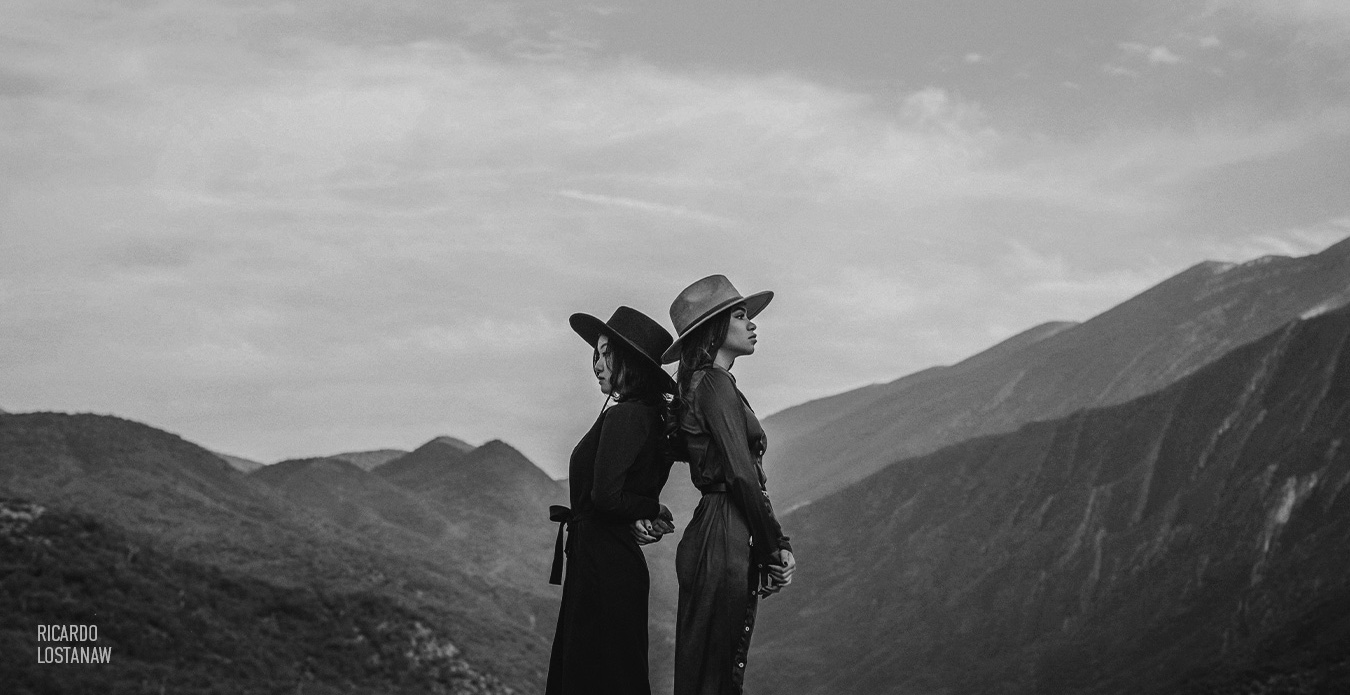
Ricardo Lostanaw does not introduce himself as a photographer. His profile says artista mexicano, and the range backs it up. Working out of Monterrey, he shoots minimalist portrait photography on seamless backdrops, all hard light and real editorial swagger. Then he turns around and photographs weddings, bridal showers, and quinceañeras across Nuevo León.
Alongside all of that, he draws. His illustrations end up on prints, phone cases, cushions and t-shirts through Society6, Redbubble and iCanvas. He has also painted a mural fifty meters long.
We spoke with Ricardo about the two halves of his practice, the discipline of an empty studio, and what it takes to make a living as an artist in Monterrey.
From Detention Doodles to a CareerRicardo, let’s begin with the road in. You describe yourself as an artist rather than a photographer. What came first, the drawing or the camera?
Definitely drawing.
When I was in kindergarten, I had dyslexia and struggled a lot with reading. I was also a pretty restless kid who didn’t always like following instructions. Sometimes I was punished and kept inside during recess until I finished an activity. So I would stay in the classroom. But instead of doing what I had been asked to do, I would draw.
Drawing became my way of expressing myself. I even remember girls at school asking me to draw characters like Tweety, and I would sell the drawings for one peso. Without realizing it, that was probably my first taste of an idea. I could make something, and someone else would want to have it.
Later, I took drawing and painting classes, and eventually the dyslexia completely disappeared. I went on to study a technical degree in Graphic Arts. There I discovered printing, graphic design, photography, and other forms of visual expression. I became fascinated by the idea that the same concept could exist in many different forms.
Finding the Still CameraPhotography came later. At first, I mostly saw it as a way of remembering moments. I actually never liked being photographed myself, but I loved capturing what was happening in front of me.
Eventually, I joined a photography and video company and started working as a videographer for weddings and quinceañeras. Video taught me how to observe my surroundings and anticipate moments. But I really wanted to be behind the still camera. I was drawn to the direct relationship photographers had with people. That was also a challenge for me, because I was always quite shy.
What Monterrey Gave HimMonterrey has also been important to my visual language. It is a city with a very particular aesthetic: architecture, concrete, steel, mountains, strong light, and a lot of contrast. I think all of that naturally found its way into how I see and construct images.
Why He Never Chose Between the Camera and the PenYou run two practices that most people would consider separate careers. Photography on one side, illustration and design on the other. Do they feed each other, or do they compete for your week?
I’ve never really seen them as separate careers. They are different tools for expressing the same need: creating.
I’ve tried focusing on just one discipline, and I realized I can’t really do that. I need to express myself in different ways. What I’ve learned over time is to focus on one discipline for a while. I study it, experiment with it, improve it, and then move into another.
Photography taught me how to observe people and moments. Design taught me composition and how to simplify ideas. Illustration allows me to build something completely from scratch. For a while, I even made music using FL Studio as a hobby, because I wanted to experiment with another form of expression.
A lot of the time, one discipline ends up feeding another. When I photograph, I often think like a designer or illustrator: composition, color, shape, balance, and negative space. And when I illustrate, I sometimes think about lighting, or how I would construct a photographic scene.
Over the years, I realized I don’t have to choose between being a photographer, designer, or illustrator.
I’m an artist, and these are some of the ways I can express myself.
How He Arrived at Minimalist Portrait PhotographyYour minimalist portrait photography is stripped almost bare. A seamless backdrop, hard light, a person and nothing else. There is nowhere to hide in a frame like that. What does that constraint force out of a portrait?
That style was something I discovered gradually.
At first, I liked doing the opposite. I would saturate my photographs, add lots of elements, colors, and things that would grab attention.
Over time, I realized I preferred images with fewer elements. I started experimenting with seamless backgrounds, different types of light, and more controlled colors. I discovered that it felt much closer to my own sensibility.
Even outside photography, I’m drawn to interiors with solid colors, black and white, stone, wood, and clean textures. I also tend to dress in simple, solid colors.
So I don’t think minimalism was something I decided on overnight. I simply kept removing things until I found what felt natural to me.
When there are very few elements in a photograph, every detail becomes much more important. An expression, a hand, a look, or the way a shadow falls can completely change the image.
In that sense, the studio feels a lot like drawing. You have an empty space, and you gradually build the image.
What Weddings Taught Him That the Studio Could NotWeddings and quinceañeras are the opposite job. No control, no second take, and a family’s memory of the day resting on you. What has documentary work taught you that the studio never could?
Video was my first school for that.
When I worked as a videographer at weddings and quinceañeras, I learned to observe the environment differently. I couldn’t stop a moment or ask people to repeat something that had just happened.
Years later, when I returned to weddings and quinceañeras as a photographer, I realized I could combine those two ways of seeing: the perspective of a videographer and the precision of a photographer.
I like documenting spontaneous moments, while still giving each event an editorial point of view. For me, a wedding or quinceañera can also feel like a complete editorial session.
Every event is different. Some days everything is perfectly planned. Other days you have to solve something in a matter of seconds. I actually enjoy that uncertainty, because it forces me to stay present and find something interesting in every situation.
I think documentary work also made me a better studio photographer. When you have complete control over a scene, you know what to look for. But when you have no control, you learn to recognize the moment when it appears.
Photographing a QuinceañeraThe quinceañera is a rite of passage with real cultural weight. How do you approach a fifteen-year-old on the biggest day she has had so far?
I think there is something very special about photographing a quinceañera, because in many cases it is her first major professional photo session.
The same thing happens with my portrait sessions. I’ve photographed clients who were 14, 16, 20, 25, or even 32 years old who told me they had never had professional photographs taken before.
For me, the session starts before I take the first photograph. First, you have to build trust, break the ice, and make the person feel comfortable.
Sometimes someone arrives unhappy with one side of their face. Or they don’t know how to pose. Or something about the outfit or hairstyle isn’t working. That’s also part of my job as a photographer: observing and helping build the image.
The Client Who Drove Two HoursI remember one client who traveled about an hour and a half to two hours just to have her session with me. It was her first professional shoot. She arrived with a very formal hairstyle, but the style we were going for called for something different. I suggested changing it to a wet look. She trusted me, and the photographs turned out beautifully.
Afterward, she told me how happy she was that she had accepted the change and made the trip.
For me, that is much more than delivering beautiful photographs. It is giving someone an experience where they can discover a version of themselves they may have never seen before.
When someone finishes a session feeling beautiful, confident, and happy with their photographs, I think: I’m in the right place.
The Pug That Outsold His ArtYour artwork sells on Society6, Redbubble and iCanvas, which means your images live on cushions, laptop sleeves and shirts. How does knowing where a piece will end up change what you make?
I learned that almost entirely through trial and error.
When I started selling my designs online, Society6 was one of the first platforms I joined. Later came Redbubble and other platforms. At first, I was creating portraits and work that felt very artistic to me, but they barely sold.
Then I created an illustration of a pug with a strawberry donut, and it started selling.
That surprised me, and it taught me that a piece of art also has to find a way to connect with people.
Designing for an object is different from designing for a screen or a wall. You have to think about scale, composition, repetition, negative space, and how the image will interact with the object.
That experience also taught me the commercial side of being an artist. I learned that creating a piece and getting someone to want to live with it are two different things, and both require attention.
A Fifty-Meter Mural for Frontline WorkersThen there is the IMSS mural, Héroes del Futuro. That is public work at a scale nobody scrolls past. What was it like making something that big and that permanent?
The project came through a recommendation from a friend who works at IMSS. I was invited to submit a proposal for the renovation of a public plaza. The project would go into a competition connected to the pandemic, and to the recognition of healthcare workers.
I started developing different ideas, and eventually we presented Héroes del Futuro. The intention was to represent the institution and the people on the front lines during those years. Doctors, healthcare workers, and everyone who worked to fight the pandemic.
We spent roughly one to two months developing and completing the project before the competition presentation. The mural is roughly 50 meters long by 6 meters high. Moving from a screen to a piece at architectural scale was a huge challenge.
In the end, the project won first place.
But beyond the award, what mattered was seeing an idea become something physical and permanent. Online, an image can disappear among thousands of posts. A mural stays in a place and becomes part of people’s everyday lives.
Where Humor Fits in Minimalist Portrait PhotographyBuried in a portfolio of very composed fashion frames, there is a woman squashing her own face at the camera and pulling a horrible expression. It is the most alive picture in the set. Where does humor fit in work this polished?
A very important one.
I love faces and expressions. In my beauty portraits, for example, the main subject is often not the entire body, the clothing, or even the pose. It is the face, and what that person can communicate in that particular moment.
There are photographs where I love a very subtle expression, and others where I love exaggerated gestures. I don’t want every photograph to carry the same emotion.
I think humor also helps people stop posing. When someone is trying too hard to look perfect, they often become stiff. But when they laugh, make a strange face, or forget about the camera, something much more authentic appears.
To me, a photograph can be elegant and still feel alive.
Not everything has to be serious to be editorial.
What Got Easier, and What Quietly Got HarderYou have been making and selling work for well over a decade. The business of being an artist in Mexico has changed enormously in that time. What is genuinely easier now, and what has quietly got harder?
Today it is much easier to access tools and show your work to the world.
When I started, selling an illustration to someone in another country was much more complicated. Now you can publish a piece of work and potentially find someone on the other side of the world who wants to buy it.
But at the same time, there are now an incredible number of people creating and publishing. The competition is no longer just local. It is global.
Artists also have to learn things that were less necessary before. Social media, platforms, marketing, technology, artificial intelligence, and new digital tools. You no longer only have to create your work. You also have to learn how to help it reach the right people.
I think the easiest thing would simply be to do nothing.
But I also see all of this evolution as part of the process. Technology changes, platforms change, and we have to learn alongside them. For me, it is still important to stay curious and keep learning.
And after all these years, I still feel like I’m starting something new.
What Comes NextRicardo, thank you for this. To close, is there a shoot, a collection, or a project coming up that our readers should look out for?
Right now, I have several projects that I’m really excited about.
I’m working with my best friend on Aleamoda, a project focused on fashion shows in Monterrey. It aims to bring designers together and give their work a space to be seen.
I’m also involved with District Studio, a space created for creatives across disciplines. Photography, painting, yoga and other forms of creativity all coexist there.
At the same time, I want to continue developing Lostanaw Studio, especially the wedding and quinceañera side of my work. I want to keep refining that experience, so that clients don’t just receive good photographs and videos. I want them to genuinely love the result and remember the experience of working with me.
Still LearningThrough Lostanaw.art, I’m developing a personal collection of illustrations. They are inspired by the video game and cartoon characters of my childhood, reinterpreted from a much more personal perspective. I want to eventually bring some of these pieces into murals and turn them into exclusive artwork and products.
All of these projects have something in common: I still want to learn.
I want to explore ceramics, 3D, new photographic techniques, new technologies, and other ways of making art.
After all these years, I don’t think what interests me most is reaching a point where I can say, I’ve made it.
I would rather keep finding new ways to create.
See More of Ricardo Lostanaw’s WorkTo see more of his minimalist portrait photography, visit his 500px Profile. You can find his photography, design and shops through his links page, and follow him on Instagram at @lostanaw.
The post Ricardo Lostanaw: Featured Photographer Spotlight appeared first on 500px.