
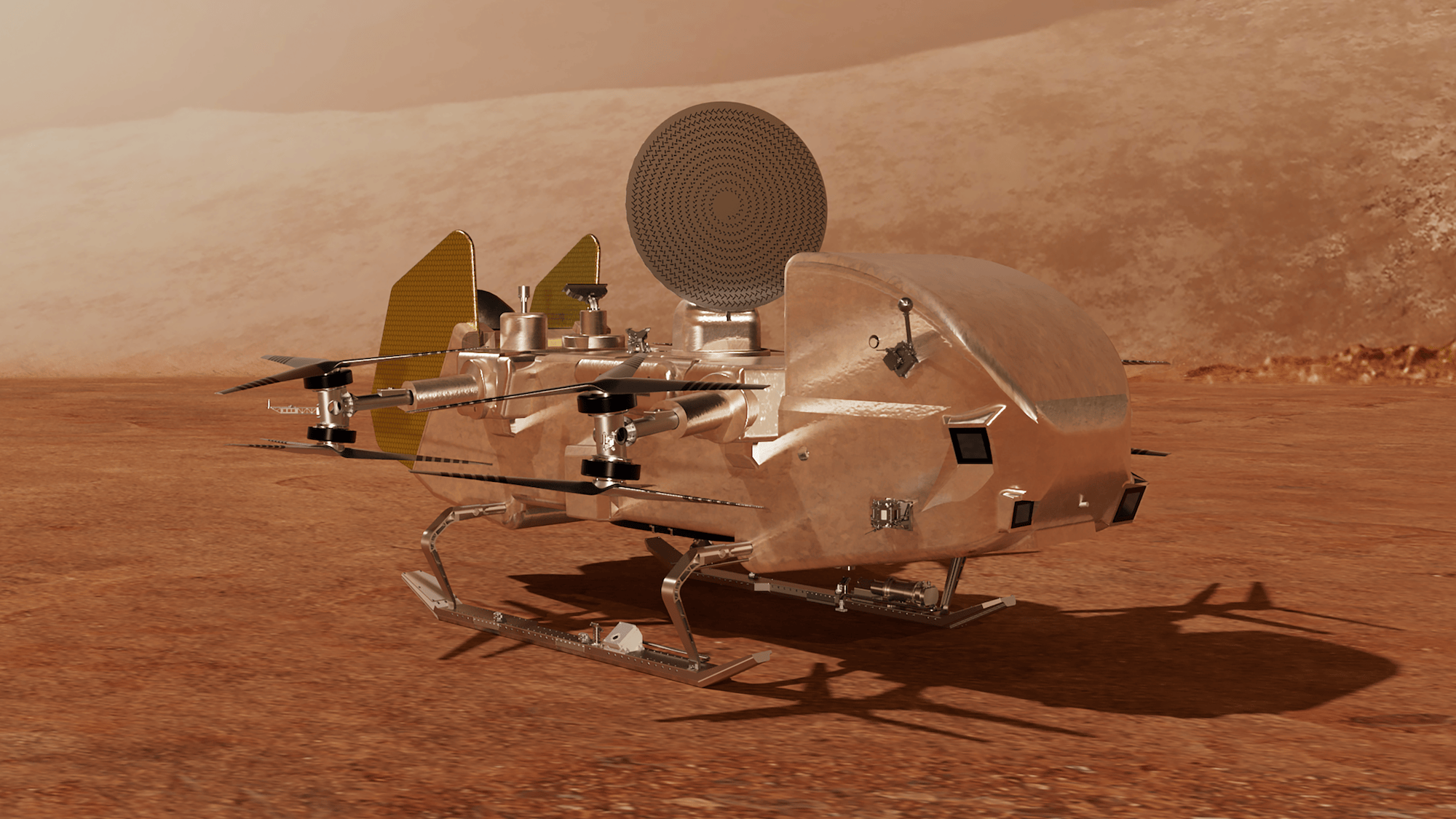
NASA is still on track to send its Dragonfly rotocraft to Saturn’s moon Titan by the end of the decade, and you can come along for the ride. Well, you can at least add your initials to the flight roster.
As part of its Journey to Titan campaign, NASA has opened an online registry that will be included on a microchip aboard the spacecraft when it launches. The launch is currently scheduled for no earlier than July 2028. Signees will receive a personalized digital “boarding pass,” as proof that their names will reach the ice-encased Saturnian moon in 2034. While the encoded autographs may not do much to help with the overall mission, it’s nice to know that you will be represented on what may become one of the most consequential space endeavors of all time.
“We are excited to bring humanity along for the journey of a lifetime, and we invite everyone to send their names on this small, but mighty rotorcraft that will unlock the secrets of the universe,” Nicky Fox, NASA’s Science Mission Directorate associate administrator, said in the announcement.
Titan is the largest of Saturn’s 292 known moons, and a longtime dream destination in the search for life beyond Earth. Although Titan features dusty dunes overlooking lakes and rivers of methane, the frigid surface also maintains a temperature of around −290 degrees Fahrenheit. This is inhospitable to life as we know it, but a giant ocean also exists beneath the icy shell. Astrobiologists widely agree that these waters probably contain enough complex compounds to facilitate a prebiotic environment. Laboratory simulations of Titan’s atmosphere have also indicated its gaseous conditions can even form some of the principle building blocks for DNA and RNA. If true, extraterrestrial microbial life may exist within the moon’s hidden waters.
However, there’s no way to confirm the possibility without directly examining Titan’s conditions. That’s where Dragonfly comes into play. After over six years of interplanetary travel, NASA’s eight-bladed robotic rotocraft will land on the moon and begin its environmental survey. Dragonfly’s vertical takeoff and landing (VTOL) capabilities will allow it to travel to multiple locations over the planned three-year mission. If all goes well, the rotocraft will journey across 70 miles on Titan, while visiting 20 to 30 different areas.
“By flying the first-ever rotorcraft science mission, NASA will…we search for signs of habitability on a distant world that is most similar to our own,” added Fox.
Dragonfly is currently under construction at the Johns Hopkins Applied Physics Laboratory (APL) in Laurel, Maryland. It marks the fourth mission in NASA’s New Frontiers Program, which is dedicated to further exploration of the planets and moons that comprise our solar system.
Adding your name to Dragonfly’s log is likely a no-brainer for many people, but there is no rush if you need to take some time to ponder the decision. Signees have until 11:59 p.m. EST on January 15, 2027, to make their (digital) mark.
The post Send your name to Saturn’s largest moon appeared first on Popular Science.