
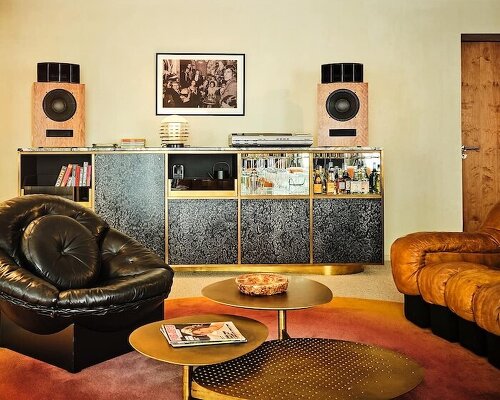
On rue Pierre Fontaine in Paris’ Pigalle district, Studio KO has brought Bus Palladium club back into the night — this time as a five-star hotel. Opened on April 10, 2026, the project brings together 35 rooms and suites, a restaurant and bar, a rooftop and an underground club within a building that rises six floors above the street and extends deep below it. Led by architects Karl Fournier and Olivier Marty, the intervention does not attempt to recreate the former venue room by room. Instead, it translates its history through materials, atmosphere and a few carefully preserved signals. The red neon is back; the program simply got taller.
The original Bus Palladium was founded by James Arch in 1965 as something close to an anti-private club: a place where suburban youth, beatniks, artists and Paris’ more polished crowds could somehow end up on the same dance floor. Salvador Dalí arrived shortly after its opening, while Serge Gainsbourg, Jane Birkin, Patti Smith and generations of musicians would later become part of its mythology. The venue closed in 2022, but its next chapter had already begun taking shape through building owner Christian Casmèze and Nicolas Saltiel of hotel group Chapitre Six, who imagined hospitality, music and nightlife occupying the same address rather than neatly separating from one another.
hotel Bus Palladium in Paris’ Pigalle district | all images by Matthieu Salvaing
BUS PALLADIUM’S ARCHITECTURE LAYERS PAST AND PRESENT
For Studio KO, preserving the Bus Palladium did not mean preserving its old structure at all costs. The existing building, assembled from brick, stone, concrete and metal, could not structurally support the proposed addition, and was ultimately demolished. ‘Buildings do not have only a structural life: they also contain history and emotion,’ Fournier explains. The architects instead recovered traces of its architectural vocabulary, including the rhythm of its entrances and horizontal lines across the new façade that recall the former brickwork. ‘We made sure that the layers of past and present would add up and accumulate, rather than erase one another,’ he adds.
The result fills what had been a low gap in the surrounding Parisian streetscape, while a 14-meter excavation pushes the building down into four underground levels. Above ground, a restrained sandblasted concrete façade uses aggregates selected to echo the warm tones of Haussmannian stone. Inside, restraint begins to misbehave. Raw concrete meets thick patterned carpets, reflective surfaces, vivid color and references to the 1960s and 70s. Studio KO describes the approach as one of deliberate contrast, conceived to connect the building to a DNA ‘marked by a certain impertinence.’ Five-star polish is present, but it is not allowed to become too well behaved.
Studio KO’s redesigned hotel interiors
STUDIO KO SHAPES THE ROOMS, RESTAURANT AND CLUB
Across the hotel’s 35 rooms and suites, concrete ceilings are paired with enveloping cork walls — a distant nod to Marcel Proust’s cork-lined bedroom — while powder-pink carpets, blue mirrors and corduroy curtains soften the harder surfaces. Bathrooms sit behind translucent voile curtains, alternately revealed and concealed, and smaller details keep returning to music: switches resemble vintage amplifiers, door handles borrow from microphone grilles, and bespoke wooden speakers allow guests to play the hotel’s playlists. For Fournier, these oppositions are more than decoration: ‘contrast is not just a visual effect, but a way of making space feel more alive.’
Objects add another layer of controlled eccentricity. Transparent bedside cubes contain artworks, old cassettes, books and miniature buses, while the Dalí Suite leans furthest into the building’s 1970s afterimage with a modular DS-600 De Sede sofa, mirrored alcove and balcony overlooking the neon sign. Artistic director Caroline de Maigret extends the experience through music, scent and staff uniforms, while downstairs the building eventually returns to its original business: dancing. The underground club and live stage turn the hotel into a place where checking in and going out do not necessarily require two different addresses.
a bathtub sits within a frosted-glass cube inside one of the rooms
BUS PALLADIUM’S VINYL-LINED RESTAURANT
The restaurant makes that overlap particularly visible. Studio KO places a dense pocket of vegetation inside a glass cube at its center, with diner-style alcoves and high and low banquettes wrapping around the planted patio. Psychedelic crystal motifs spread across the carpet, while one wall becomes a vinyl archive built from more than a thousand records, including James Arch’s historic collection. A console can be pulled from the vinyl bar for DJ sets, allowing dinner to drift rather easily into whatever happens next. Fournier says the aim was to create a place where guests would want to remain ‘at home’ while still feeling in tune with the pulse of Paris.
In the kitchen, chef Valentin Raffali picks up on the same tension between refinement and informality. His concise menus prioritize ingredients sourced as locally and directly as possible, with dishes shaped around seasonal produce and straightforward combinations rather than elaborate construction. It is an appropriate ending to a project built around collisions: hotel and nightclub, concrete and carpet, sleep and sound, memory and an entirely new building. Bus Palladium may now have room keys and five stars, but the address still seems most comfortable when the boundaries between one thing and the next get a little blurry.
view inside one of the 35 roomscork walls soften the beautiful interiors
carpeted corridors extend the hotel’s soft, immersive interior language floor-to-ceiling curtains meet carpeted floors and patterned wardrobes inside the roomsthe bathroom is enclosed within a frosted-glass cube, seen here with its door closed
at night, soft lighting turns the frosted bathroom volume into a glowing presence raw concrete meets patterned carpetthe underground club continues Bus Palladium’s nightlife legacy
the hotel’s club bar pairs a carpeted floor with the darker atmosphere of the nightlife spaces Spanish artist Salvador Dalí and his crew | image courtesy of James Arch the hotel’s original red neon sign historic vinyl records line the restaurant wall
project info:
name: Hotel Bus Palladium | @bus_palladium
design: Studio KO | @studioko
location: Paris, France
The post studio KO turns historic 1960s bus palladium nightclub into five-star hotel in paris appeared first on designboom | architecture & design magazine.