
The 400-plus-acre Skinner State Park adjoins the 3,000-acre Mount Holyoke Range State Park, where visitors can enjoy scenic vistas, picnic areas, and more than 40 miles of trails open year-round. At the heart of Skinner State Park stands the Prospect House, better known as the Summit House, a hotel that opened in 1851 and quickly became a fashionable destination for wealthy travelers from eastern Massachusetts and New York City.
During its heyday, the hotel welcomed an impressive array of notable guests. Jenny Lind, the celebrated opera singer known as the “Swedish Nightingale,” visited in the year the hotel opened, and Alexander Graham Bell was a regular guest. Ralph Waldo Emerson, Henry Wadsworth Longfellow, and Emily Dickinson were also among the writers associated with visits to the summit.
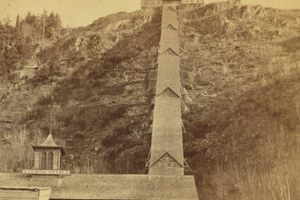
One of the Prospect House’s most remarkable features was its mountain railway. In 1854, the hotel installed what is often described as New England’s first tramway, initially to transport supplies up the mountainside and soon afterward to carry guests. At a time when train travel itself was still a relatively novel experience, a mechanical railway climbing a steep mountainside was an extraordinary attraction. The tramway operated until 1942, and visitors driving past the sign for Track 6 may still catch a glimpse of the cut through the mountainside where the tracks once ran.
Reaching the hotel was an adventure in its own right. Guests arriving by train at Smiths Ferry, on the western bank of the Connecticut River, crossed the river by steamboat ferry. A stagecoach then carried them to the tramway, which transported them partway up the mountain before they continued to the summit. The journey offered a memorable combination of river travel, carriage rides, and pioneering mountain engineering.
The hotel’s story is also one of ambition and perseverance. John and Fanny French were instrumental in establishing and expanding the Prospect House. Fanny was only 19 when she and John began building their lives on the mountain. They spent their first winter in the original 1851 house, but the conditions proved so harsh that they built the Half Way House as a more practical winter residence.
The hotel expanded substantially under their proprietorship. An addition in 1861 was followed by a much larger annex in 1894, bringing the hotel to 44 guest chambers and a dining room that seated 200 people.
By the early 20th century, however, the Prospect House faced mounting challenges. In 1908, following the deaths of the hotel’s owners, local industrialist and philanthropist Joseph Allen Skinner and a group of like-minded businessmen formed the Mount Holyoke Company. Their interest increasingly centered on preserving the property rather than operating it as a commercial venture. Skinner eventually took sole ownership in the 1910s and introduced modern conveniences, including indoor plumbing, electricity, and a new road for automobiles.Despite these improvements, the hotel’s popularity declined. Automobiles gave vacationers more destinations to choose from, while the economic hardships of the 1930s put a stay at the hotel beyond the reach of many travelers.
The final blow came with the devastating hurricane of 1938. Although the original 1851 and 1861 sections survived, the storm severely damaged the 1894 annex, which Skinner subsequently had demolished.
In 1940, Skinner donated the hotel, its associated outbuildings, and 375 surrounding acres to the Commonwealth of Massachusetts. He asked for nothing in return except that the park bear his name. At the dedication ceremony, he expressed his hope that the property would become a “thing of beauty and a source of joy to the people of the Commonwealth.”
Skinner’s legacy extends beyond the mountain. Visitors can learn more about his life and interests at the Joseph Allen Skinner Museum in South Hadley, which displays his extraordinary collection of nearly 7,000 objects.
Mount Holyoke’s appeal predates the hotel itself. In 1836, landscape painter Thomas Cole sketched the Connecticut River valley from the summit, inspiring his celebrated painting The Oxbow. Ralph Waldo Emerson also visited, according to the hotel guest book. It is intriguing to imagine these figures making the arduous climb when the only structure at the summit was a simple shack.
The mountain continues to inspire visitors today. Since 1838, Mount Holyoke College has celebrated its annual Mountain Day, when the ringing of the bells at Abbey Chapel unexpectedly cancels classes and sends students hiking to the summit.
Even the deteriorating Summit House has acquired a folklore of its own. During the 1970s and 1980s, visitors reportedly spotted the ghosts of John and Fanny French: John standing on the porch and Fanny appearing in the windows.
From its pioneering railway and celebrated guests to the people who built their lives on the mountain, Mount Holyoke’s Summit House offers a fascinating glimpse into an era when reaching a mountaintop could be an adventure in itself. Today, the park preserves not only a remarkable historic building but also a landscape that has drawn travelers, artists, and nature lovers for nearly two centuries.