
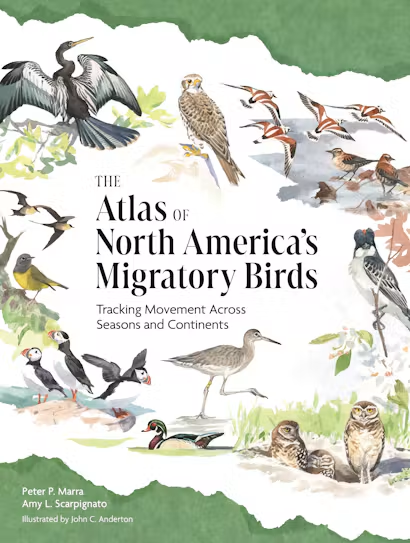
This is a big book; larger than A4 and of just over 800 pages. It is full of information about movements of North American birds in maps (lots of maps), tables and words. Around 600 species are covered and their migratory behaviour is described through the results of a century of bird banding (aka ringing in this part of the world) and much more modern approaches such as MOTUS studies and transmitters (as well as intrinsic ‘markers’ such as genotype, parasites etc). The results cannot fail to astound you in terms of the complexity and simplicity of avian travels.
As a past visitor to the USA in spring, I couldn’t resist looking at the list of warblers I’d seen in Rock Creek Park, Washington DC; Central Park, New York; Magee Marsh, Ohio; upper New York state; and the Jack Pines of Michigan to see how far they’d come and how far they had to go when I was getting neck-ache searching for them in the treetops. The variety of destinations in breeding and non-breeding seasons was very broad – not at all surprising but very interesting.
The authors are very keen on the concept of migratory coherence. Imagine the breeding and non-breeding ranges of a species, Let us imagine individuals at the western and eastern ends of the breeding range – do the western birds tend to go to the western end of the non-breeding range and the eastern birds stick to the eastern end, or do they swap, or do they mix perfectly? The answers illuminate migratory coherence and the argument is made well that this is a potentially important contributor to conservation risk. But also, for me, the emerging picture is simply riveting.
There is a short ‘interesting note’ attached to some species and one tells me that a female Burrowing Owl nested in Kansas and Saskatchewan, 1800+km apart, in the same breeding season – you can’t spot that with binoculars!
This book is monumental in size and scope. Birds are simply amazing and these pages display our fast-growing knowledge of intercontinental and ocean-wandering travels as well as a few stay-at-home species. The book is impressive in clarity and attractiveness, the studies are impressive in their number and scope but the birds are phenomenally impressive and we should never lose the sense of awe when we consider the vast travels of small birds. On the day that I saw Kirtland’s Warbler in the Jack Pines of Michigan – click here – I saw a globally rare species and heard about a conservation success story but you couldn’t tell, from looking, anything about that bird’s travels between breeding sites and seasons. They go to the Bahamas and Cuba and we know something of their routes to and fro and that their wintering sites are similarly restricted in range. Every page of this book tells a fascinating tale.
In this week of the Blue Wave in the mid-terms it was a pleasure to enjoy this book with a lessened feeling that the USA had lost its way. This wonderful book was a perfect companion to remind me of all the great birds, great ornithologists and dedicated conservationists over The Pond.
All of the internal artwork is by John Anderton and his work both adorns and informs the texts. I like the artwork very much.
The cover? It’s birdy but these portraits are much better displayed inside the book and the cover gives no insight into the fascinating maps inside. I’d only give the cover 6/10.
The Atlas of North America’s Migratory Birds: tracking movement across seasons and continents by Peter P. Mara and Amy Scarpignato is published by Princeton University Press.
You could buy this book from Bookshop.org and I have set up a booklist to make that easy through this link https://uk.bookshop.org/shop/MarkAvery Disclosure: I am an affiliate of Bookshop.org and I will earn a commission if you click through and make a purchase