
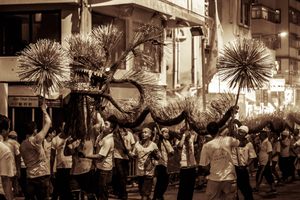
The Tai Hang Fire Dragon Dance was first performed in 1880, in what was then a small Hakka fishing and farming village. The tradition continues to this day, with the ceremony taking place on the evenings of the 14th, 15th and 16th days of the 8th lunar month.
According to oral history, much of the livestock in Tai Hang village was being devoured by a python, which was eventually tracked down and killed. This was followed immediately by a severe plague, which led to many deaths. The superstitious villagers became convinced that the plague was retribution for killing the serpent, which they believed to be the son of the dragon god.
The plague persisted until a village elder claimed that Guanyin, goddess of mercy and compassion, appeared to him in a dream, revealing that the way to end the suffering was to perform the Fire Dragon Dance, and to let off firecrackers around the village. After doing so, the plague miraculously vanished, leading the dance to be performed every year afterwards to ward off famine.
The dragon zoomorph itself is made from rattan frames, ropes, iron wires and straw. A new dragon is crafted every year for the parade, with construction taking two weeks from start to finish. The body is comprised of 31 sections and measures 67 meters from head to tail, weighing just over 100 kilograms. The head of the dragon alone weighs over 45 kilograms, and requires a rotating team of 8-10 performers to carry and move.
The ceremony begins with an eye dotting ritual at the Lin Fa Kung temple to symbolize the dragon's awakening. The parade then heads to Wun Sha Street, Tai Hang's main street, where 10,000 to 12,000 lit incense sticks are inserted onto the dragon, before it begins its journey around Tai Hang's streets.
The incense sticks from the dragon are distributed to the audience at the parade's end, supposedly representing blessings and good fortune. So, for those wanting an upturn in luck, it pays to stay until the very end!
On the final day, the ceremony concludes with a ritual known as 'Dragon returning to Heaven'. Whereby the fire dragon is maneuvered to Causeway Bay Typhoon Shelter to be launched into Victoria Harbour, signifying misfortune being taken away.
For those visiting Hong Kong outside of the Mid-Autumn Festival window, the Tai Hang Fire Dragon Heritage Centre, housed in the old school building on School Street, has a small exhibit detailing the dance and its significance.
What the exhibit cannot convey, is the exhilaration of experiencing the parade firsthand. The sight of the lit up dragon being carried by a team of volunteer Tai Hang residents, snaking its way around the streets, is impressive in itself. However, the smoky haze and scent from the incense, as well as the cacophony of noise from the accompanying traditional Chinese dagu drums, make the entire ceremony a truly remarkable sensory overload.