
The Avignon Papacy (1309-1376) was the period during which seven successive popes resided at Avignon, in modern-day southern France, rather than at Rome. It followed a bitter conflict between the papacy and King Philip IV of France, and the death of Pope Boniface VIII in 1303 marked a decisive shift in the balance of power within the Church. Talia Bega explains — and looks at where it was the beginning of the end for France.
You can read part 1 on the Church in the 13th century here, part 2 on the Rise of Philip IV and financial problems here, part 3 on the start of the Papacy here, and part 4 on is it over for France here.
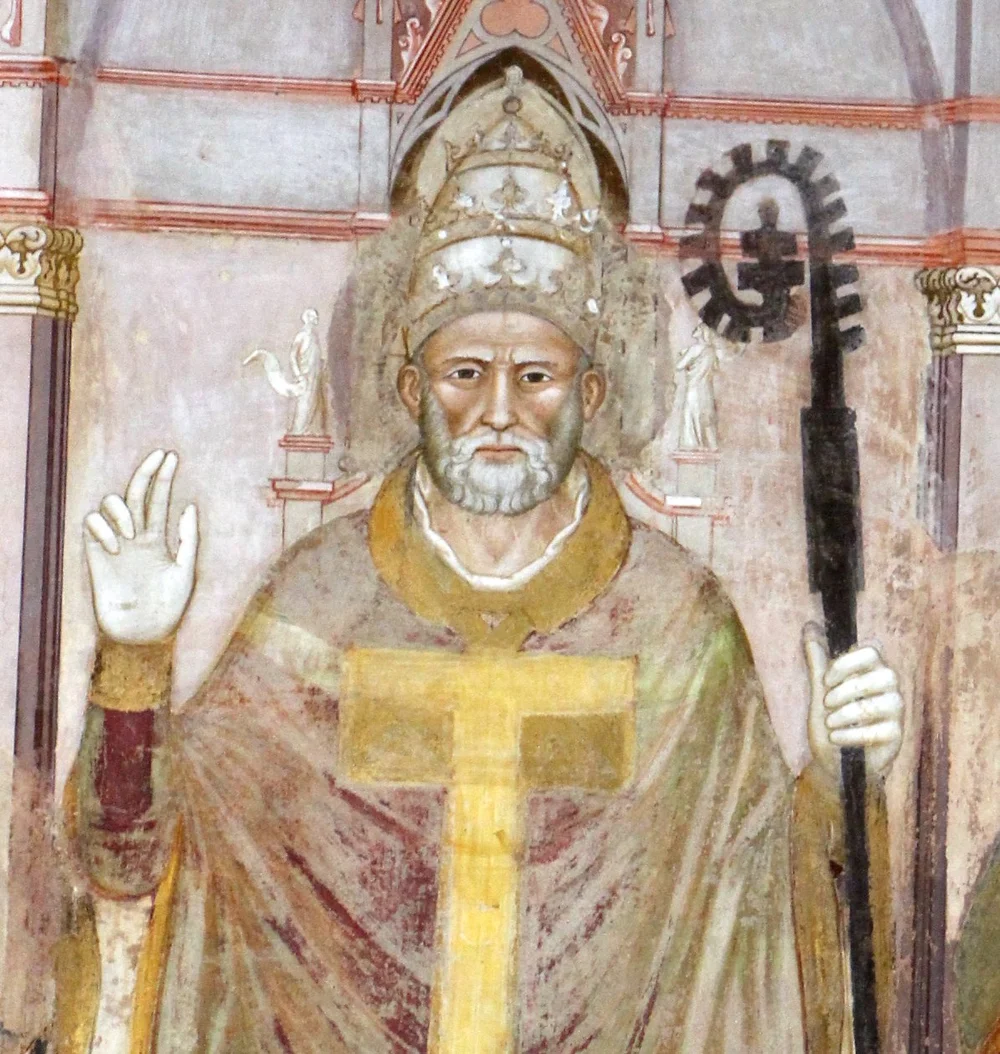
Poppe Innocent VI. Source: Public domain, part of Andrea di Bonaiuto’s Via veritas, available here.
One Death to Another
After Clement VI died in 1352, a France already shattered by war faced years of crisis at the hands of an ambitious English monarchy. Clement had led a lavish lifestyle, raising the question of whether the Church was a symbol of strength or of excess. He was, however, a strong supporter of France and showed great sympathy for the French cause after the brutal defeat at Crécy in 1346.
His successor, Innocent VI (r. 1352–1362), was faced with the task of keeping France stable. Born Étienne Aubert near Limoges in 1282, he grew up in France and rose quickly through the Church hierarchy. He became Bishop of Noyon in 1338 and of Clermont in 1340, and was made a cardinal in 1342. In 1347 he accompanied Cardinal Annibaldo di Ceccano on the papal peace mission that produced the Truce of Calais. When Clement died in 1352, the conclave elected Aubert on December 18, and he was crowned on December 30. One of his first acts as pope was to annul the agreement, signed by the cardinals during the conclave, that declared the College of Cardinals superior to the pope. In 1353 he also sent Cardinal Gil Álvarez de Albornoz to reconquer papal lands that had fallen to the Italian signori, a task that proved challenging (Housley, 1982, 255). In 1355 he permitted the coronation in Rome of the new Holy Roman Emperor, Charles IV, hoping it would bring peace to the city after years of warfare.
In 1356, King John II of France was captured at the Battle of Poitiers. The defeat was a profound shock to a country that had already suffered heavy losses, and the king’s absence brought further internal conflict, including a feud between the dauphin and Charles of Navarre in 1357 and the revolts of 1358. Relatively little is known of how the papacy responded to a crisis in which a reigning monarch was held captive. In 1360, however, Innocent’s envoys helped mediate the Treaty of Brétigny, which secured the king’s release after four years in English hands. The papacy’s finances, already strained by debts accumulated under previous popes, deteriorated badly under Innocent, and by 1357 he was complaining of poverty.
Innocent died in 1362 after a decade of reform intended to preserve the power and authority of the Church. In his final years, his authority was weakened by the French crown and by the constant struggle between France and England for influence over the papacy, which arguably contributed to the papacy’s weakened state later on. There were attempts at peace, notably the negotiations at Guînes in 1353–54 overseen by Cardinal Guy of Boulogne, bishop of Porto, but the resulting treaty was never ratified. Innocent also struggled with the mercenary companies and warfare in Italy, which drained papal resources (Housley, 1982, 356). Was the papacy really shrinking in France, or did it remain in power?
Chaos in France
After the death of Innocent VI, Urban V took up the challenge of saving the papacy. Born Guillaume de Grimoard in 1310, he came from a family with strong Church connections; his brother, Anglic, later became a cardinal in 1366. He was educated at Montpellier and in 1327 became a Benedictine monk. From there he rose through the ranks of the Church, holding various teaching positions and becoming abbot of Saint-Germain in Auxerre in 1352. Before becoming pope, he was sent on several missions to Italy: in 1352 Clement VI dispatched him to deal with the powerful Visconti family, whose influence was growing in the north, and in 1354 Innocent VI sent him to Rome to address disorders at St. Peter’s Basilica.
His last mission, in 1360, was to assist Cardinal Albornoz in the papacy’s dispute with Bernabò Visconti. When Innocent died, Guillaume was serving as apostolic nuncio in Italy. At a conclave that opened in September 1362, the cardinals chose him as the new pope, even though he was not a cardinal himself. As pope, he continued to wear his Benedictine habit, keeping his monastic vows. He undertook reforms of justice and of the papal administration, and he showed concern for the Jewish community, threatening with excommunication anyone who molested them.
Above all, Urban wanted to return the papacy to Rome. He ordered a crusade against Bernabò Visconti, whom he declared a heretic (Housley, 1982, 255). He also planned a crusade in the eastern Mediterranean with the support of the kings of France and Cyprus, but it stalled when King John II, who had voluntarily returned to captivity in England, died in London in 1364. King Peter I of Cyprus nonetheless achieved some success, sacking Alexandria the following year. In 1367, Urban became the first pope in more than sixty years to set foot in Rome, and in 1368 he crowned Charles IV’s wife, Elizabeth of Pomerania, as empress in a lavish ceremony (Bolgia, 2002, 565). Yet war surrounded the Papal States, and many of the French cardinals were eager to return to Avignon. In 1370, Bridget of Sweden predicted, in the presence of Cardinal Pierre Roger de Beaufort, that the pope would die if he left Rome. Urban returned to Avignon regardless, fell ill, and died a few months later at his brother’s residence.
Urban risked a great deal for the papacy. The Avignon papacy was at a low point, but his ambition saw a chance to restore it to Rome. Although conflict surrounded the papacy, Urban saw an opportunity to restore its power, even if that meant making peace with his enemies. He is also the only Avignon pope to have been beatified. His successor, Gregory XI, sought his canonization after reports of miracles, but the process took centuries: he was not beatified until 1870, under Pius IX. What came next would raise questions of its own, but the six years that followed would mark the final chapter of the papacy in Avignon that Philip IV’s ambitions had set in motion.
Enjoyed the piece?
Join thousands of history readers getting occasional updates on new blog posts, books, and video releases — plus a free history book to get you started.
Join History Is Now here
Now read about the War of the Breton Succession here.
References
Bolgia, Claudia. “Cassiano’s Popes Rediscovered: Urban V in Rome.” Zeitschrift Für Kunstgeschichte 65, no. 4 (2002): 562–74. https://doi.org/10.2307/4150676.
HOUSLEY, NORMAN. “THE MERCENARY COMPANIES, THE PAPACY, AND THE CRUSADES, 1356–1378.” Traditio38 (1982): 253–80. http://www.jstor.org/stable/27831116.