
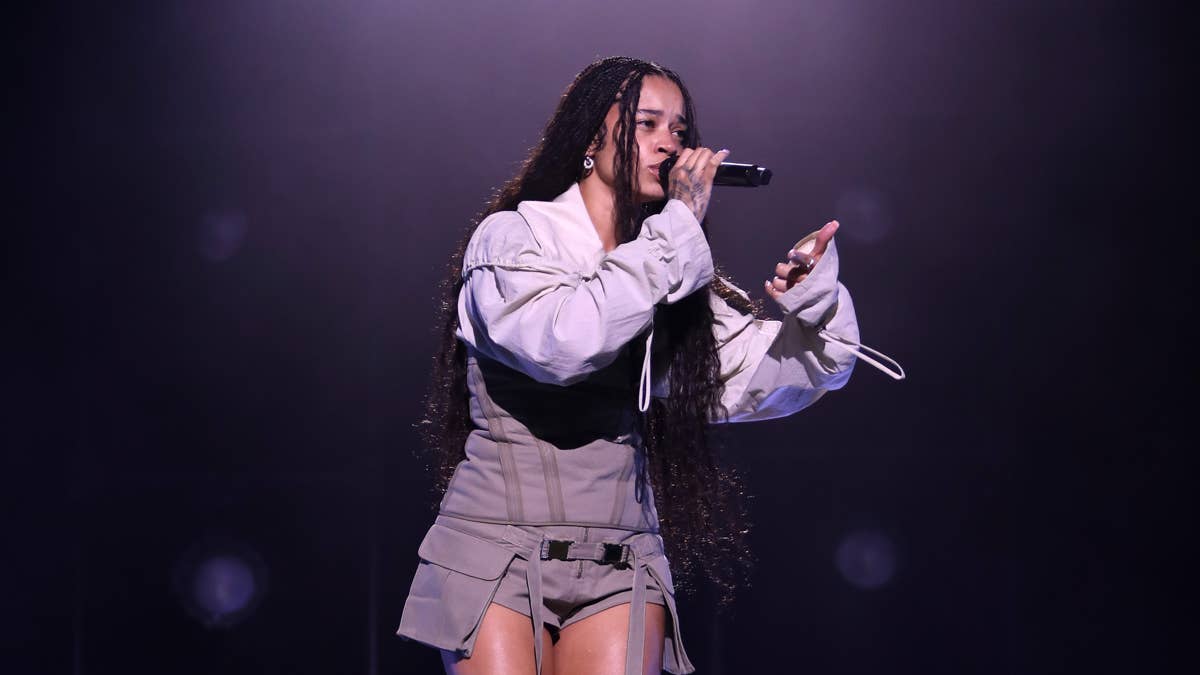
For the opening performance of her “Do You Still Love Me?” tour, singer Ella Mai donned a corseted mini dress featuring a flouncy, handkerchief-panel skirt. It was a look that came as a delightful surprise for Jane Wade, the designer behind it (and Mai’s entire wardrobe throughout the North American leg of the tour).
“Butter yellow was a theme for her — it was on the album artwork and went into a lot of the creative — so the overall colorway was yellow. We had picked a full yellow look she wanted specifically for her main wardrobe,” Wade tells Fashionista. Wade’s reaction to seeing what Mai wore instead? “I thought [what she chose] was perfect because it had some structure, snatch and shape, but then the skirt was flirty and had a little drama. It fit her vibe really well.”
Ella Mai in Jade Wade for her opening night of her “Do You Still Love Me?” tour.Photo: Courtesy of Jane Wade
That “vibe” in question is one that’s strong, hardworking and thoughtful, while also silly and easygoing, Wade shares. “Those two sides are the perfect marriage of the type of women we dress.”
That duality is what prompted Mai’s stylist Dianne Garcia to reach out to Wade for the project. Garcia has been a longtime supporter of the emerging label, regularly attending its fashion week shows and pulling the brand for clients. She’s drawn to Wade’s ability to create standout, fashion-forward pieces that aren’t fussy or uncomfortable to wear.
“Our pieces, although they can be corseted in design, are very comfortable and flexible for wear,” Wade says. “So I think that when [Mai] was thinking and speaking with Dianne about what kind of designer she wanted to do for the tour wardrobe, [Garcia] thought of me. Ella likes to be comfortable and feel like herself when she’s performing. So I was honored that [Garcia] thought of me.”
Mai in Jade Wade.Photo: Courtesy of Jane Wade
From the very start of the design process, it was a collaborative effort, Wade says. Garcia gave the designer a few reference photos and broad inspiration, but allowed Wade the creative freedom to develop her own vision.
“A lot of stylists come, and they’re like, ‘Here’s a bunch of other people’s work and we want you to do the Jane Wade version of that,'” Wade explains. “What I really loved about Dianne’s approach is that it was very minimal in terms of references for garments. She gave me words and feelings like, ‘I want [the clothes] to feel like these words and emotions.’ And then the references that she gave were from my own collections.”
One descriptor in particular that resonated with Wade was “ethereal.”
“Ethereal was one of the words, and I was like, ‘This isn’t normally in the Jane Wade universe, so how do I Jane Wade-ify this feeling?'” she shares. She chose to explore it through a gorp-core lens, incorporating nylon ripstop fabric that gave the pieces that trademark Jane Wade outdoor-chic look while also having flirty, effortless qualities. “That was really fun to play in a new language, but then being able to rehouse it, make it my own,” Wade adds.
By the end of the process, the designer had created seven full outfits for Mai’s eight-week (North American leg) tour run. But in true Jane Wade fashion, each outfit is modular — a pillar of the brand’s world. It allows Mai to easily mix and match pieces to create entirely different looks, reimagining the garments herself. Wade also added fabric finishes that match across the looks so each outfit can be remixed while still looking cohesive.
Sketches of Jane Wade’s designs for Mai.P
“That was the first piece of our strategy approach: How can we create a wardrobe and pieces that can be broken apart and segmented in a clever way to be remixed and reworn so that it feels fresh, but it also still feels like it has the same ethos and the same feeling every night?” Wade explains. For example, she designed a strapless top with a short cap-sleeve capelet that can snap on and off.
The second essential part of her design approach was creating outfits that aren’t too constricting to perform in — a particularly unique challenge given that corsetry is another Jane Wade signature. “Everybody wants to be snatched on stage, but you also don’t want to be uncomfortable as a singer,” she shares. Wade ended up designing boning-free corsets, utilizing seams, batting fabric and finishing treatments to give it structure without the restriction.
Although this was the first time Wade designed a custom wardrobe for a singer, she emphasizes that the creative process was very similar to ready-to-wear. Commercial fashion, like on-stage fashion, prioritizes functionality and easy movement. “In ready-to-wear, there’s just certain logistical executions that the garment needs to be able to do,” she explains. “We think very critically in the design phase of, ‘Can this person wear this pant in an everyday way?’ Is this an easy shirt to put on and off?’ So I think there is a very similar approach to performance wear in terms of the practicality.”
Behind-the-scenes of Mai’s fittings.
Photo: Courtesy of Jane Wade
View the 2 images of this gallery on the original articleThe biggest difference between the two categories? Bringing the drama in the silhouettes. “You want to be able to create something that feels dramatic and feels eye-catching just in the shape alone,” she says. To that end, two of her favorite standout looks are fitted, corseted dresses: one featuring bustled canvas panels on the hem to create the skirt, and the other made of a cotton twill bustier with a parachute-like billowing skirt.
The biggest learning curve was working with the technological aspects of on-stage performances, according to Wade; accounting for the mic packs, wires and in-ear monitors wasn’t something the designer had initially thought of when she took on this opportunity. But like with every other aspect of the process, she welcomed the challenge.
Mai in Jane Wade.Photo: Courtesy of Jane Wade
“We were like, ‘Oh, we should make matching mic packs and then integrate those into the looks so that way they’re completely seamless,'” she recalls. “That technical side of the integration of her onstage tech was a surprise, but cool to work through.”
With one custom design experience under her belt, Wade is eager to take on additional bespoke projects. Whether it’s for another tour or a one-of-a-kind piece for press rounds, she hopes to not only grow her custom design presence, but establish a clear identity in the space.
But until then, she has a Spring 2027 runway show to focus on. Wade can’t share much about what she’ll present during New York Fashion Week this September, but she teases that some of her work for Mai influenced her ready-to-wear collection:
“There’s definitely going to be some pieces that are going to mirror some of the silhouettes that we gave Ella and the material composition, mirroring the parachute fabric and that nylon ripstop. You will see that on the runway.”
Do you have an emerging brand you want to share with Fashionista readers? Jumpstart your business with our affordable digital offerings.