
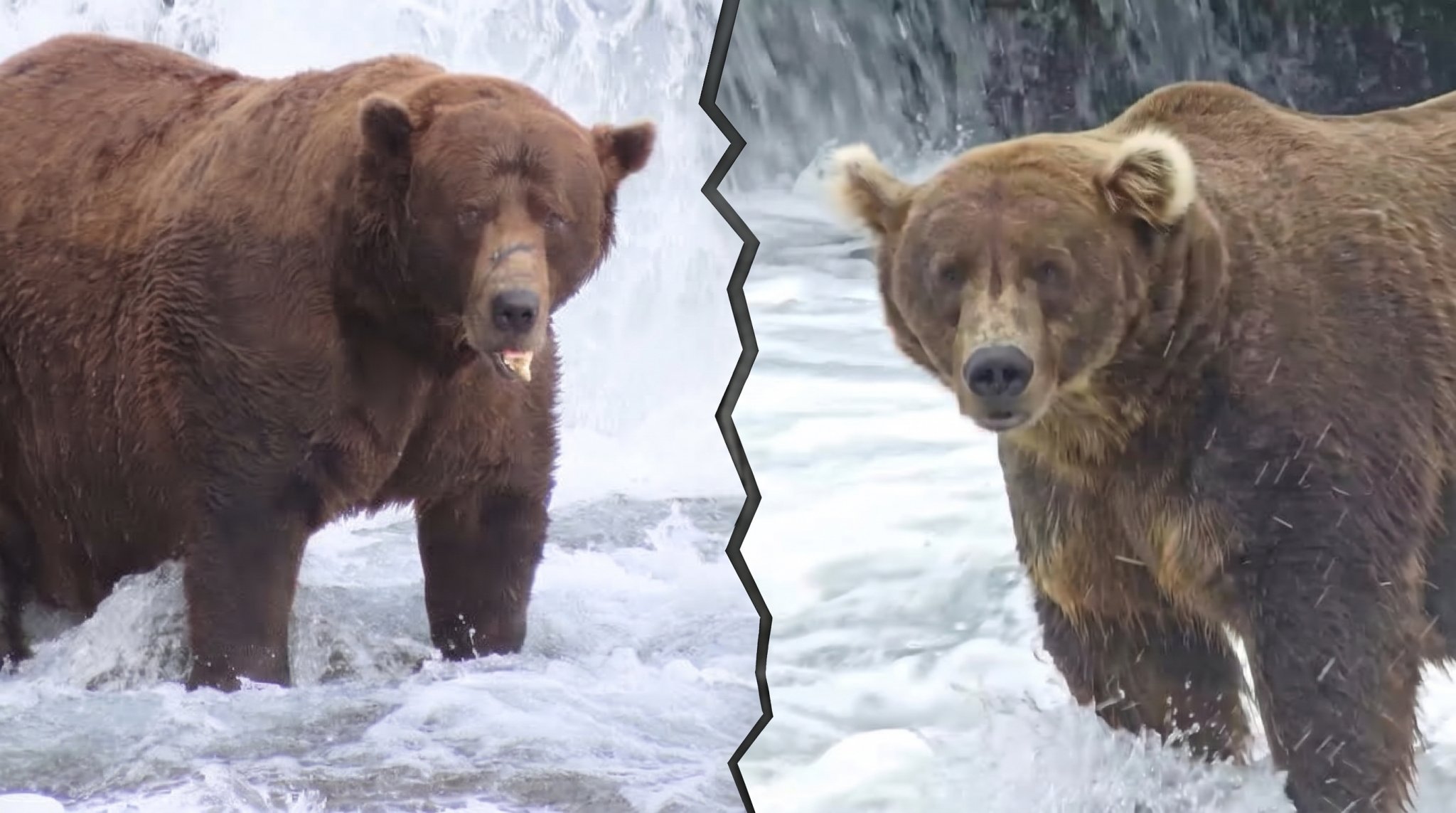
It’s almost time! The official Fat Bear Week 2026 bracket has landed, and this year’s competition will see 16 adult brown bears (Ursus arctos) in Alaska go head-to-head in the bracket-style online competition.
In group one are the mother bears, including:
- Bear #132, a first-timer, and her three spring cubs
- Bear #284 (Electra) and her two cubs, a bear with a long lineage at Katmai
- Bear #806 and her mixed age cubs
- Bear #901 and her spring cub
In group two are the single adult females, including:
- Bear #909, a resilient mama bear who lost two of her cubs this season
- Bear #428, the descendant of a former Fat Bear Week champion Bear #128 Grazer
- Bear #131, a 9-year-old bear who was once nicknamed Marshmallow for her light-brown appearance
- Bear #910, a member of a history-making blended bear family who has drawn the attention and affections of fellow Fat Bear Week contenders Bucky and Walker
In group 3, we have the sub-adult bears:
- Bear #694, a first-timer born in 2022
- Bear #620, a sub-adult on the cusp of adulthood and a member of Katmai’s Brady Bunch crew
- The resilient Bear #610
- Bear #89 (Backpack), a crowd-favorite who is the son of Bear #435 Holly, the 2019 Fat Bear Week champion
And finally, in group four, the behemoth adult male bears:
- Bear #32 (Chunk), the 2025 Fat Bear Week Champion
- Bear #164 (Bucky Dent), a young upstart and ace fisher-bear
- Bear #151 (Walker), a regular at Brooks River
- Bear #903 (Gully), another offspring of two-time champion Grazer who got his nickname because he likes to snack on gulls in addition to salmon
In addition to being digital competitors in this online tournament, Bear #151 and Bear #903 have proven to be real-life competitors, often going after the same salmon.
The 2026 Fat Bear Week Bracket. Image: explore.org.According to Katmai National Park and Preserve naturalist Mike Fitz, the brown bears have reached “peak fat” and are ready to handle the long salmon-less winter ahead. Over 100 different bears were identified at Katmai’s Brooks River this summer, and not all of them could be included in the competition. The team at Katmai selected from bears who showed up at the river early in the summer and re-appeared again later in the season. This allowed the team to take good before-and-after photos that show off how much weight they packed on while feasting on salmon over the summer.
Fat Bear Week begins on Tuesday, September 22, and a winner will be crowned on Tuesday, September 29. Voters can continue to get to know Katmai’s iconic bears via explore.org’s livestream and highlight reels.
Here is everything you need to know to prepare for this year’s celebration of Alaska’s chunky predators:
Think March Madness, just without the basketball and significantly more bears. Fat Bear Week is a single-elimination tournament, where bear enthusiasts from around the world can vote online for their favorite chunky bear. After each round, the bear with the most votes advances until the winner is announced. According to the Katmai Conservancy, the event began as a one-day event in 2014 with 1,700 votes cast. Only 10 years later, 1.2 million votes were cast from over 100 countries.
The brown bears return to Brooks Falls for the salmon migration every year in late June, where viewers can watch them on explore.org’s livestream. There, they will feast to fatten up for the long winter ahead. By late summer, the nutritious fish will spawn and then begin to die. The bears will then move to the lower Brooks River in September and October to eat the dead and dying salmon near the river’s mouth.
Eating all of this salmon is important because the heftier the bear, the better chance they will survive their long winter hibernation. Despite being the poster species for winter hibernation, bears are not “deep hibernators,” they way that squirrels, bats, and bees are. Bears enter a state called torpor, which is an involuntary state primarily triggered by lack of food. During this time, the bears rely on stored fat reserves for energy. A torpid bear’s eating, drinking, and waste functions will cease, as its body metabolizes these stores it put on over the summer.
When is Fat Bear Week 2026?This year, Fat Bear Week begins on Tuesday, September 22, and a winner will be crowned on Tuesday, September 29.
How can I vote?Votes may be cast from 12 p.m. to 9 p.m. EDT (9 a.m. to 6 p.m. PDT and 8 a.m. to 5 p.m. ADT) from September 22 and 29 at fatbearweek.org.
Photographs comparing the bears from earlier in the summer and later in the summer will be shown, so voters can get an idea of just how much weight the bears put on during their salmon fest. An adult male bear can go from roughly 700 pounds in the early summer to over 1,200 pounds by fall. Voters are also encouraged to get familiar with each bear’s life history and the unique challenges they face to survive.
Which bears are competing this year?This year’s competition includes 16 adult brown bears separated into four main groups—mother bears, single females (those who do not have cubs), sub-adults, and adult males.
In 2025, Bear #32 (Chunk) took the crown, despite beginning the salmon run with a freshly broken jaw. He was likely injured while fighting with another bear for a mate, but he still managed to catch plenty of fish. Chunk is known for his dominance and size, but also narrow-set eyes, dark fur, a prominent brow ridge, and a distinctive scar across his muzzle.
Chunk wasn’t always a fan favorite though. In 2024, he lost the Fat Bear Week crown for the second year in a row to mama bear Grazer. The two bears had been involved in an incident in which two of Grazer’s 2024 cubs were attacked by Chunk after falling over a waterfall. Grazer put up a fight against Chunk to defend her cubs, but one cub died after the encounter.
What happened to Fat Bear Week Junior?In past years, Fat Bear Week Junior has pitted cubs against each other in a similar, single-elimination bracket. For 2026, the competition will not happen. Instead, young cubs are competing as part of family units in the adult bracket.
How can I support Katmai’s bears?Donations can be made to Katmai Conservancy’s Otis Fund. The Otis Fund is named after Bear #480 (Otis), who won four Fat Bear Week titles before his death around 2024. All donations made between September 22 and October 3 will be matched by explore.org.
What happened with the bears this summer?This year’s livestream featured an example of how wild (and upsetting to humans) nature can be. On Tuesday, July 28, the live-cams captured a young brown bear cub being killed and eaten by an unrelated mother bear (Bear #806). The deceased cub was born this spring and the child of Bear #909, a 10-year-old brown bear. Bear #909 started the season with two cubs, but now lost both.
On Sunday, August 2, one of Bear #335’s (Jolly) cubs died, after following three unrelated cubs up a tree. The mother of the cubs already in the tree attacked Bear #335’s cub, who did not survive the encounter. The identity of the mother bear who killed the spring cub was not confirmed.
Following the first cub’s death, naturalist Mike Fitz and park rangers Christine Loberg and Sarah Bruce said this likely the first documented case occurring at Brooks River. While there is no one answer as to why mother bears are killing cubs, some experts suspect bear adoption, food scarcity, and fights for dominance all play a role.
Additionally, this year also saw a cub with silver-hued fur, one cub who hopefully learned important lesson about porcupine quill safety, the unique fishing stylings of Bear #164 (Bucky Dent), Bear #284’s (Electra) family who can “walk on water,” and even a few cubs take a tumble over a waterfall.
The post The Fat Bear Week 2026 bracket is here and chunkier than ever appeared first on Popular Science.