
The very title, “Football War,” is misleading. This is not a story about rivalry between football clubs and their fans. It was a brief conflict fought between El Salvador and Honduras in July 1969, and it was only tangentially connected to the sport itself. The name comes from its timing: the fighting broke out just weeks after the two countries had played a bitterly contested series of qualifying matches for the 1970 World Cup. It is also known as the 100-Hour War.
Steve Prout explains.
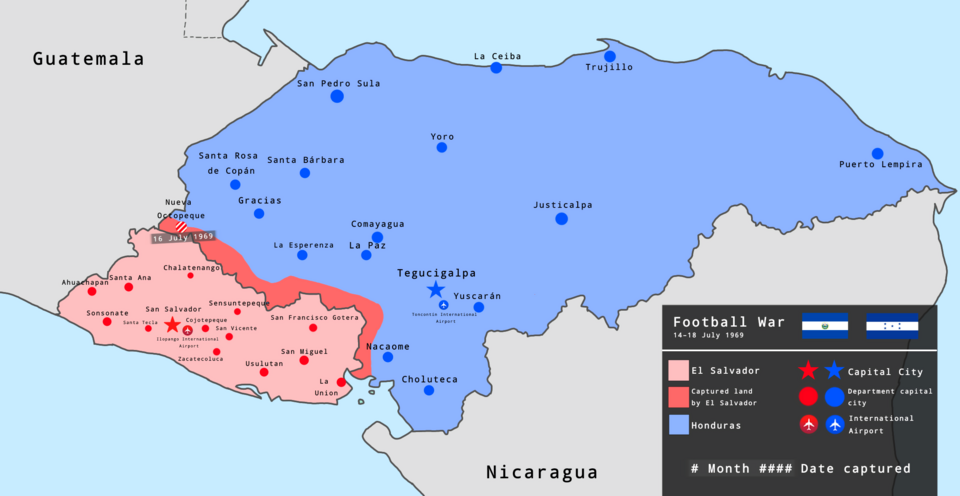
A map of El Salvador and Honduras showing the territories seized by El Salvador at the height of the conflict. Source: Creative Commons Attribution-Share Alike 4.0 International license, JuanJose1969, available here.
The Background
Football was not the cause of the war; if anything, it was the spark that lit the powder keg. The war grew out of tensions over the mass migration of Salvadorans into neighboring Honduras. El Salvador was experiencing numerous internal problems, chief among them a discontented, impoverished peasant population and deep inequalities in the distribution of land. El Salvador was overpopulated, the people suffered high unemployment rates, and much of the country’s peasant population was landless. By the 1960s, only 5% of farms occupied 70% of its land. At the same time, there were unresolved frontier disputes between El Salvador and Honduras.
Unsurprisingly, desperation and resentment grew within El Salvador. The peasants’ lot was made worse by the rapid expansion of cotton plantations, which took even more scarce farmland away. These peasants now looked beyond their borders to neighboring Honduras, which was five times larger and had jobs available, although much of that employment was low-paid work.
Over several decades, around three hundred thousand migrants from El Salvador crossed into Honduras. Many of them found low-paid work on banana plantations or with employers that offered similar terms and conditions. By 1969, these migrants accounted for more than 10% of the total population of Honduras. This became a troubling statistic when Hondurans found themselves competing for land and jobs against a huge influx of newcomers.
Meanwhile, Honduras already had its own problems around land distribution and ownership. The arrival of migrants from El Salvador made an existing problem even worse. Land availability was not eased by the dominance of large foreign companies such as the US-owned United Fruit Company, which held around 10% of Honduran land. However, the focus remained on the arrivals from El Salvador. Honduran farmers and ranchers pressured the government to protect their rights from the Salvadoran newcomers. In 1969, the Honduran government turned to an agrarian reform law, passed in 1962 and fully enforced from 1967, which enabled it to seize land held by Salvadoran settlers and redistribute it to native-born Hondurans. Mass expulsions followed, and violence erupted. All it took was a series of football matches to ignite this toxic mix of contention and hatred into something bigger.
FIFA World Cup and the outbreak of hostilities
In June 1969, the two countries met in a qualifying playoff for the 1970 World Cup. The first match, played on June 8 in the Honduran capital, Tegucigalpa, was won 1–0 by Honduras, and Salvadoran fans reportedly set fire to the stadium in protest. The two sides faced each other again on June 15, this time in San Salvador. El Salvador won 3–0, but the match was marred by violence as Salvadoran fans besieged the Honduran team’s hotel and attacked Honduran supporters, with several reported deaths. Anti-Salvadoran riots then broke out across Honduras, and, by El Salvador’s count, around 12,000 Salvadorans fled the country. With one win each, the teams met for a deciding match in Mexico City on June 27, which El Salvador won 3–2 after extra time. The day before, El Salvador had severed diplomatic relations with Honduras. What should have been a matter for the police had become an urgent matter for the military.
The build-up begins
The main hostilities were preceded by nearly three weeks of mounting tension, border skirmishes, and limited engagements between the two sides. The first officially reported engagement was on July 3, 1969, when Salvadoran anti-aircraft guns fired at a civilian airliner in Honduran airspace. Ground forces then briefly clashed near the border town of El Poy. At the request of the Organization of American States (OAS), the neighboring Central American countries of Nicaragua, Costa Rica, and Guatemala attempted to mediate, but their attempts to restore peace were of little avail.
El Salvador claimed that Honduran forces had crossed into its territory, and accusations were exchanged. On July 12, 1969, Honduras claimed that four Salvadoran soldiers had been killed during a failed incursion into its territory, a claim El Salvador denied. Limited artillery fire on border towns also caused civilian casualties.
The “100-Hour War,” or the Football War
On the evening of July 14, 1969, the Football War began in earnest. Salvadoran aircraft attacked Honduran airfields while ground forces simultaneously launched a two-pronged invasion, one thrust aimed at the Sula Valley and the other along the Pan-American Highway toward Tegucigalpa. According to the Salvadoran press, the army advanced some twenty-five miles in a single day.
Honduras retaliated with airstrikes of its own. On July 15, Honduran aircraft bombed Ilopango airport and the oil facilities at Acajutla and Cutuco, destroying one-fifth of El Salvador’s fuel reserves, but Honduran ground forces maintained a defensive position rather than advancing. El Salvador, in the meantime, continued to advance and surrounded the town of Nueva Ocotepeque. After heavy artillery fire, Honduran troops and civilians retreated, and the town fell on July 16 in the war’s only major battle. At this point, both Salvadoran advances stalled because of ammunition shortages and stiffening Honduran resistance. The next day, July 17, saw the last of the significant military engagements, including a dogfight between six aircraft in Honduran airspace (interestingly, both sides were still flying American fighters from the Second World War). That day, Honduran pilot Captain Fernando Soto shot down three Salvadoran aircraft in what are often described as the last dogfights between piston-engined fighters.
Meanwhile, in the background, the OAS was making strenuous efforts to bring about a peace deal. On the night of July 18, a ceasefire was agreed, and it took full effect on July 20. The war had ended, and both sides met at the negotiating table.
Outcome of Negotiations
El Salvador continued to occupy Honduran territory after the fighting ceased. Its conditions for withdrawal required Honduras to guarantee the safety of Salvadoran citizens in Honduras, pay reparations, and punish those responsible for attacks on Salvadorans. The talks were only partially successful, because Honduras gave the guarantee but did not pay reparations or punish those responsible. Although not satisfied with the outcome, El Salvador withdrew its occupying forces on August 2, 1969, under the threat of OAS sanctions.
As far as the actual football was concerned, El Salvador went on to beat Haiti and qualify for its first World Cup. At the finals in Mexico in 1970, however, it lost all three of its group matches, against Mexico, Belgium, and the USSR, without scoring a goal. The human cost of the four days of fighting was far greater. El Salvador reported up to seven hundred casualties, including 107 dead, and Honduras officially reported 165 casualties, including 99 dead, though these figures are disputed. Most estimates put the overall death toll at around two thousand or more, most of them Honduran civilians, and tens of thousands of people were displaced.
Conclusion
The war was not only one of the briefest wars of the century, but it also passed largely unnoticed by the rest of the world, except for the OAS. Latin American affairs, with some exceptions, usually elude the world’s headlines, as events elsewhere compete for the attention of the international media. Those exceptions include the continuing dispute between Argentina and Britain over the Falklands and US interventions such as those in Panama (1989) and Venezuela (2026).
There are, of course, other reasons why this small conflict escaped the world’s notice. In July 1969, the Apollo 11mission and the moon landing captured the world’s attention. By the time Neil Armstrong took his “giant leap for mankind” on the moon on July 20, the four-day conflict had ended, before most people outside the two warring countries had noticed.
The war still left deep resentment between the two countries for another two decades. There was no formal peace treaty until the General Peace Treaty was signed in Lima on October 30, 1980, under which the two countries agreed to settle their remaining border dispute. When those negotiations failed, the dispute went to the International Court of Justice, which in 1992 awarded Honduras around two-thirds of the disputed land along their border, as well as the island of El Tigre in the Gulf of Fonseca. El Salvador, already the smaller of the two countries, did not formally accept the ruling until 1999, and even then only grudgingly. Even in 2012, the borders and security of the Gulf of Fonseca were still under discussion between the two former warring nations and Nicaragua.
Enjoyed the piece?
Join thousands of history readers getting occasional updates on new blog posts, books, and video releases — plus a free history book to get you started.
Join History Is Now here