
It’s no secret that dolls have had a major influence on the fashion world, with Loewe’s cartoonish foam pumps and Marc Jacobs’ dramatically proportioned dresses being just a couple of recent examples. Meanwhile, fashionable figurines like Barbie, Bratz and Polly Pocket are among the industry’s busiest collaborators. It all stems from the longstanding phenomenon of “doll dressing.”
Coined by the Museum at FIT’s Senior Curator Dr. Colleen Hill, the phrase describes clothing, accessories, hair and makeup that draw inspiration from dolls, a concept that dates back centuries. Now, with the institution’s latest exhibit — also titled “Doll Dressing” — this subject is explored in depth for the very first time.
From left to right: “Lola” doll and couture wardrobe by Kenneth King, Creatable World, Cult Gaia x Bratz, Daisy by Mary Quant, Jett by Jason Wu and David Buttry, Black Barbie by Mattel, Viktor & Rolf x Disney Collector and Diane von Furstenberg Barbie.Photo: Courtesy of The Museum at FIT
“I never really wanted to do an exhibition that was solely on fashion dolls, partly because that’s been done and done very well,” Dr. Hill told Fashionista during a preview. “I started thinking about this idea of the living doll, and how that could transcend something vapid to become something agentic.”
Aesthetic-focused subcultures such as the dolly birds of the 1960s or the Japanese Lolita, which emerged in the 1990s, are prime examples of this. Both styles of dress borrow heavily from doll aesthetics and simultaneously allowed women to express themselves in ways they hadn’t before: The ruffles and frills of a Lolita frock subverted expectations of uniformity, while entrepreneurs like Twiggy and Biba’s Barbara Hulanicki flipped the derogatory origins of the term “dolly bird” on its head by building successful brands at a time when women were still expected to become housewives.
“Dolly Birds” featuring the Sindy doll and accessories and a Twiggy mannequin wearing a dress by Twiggy London Girl.Photo: Courtesy of The Museum at FIT
Of course, there’s no shortage of actual fashion dolls featured in the exhibition. Britain’s Sindy and Japan’s Jenny are two international examples, and designer collaborations with Barbie, Blythe and Monster High also make appearances. Toys like these also acted as the earliest mannequins for acclaimed couturiers like Martin Margiela, Anna Sui and Jason Wu, who got their start by making clothes for their childhood dolls.
“So many designers begin thinking about clothing by making things in miniature. Dolls are available to them, scraps of fabric are available. It’s a way to start thinking about the body and thinking about design,” Dr. Hill said.
“Flappers and Boudoir Dolls” featuring a 1920s dress and doll (left) and oversize silk tie printed with an Erté illustration (right). In case: 1920s doll-shaped bag. Artwork on wall: 1920s actresses and entertainers posing with dolls.Photo: Courtesy of The Museum at FIT
Some designers have even worked dolls into their collections. Long before Labubus became coveted accessories, Paul Poiret popularized the boudoir doll in the early 20th century, dressing them in looks that coordinated with his life-size designs.
“They were like little accessories or mascots,” Dr. Hill explained. “It was a real trend during the 1920s to just go out for the evening with your doll by your side. For the most part, they’re not functional. There are a few bags — I have one in the show that’s shaped like a doll, and its skirt conceals a little purse — but usually, you just carried a doll.”
“Broken Dolls” featuring looks inspired by Hans Bellmer and Kinderwhore. From left to right: dress by Olivier Theyskens, dress by Comme des Garçons, dress by Dice Kayek and dress by Love, Courtney x Nasty Gal. In case, left to right: Visionaire magazine, Babes in Toyland’sSpanking Machine record and Hole’s “Doll Parts” record single.
Photo: Courtesy of The Museum at FIT
Dr. Hill was also drawn to the ways in which dolls intersect with pop culture. As a teenager in the ‘90s (before Olivia Rodrigo was even born), she was obsessed with the “kinderwhore” aesthetics of bands like Hole and Babes in Toyland, who incorporated dolls — and babydoll dresses — into their album art and music videos. These appear in the exhibit alongside a Nasty Gal minidress designed in collaboration with Courtney Love.
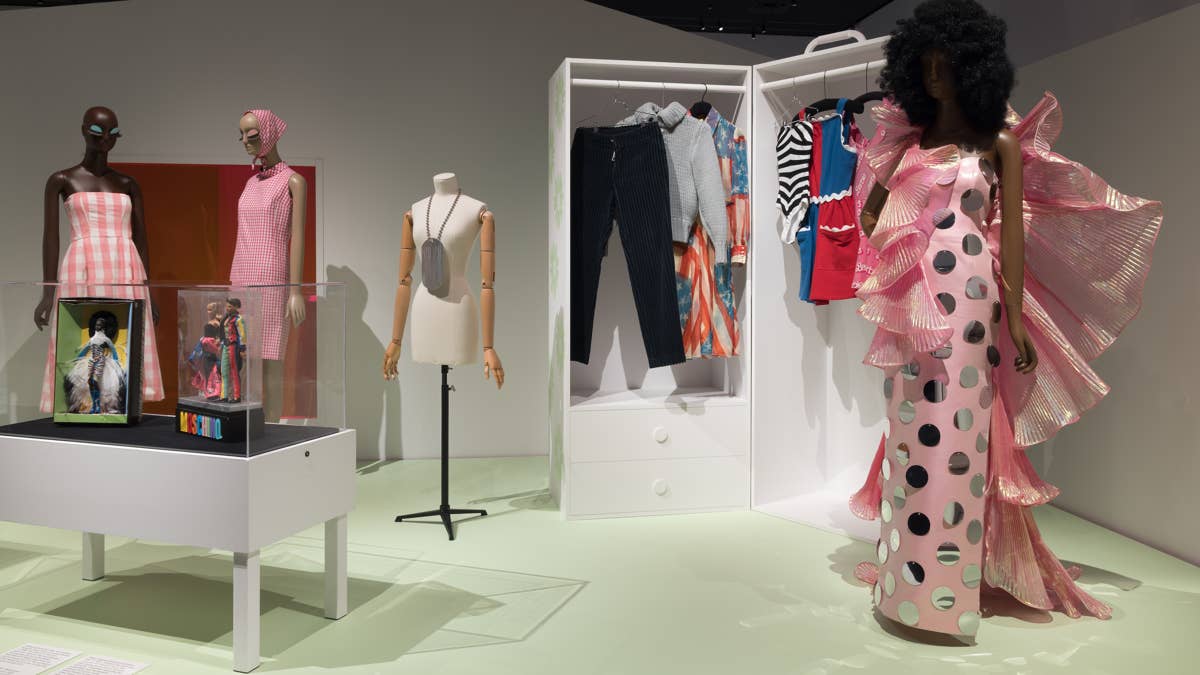
Given her reputation as the preeminent fashion doll, Barbie — who’s worn approximately one billion outfits in her nearly 70-year history — fills an entire section of the gallery. Jeremy Scott’s longtime obsession with the miniature blonde manifested in his Spring 2015 line for Moschino. The finale look, an iridescent gown plastered with giant paillettes, is displayed beside a blown-up version of Barbie’s fold-out wardrobe.
“Pink Gingham” and “Barbie” sections. Far left: dress by Zara x Barbie: The Movie, reproduction Biba dress and headscarf by Matthew Carlsen. In case: “Mbili” Barbie by Byron Lars (left) and Moschino Barbie and Ken dolls. Center, on dress form: enlarged G.I. Joe dog tag by Maison Martin Margiela. Fashion case featuring Barbie-inspired designs from left to right: trousers by Maison Martin Margiela, sweater by Maison Martin Margiela, dress by Catherine Malandrino, swimsuit by Barbie x Unique Vintage, dress by Fashion Brand Company and dress by Jeremy Scott. On mannequin: dress by Jeremy Scott for Moschino.Photo: Courtesy of The Museum at FIT
Hanging on one rack are pieces from Margiela’s Fall 1994 collection, for which the designer recreated doll clothes and accessories by enlarging them to 5.2 times their original size. Dr. Hill was also adamant about exhibiting Margiela’s G.I. Joe-inspired dog tag necklace — released in 1999 as a nod to his original “doll’s wardrobe” collection. Though it initially proved tricky to track down, she happened to find one thanks to a noteworthy donor, poet Mei-mei Berssenbrugge, wife of artist Richard Tuttle.
“We’d been working with her for a few months, and she’d given us some absolutely incredible things,” Dr. Hill said. “She invited us back for one last look at a trunk full of clothes she found, and there the necklace was.”
“We Can All Be Dolls” with framed artwork by Courtney Charles and photographs from Pat McGrath for Maison Margiela (on lightbox). In small case: Barbie wearing a “Black Dolls Matter” T-shirt by Mark Ruffin and a Laverne Cox Barbie. On dress forms: “Protect the Dolls” T-shirt by Conner Ives (left) and “Boy Doll” jacket by Celine Homme (right). In large case: an ensemble on loan from Lynn Yaeger.Photo: Courtesy of The Museum at FIT
There are many more recent and recognizable designers featured throughout the exhibit as well, including Conner Ives (his “Protect the Dolls” tee, of course), Vettese, Fashion Brand Company, Bode and Simone Rocha.
“Doll Dressing” is on view now through Jan. 3, 2027 at the The Museum at the Fashion Institute of Technology.
View this post on Instagram