
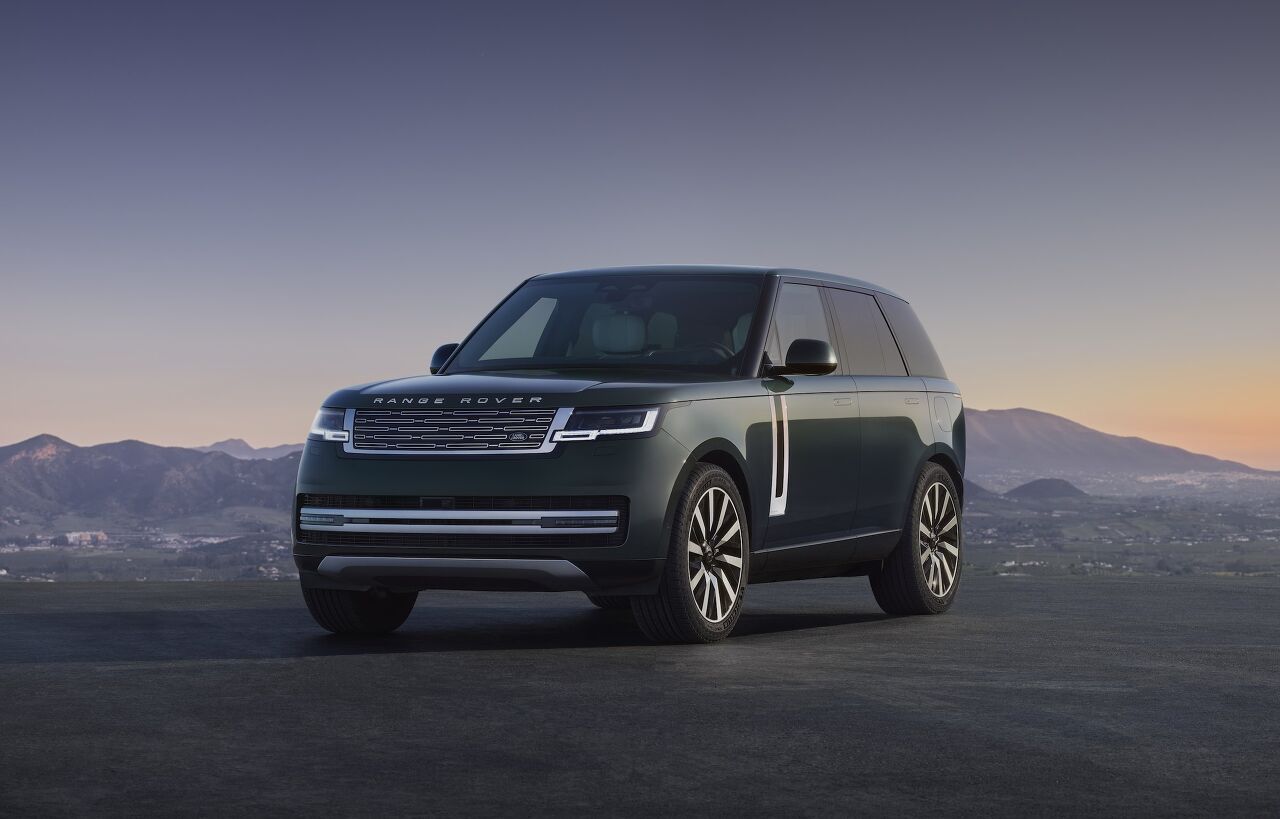
Jaguar Land Rover pledged a fully battery-powered Range Rover at least five years back, when it rolled out its "Reimagined Strategy" and promised to electrify every vehicle in the lineup. Then nothing shipped, for years, while the rest of the industry got on with the business of selling electric SUVs.
The delay was not laziness. The short version: the propulsion system Land Rover originally designed could not keep its promises off-road, and the company refused to launch a Range Rover that drives like something less than a Range Rover.
The longer version involves an induction motor that overheated, 300 patent filings, and a company that decided a half-right flagship was worse than a late one. Here is what actually happened, and why the wait produced the vehicle it did.
The original plan put an induction motor on the front axle. On paper this is clever engineering. An induction front motor can be disconnected entirely during normal road driving, when the vehicle doesn't need all-wheel drive, which saves energy and stretches range, then re-couples itself when the vehicle needs extra traction. For a luxury SUV that spends most of its life on motorways, that efficiency is worth chasing.
It did not survive testing. According to program chief Simon Fairbrother, the induction setup was getting too hot, forcing the team to back off the power. The problem showed up hardest in high-temperature testing, where the front-axle arrangement could not deliver consistent Range Rover off-road capability. A Range Rover that backs off its own power when it gets warm is not a Range Rover. Fairbrother has said the central challenge of the whole program came down to the propulsion system meeting the attributes the brand demanded.
So the team went back to the drawing board. The inability to hold consistent off-road performance killed the induction concept outright.
Land Rover had already built a tougher permanent-magnet motor for the rear axle. The solution was to copy that motor onto the front axle too, giving the Range Rover Electric two identical permanent-magnet synchronous drive units. Each one puts out 349 hp, or 260 kW, for a combined 542 hp and 627 lb-ft of torque — more torque than any Range Rover before it.
Swapping motor types is not a parts-bin exercise. It meant Land Rover had to go back and model, test, and validate the new setup from scratch. That revalidation is a big piece of why the car arrived when it did, as a 2027 model year vehicle, rather than years earlier.
Fairbrother's team settled on twin permanent-magnet motors that put out 20% more torque than rival units of the same physical size, helped by silicon carbide semiconductors in the drive units. Traction management now reacts up to 100 times faster than an equivalent combustion vehicle, with Integrated Traction Management controlling motor speed within 50 milliseconds.
The delay was a policy, not an accident. Range Rover product manager Rachel Hogg put it plainly: these are the things customers have told the brand they want, and delivering on that promise mattered enough that the team felt it had to get it right rather than rush something to market that was not right for the brand.
The program ran more than 250,000 hours of virtual testing, a record for the brand, and the physical fleet piled on mileage equal to circling the globe 38 times, according to JLR. Managing Director Martin Limpert has said the testing and development programs went further than originally planned, and described the result as the most accomplished Range Rover ever. The company filed 300 patent applications along the way, making this likely the most patented Range Rover in the brand's history.
The guiding rule throughout was that the vehicle had to be a Range Rover first and electric second. That is why it looks virtually identical to the combustion models, with the absence of tailpipes being the clearest giveaway.
A Range Rover that can't go where a Range Rover goes is a non-starter, which is why the heat problem was fatal rather than inconvenient. The electric version holds the line on the metrics that matter. Its angles of ascent and descent match the gas model, and its fording depth is identical — still 900mm, or three feet, of water.
There are small concessions. Ground clearance and break-over angles drop slightly versus the petrol car, and the departure angle shrinks a touch because of a new aero rear diffuser. Fairbrother argues the completely flat floor makes up for some of that, letting the vehicle "sledge" over obstacles it would otherwise scrape on. That flat floor exists because of the structural integrity of the battery pack.
The electric layout brings advantages a combustion Range Rover cannot match. Single-pedal driving lets it climb slopes up to 45 degrees and pull away smoothly on grades up to 33 degrees — a pitch JLR likens to a black-diamond ski run. Intelligent Driveline Dynamics shifts rear torque from 100 percent to zero to head off traction loss before it happens.
The Range Rover Electric rides on the same Solihull production line as its combustion and plug-in hybrid siblings, which lets Land Rover flex output to demand within weeks. That is possible because, as Ars Technica reported, the MLA architecture was engineered more than ten years ago to work regardless of powertrain, handling combustion, mild-hybrid, plug-in hybrid, and battery-electric drivetrains on one platform.
Dropping the front, center, and rear differentials along with the driveshafts claws back nearly as much mass as the battery and motors add. The net result: the electric Range Rover weighs just 165 lbs, or 75 kg, more than the V8, while sitting on a lower center of gravity.
Power comes from a usable 118.5 kWh double-stack battery built from 344 prismatic cells, running on an 800-volt architecture. WLTP range tops out at 372 miles, with a real-world figure of up to 333 miles. On a 350 kW rapid DC charger it goes from 10 to 80 percent in about 22 minutes, adding 137 miles in 10 minutes. Not everything survived the packaging, though: the large rear motor rules out a seven-seat variant that the long-wheelbase petrol model offers.
Land Rover reports more than 80,000 genuine expressions of interest. Fairbrother has noted a surprising majority come from the United States — half of all hand-raisers are North American, concentrated in New York, California, Oregon, and Washington. Roughly 70 percent are new to the brand, and about 20 percent already own an EV.
Hogg expects fully electric models to settle at 10 to 20 percent of Range Rover sales over time. If you are among the interested, the next step is an order: in the UK the car starts at £154,070 OTR, with US pricing from $138,000. The Curated First Edition offers three exterior colors for buyers who want the earliest build.
[Images: Jaguar Land Rover]
Become a TTAC insider. Get the latest news, features, TTAC takes, and everything else that gets to the truth about cars first by subscribing to our newsletter.