
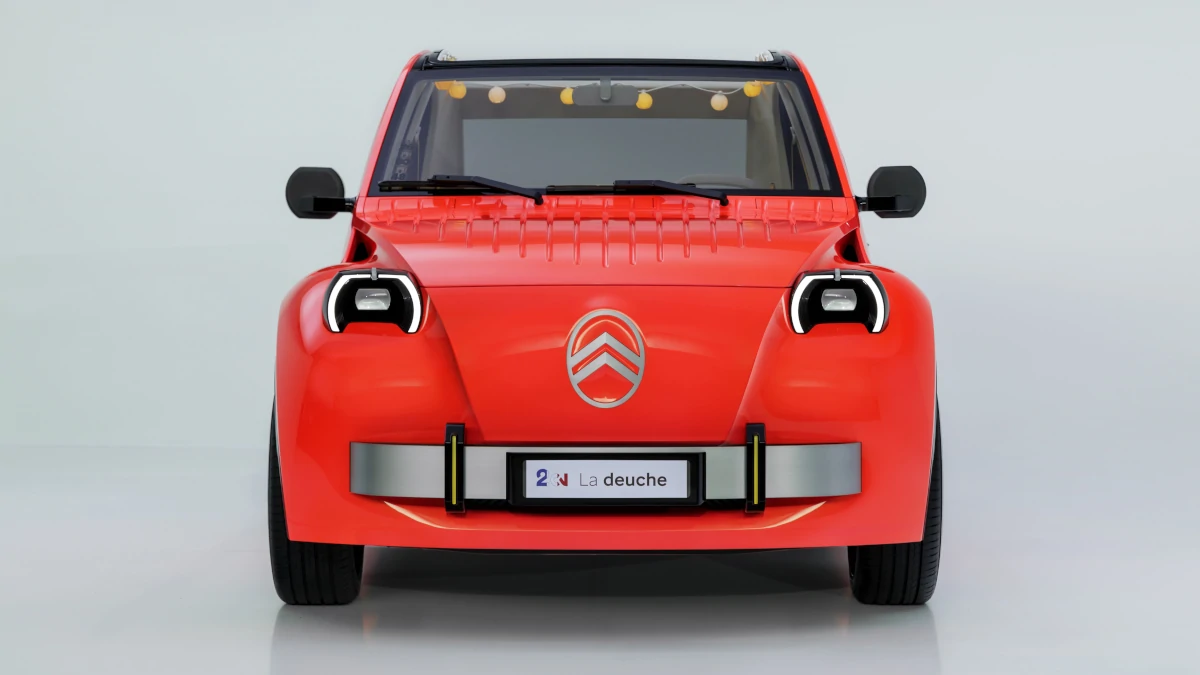
Cometh the hour, cometh the car. The original Citroen 2CV arrived into a diminished postwar world. As the carmaker notes, it was never intended to become an icon, but accepted that status because of what it made possible. It democratized transport and travel, a car that embodied joie de vivre and other notions that somehow sound better in French. The new one aims to pull off the same trick; it certainly radiates that ineffable, indefinable specialness when you’re up close to it.
Just don’t call it r*t*o. Although the Citroen 2CV Concept is clearly inspired by the original, it doesn’t replicate the car so much as the spirit that infused it. The silhouette is familiar and cuddly, the execution fastidiously detail-focused. We live in a hellishly noisy world, and economic value is attached to how much attention—or anger—something attracts.
PHOTO BY Citroen
PHOTO BY Citroen
Well, only an irredeemable misanthrope could be angry about the new 2CV. Or its mission statement. Citroen says it “redefines a sensible set of specifications that focuses on essential needs...[it’s] inspired by the original yet free from nostalgia.”
OTHER STORIES YOU MIGHT HAVE MISSED:
Here is your first look at the 2027 Hyundai Tucson N Line
The Mazda Fan Festa shows exactly why Mazda has such a loyal following
So, evocative, charming, but above all fit for purpose. Keep that last bit in mind.
“Why was the original born? What was the brief, what was the context, and how does this idea make sense in the world of today?” Stellantis design director Gilles Vidal asks Top Gear. “On a project like this, the engineering department was suddenly motivated to make the impossible possible. Everyone is working really hard to achieve that.”
PHOTO BY Citroen
PHOTO BY Citroen
Vidal has form here. Following 24 years at Citroen and Peugeot, he switched sides to Renault in 2020, where he helped steer the 4, the 5, and the Twingo into critical and commercially acclaimed life. EVs with snap, crackle, and pop, they generate fuzziness and fizz even in buyers for whom the originals are just a distant folk memory. Faced with a relentless wave of tech-savvy but charmless Chinese rivals, Vidal is charged with revitalizing the group’s visual identity across a sprawling product portfolio. Think differentiation and personality. This is key to the new 2CV.
“We need to be super sharp about what our brands stand for. They are the company’s biggest asset,” he continues. “It’s a matter of finding the sweet spot between shocking in a positive way with an execution that makes you want something the moment you see it.”
PHOTO BY Citroen
PHOTO BY Citroen
At just 3.76 meters long, the new car is even shorter than the original. Citroen says it’s aiming for a weight figure of 1,000kg, and a modest range target should permit the use of a small-ish battery. We reckon 270km or so would do. No word yet on capacity, configuration, or range, but the new 2CV is part of a coming wave of small EVs, developed and engineered in line with the European Commission’s e-car proposal.
So it’ll likely use lower-cost lithium-ion phosphate batteries, and tap into Chinese partner Leapmotor’s tech. It’ll sit between the Ami quadricycle and the C3, with prices said to start from €15k (around P1.05 million before taxes) when it arrives in 2028—80 years after the original. Expense is currently a barrier to entry for many potential EV owners; the 2CV should eradicate that while capitalizing on arguably the most beloved car in French automotive history.
PHOTO BY Citroen
PHOTO BY Citroen
The floating LED headlights and the outsize double-chevron logo give the car a pronounced face. Rather than copying the original’s boxy little taillights, the concept moves them higher up either side of the rear window. “We could have copied those lights, but we decided to do something that never existed before,” Vidal says, “which actually makes the car super modern.”
As does the pressing technique on the hood, allowing the signature 2CV indentations on either side. In the wrong hands, it could all have ended up looking like the work of a clumsy pasticheur. Instead, it’s a characterful car that demands to be taken seriously.
PHOTO BY Citroen
PHOTO BY Citroen
If the 2CV’s exterior delivers a nicely Proustian rush, the interior is where the designers really stretch out—while keeping everything blissfully simple. There’s no dashboard; instead, the steering wheel—single spoke, obviously—the drive selector, and the eight-inch touchscreen are attached to a cylindrical base. They have a Bakelite feel to them, which manages to be simultaneously nostalgic and fresh-feeling.
The screen graphics are the work of Belgian comic book artist and 2CV fanboy, Jean-Luc Delvaux. Ahead of the driver, essential info is projected onto a slender screen: The speedo graphic echoes the rotating drum used by classic Citroens. There’s a removable storage basket where you’d usually find a center console. Also removable/detachable is the ‘Radioen,’ basically a portable sound system.
PHOTO BY Citroen
PHOTO BY Citroen
Vidal says a big switch to more sustainable materials is an expensive transition to make, but becomes viable as time goes on and the economies of scale improve. “We would like everything to be fabric inside, so it’s super welcoming and special, but also simple at the same time,” he notes.
The original, of course, was designed to be driven by French farmers across plowed fields with a basket of eggs on the passenger seat. Look in the door-bins here and you’ll find egg-shaped storage space. There’s a tortoise graphic on the brake pedal, a rabbit on the accelerator. The sound of the electric motor mimics the breezy wheeze of the original’s flat-twin, and the horn parps cheerily. Again, it’s cute without being cringe, French without the rioting.
PHOTO BY Citroen
PHOTO BY Citroen
Michelin has developed special tires for the car that can adapt to the environment and continuously monitor their condition. The logo is another throwback. But how much of all this conceptual eye candy is truly feasible? Vidal insists it’s for real.
“Oh, it’s going to work for sure. We’re very serious about all this fun. There’s a ton of really cool things that we want to bring into production as much as we can—because that’s what people want to buy.”
We’re in the queue already.
More photos of the Citroen 2CV Concept:PHOTO BY Citroen
PHOTO BY Citroen
PHOTO BY Citroen
PHOTO BY Citroen
PHOTO BY Citroen
PHOTO BY Citroen
PHOTO BY Citroen
PHOTO BY Citroen
PHOTO BY Citroen
PHOTO BY Citroen
PHOTO BY Citroen
PHOTO BY Citroen
PHOTO BY Citroen
PHOTO BY Citroen
PHOTO BY Citroen
PHOTO BY Citroen
NOTE: This article first appeared on TopGear.com. Minor edits have been made.