
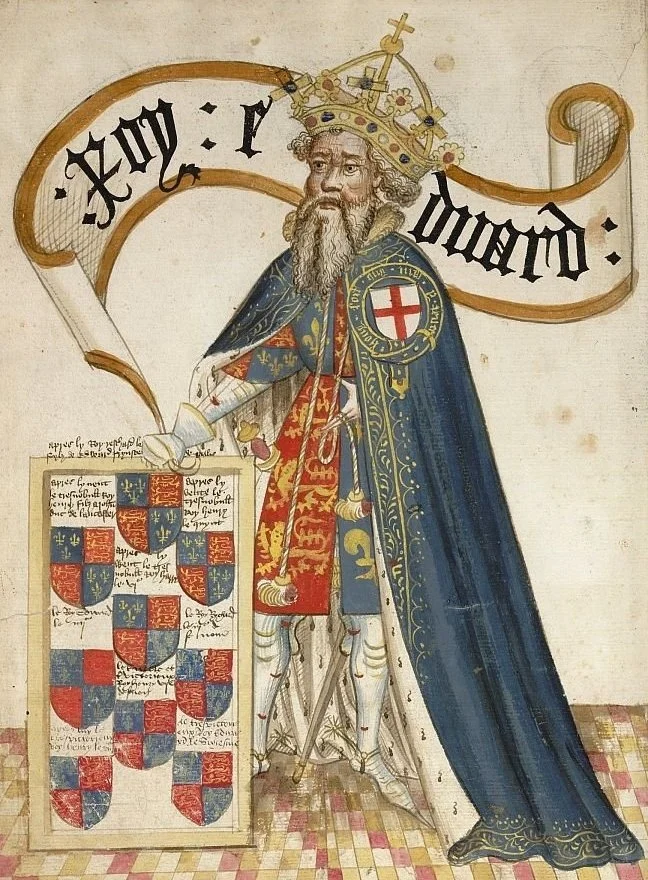
How Edward III and his eldest son forged England's reputation on the battlefields of France, and laid the foundations of a conflict that would endure for generations.
In the summer of 1346, an English army landed on the coast of Normandy and began a campaign that would shake the foundations of the French kingdom. At its head was King Edward III of England, a monarch determined to press his claim to the French crown. Among his commanders was his sixteen-year-old son, Edward, Prince of Wales, who would later become known to history as the Black Prince. Within weeks, the young prince would find himself at the center of one of the most consequential military encounters of the Middle Ages: the Battle of Crécy.
Yet the story of England's extraordinary military reputation in France began long before that August afternoon. It was rooted in dynastic ambition, disputed inheritance, political rivalry and the struggle to control territories that had bound the English monarchy to the French crown for centuries. What emerged was not simply a war between two kingdoms, but a prolonged contest for sovereignty, wealth and prestige that would transform medieval warfare and leave an enduring mark on both nations.
At the heart of this unfolding drama stood two generations of English royalty: Edward III, whose ambitions helped ignite the conflict, and his eldest son, whose military achievements would make him one of the most celebrated warriors of his age. Their successes would bring England glory, territory and enormous ransoms. They would also unleash devastation across the French countryside, expose the limitations of military conquest and create political problems that neither father nor son could ultimately resolve.
Terry Bailey explains.
Edward III of England by William Bruges> Source: Public domain, British Library/Bruges Garter Book, available here.
The origins of the Hundred Years' War lay in a dynastic dispute that threatened to destabilize the political order of western Europe. When Charles IV of France died in 1328 without a surviving son, the direct male line of the French royal House of Capet came to an end. Two principal claimants emerged: Philip of Valois, a powerful French nobleman and cousin of the late king, and Edward III of England, whose mother, Isabella, was Charles IV's sister.
Edward possessed a genuine hereditary connection to the French throne. Through his mother, he was the grandson of Philip IV of France, while Philip of Valois descended from Philip IV's brother. Edward could therefore argue that his claim was at least as strong as that of his rival.
The French political establishment, however, rejected the prospect of a king ruling France through his maternal line when a male-line relative was available. Philip of Valois was crowned Philip VI in 1328, establishing the Valois dynasty that would rule France for generations. Edward initially acknowledged Philip's kingship, but the question of whether he had surrendered his ultimate claim would remain a source of tension.
The dispute was complicated by the English king's position as Duke of Aquitaine. Although Edward ruled England as an independent monarch, his lands in southwestern France were held under the French crown. This produced an uncomfortable constitutional arrangement: the King of England was simultaneously a sovereign ruler in his own kingdom and a vassal of the King of France for his continental possessions.
For Edward, this was more than a legal inconvenience. French kings could interfere with English interests in Aquitaine, challenge the extent of English authority and threaten the revenues derived from one of the wealthiest regions under English control. Aquitaine was particularly valuable for its wine trade, especially the export of Gascon wine to England.
Other disputes deepened the rivalry. French support for Scotland threatened England's security, while English involvement in the Low Countries and other continental affairs brought the two monarchies into competition. Control of territory, commercial interests and the balance of power all became entangled with the question of the French succession.
In 1337, Philip VI confiscated Edward's duchy of Aquitaine, providing the immediate catalyst for open war. Edward responded by reviving his claim to the French crown and challenging the legitimacy of the Valois monarchy. The conflict that followed would become known as the Hundred Years' War, although the name was coined much later and the fighting itself unfolded through successive campaigns, truces and renewed hostilities over more than a century.
What began as a dynastic contest soon became a struggle for national prestige, territorial possession and political survival. Neither side could have anticipated the full scale of the destruction that lay ahead.
Edward III was not simply an ambitious monarch pursuing an inherited grievance. He was a ruler who understood the importance of military reputation, aristocratic loyalty and the rewards that victory could bring.
His early reign had been troubled. As a young king, Edward had initially been dominated by his mother, Isabella, and her ally Roger Mortimer, whose influence followed the overthrow and death of Edward II. In 1330, Edward III asserted his independence, arrested Mortimer and established personal control of the government. War in France offered an opportunity to strengthen his authority, unite the political elite around the Crown and restore the prestige of the English monarchy.
Edward also possessed an effective military and financial system for supporting campaigns overseas. English kings had long relied upon a combination of noble military service, contracted troops, taxation and loans to sustain their armies. Edward developed these resources further, drawing upon the wealth of the kingdom and the commercial networks of its merchants.
But the war would prove enormously expensive. Campaigns required ships, horses, armor, provisions, wages and supplies of arrows. The Crown had to negotiate with Parliament for taxation and borrow heavily from merchants and financiers. Military success might generate booty and ransom payments, but it could not guarantee that the proceeds would cover the costs of maintaining an army abroad.
Edward's ambitions also demanded a new generation of commanders capable of translating royal strategy into battlefield success. His eldest son, Edward of Woodstock, was destined to become the most celebrated of them.
Born in 1330, the prince grew up in a court where military achievement was central to aristocratic identity. He was trained in horsemanship, arms, command and the responsibilities of noble leadership. His later reputation would be shaped by courage and tactical ability, but also by the expectations placed upon him as heir to the English throne.
The prince's familiar title, the Black Prince, has inspired generations of speculation. Its precise origin remains uncertain, and the name was not consistently used during his lifetime. What is beyond doubt is that his military career became inseparable from England's rise as a formidable power in France.
The English victories of the fourteenth century were not the product of a single weapon or tactical innovation. They emerged from the interaction of disciplined infantry, experienced archers, dismounted men-at-arms, defensive positioning and effective command.
The longbow nevertheless became one of the defining weapons of English armies. Powerful and capable of rapid shooting in trained hands, it allowed large numbers of archers to deliver sustained volleys against advancing troops. Arrows could injure horses, disrupt formations and exploit weaknesses in armor, particularly when opponents were exposed at close range or struck from advantageous positions.
English military organization made effective use of these archers alongside men-at-arms, who were equipped with swords, lances, armor and other weapons appropriate to close combat. Rather than relying exclusively upon mounted knights charging into battle, English commanders increasingly employed men-at-arms fighting on foot, supported by archers and positioned to exploit difficult ground.
This combination could prove devastating against an opponent who attacked without adequate reconnaissance or failed to coordinate his forces. The French aristocracy possessed considerable military experience and formidable cavalry, but its traditional emphasis on mounted combat could become a disadvantage when confronted by a well-positioned enemy.
The longbow was not invincible. It required years of training, dependable supplies of arrows and suitable battlefield conditions. Heavy rain, inadequate positioning, exhausted troops or a failure to exploit an initial advantage could undermine its effectiveness. Nor did the English abandon cavalry or conventional knightly warfare. Their success came from adapting established military traditions to the demands of particular campaigns.
The men who wielded these weapons were often recruited from the communities of England and Wales. Their participation reminds us that the war was not fought solely by kings and aristocrats. It depended upon thousands of ordinary men whose military skills could decide the fate of kingdoms, even as their service removed them from farms, workshops and families.
Edward III's invasion of Normandy in 1346 marked a turning point in the conflict. His army landed in northern France and advanced through the countryside, capturing towns, taking supplies and devastating settlements as it moved south. The campaign was designed to draw French forces into battle while demonstrating the reach of English power.
The French king, Philip VI, gathered a much larger force and pursued the invaders. Edward's army eventually moved northwards, seeking to reach friendly territory in Flanders. Near the village of Crécy, the English king chose to stand and fight.
The Battle of Crécy, fought on the 26th of August 1346, became one of the defining English victories of the Middle Ages. Edward arranged his army on favorable ground, deploying archers alongside men-at-arms and taking advantage of the terrain to strengthen his defensive position.
The French attack was hampered by disorder and poor coordination. Crossbowmen serving the French were unable to deliver their full potential, while successive assaults by French cavalry and infantry encountered concentrated English missile fire and determined resistance. The English position held, and the French army suffered severe losses among its leading nobles and fighting men.
The young Prince Edward, then sixteen, was given an important command and experienced battle at first hand. Accounts of the fighting describe a moment when his position came under pressure and assistance was requested from the king. Edward III is traditionally said to have refused to send help, declaring that he wished his son to win his spurs. Although the precise wording belongs to the traditions surrounding the battle, the episode captures the significance of the prince's first major military test.
Crécy established the reputation of the English army as a force capable of defeating a larger opponent through discipline, tactical preparation and the effective combination of different troop types. It also demonstrated the vulnerability of the French aristocracy when confronted by an enemy whose methods frustrated the traditional expectations of mounted combat.
The victory did not, however, destroy France's capacity to resist. Edward continued his campaign and turned his attention to Calais, a strategically important port on the Channel coast. After a prolonged siege, the town surrendered in 1347.
Calais would become one of England's most valuable continental possessions, providing a fortified base for trade, diplomacy and future military operations. Its capture also demonstrated that victory in the field did not automatically produce political submission. Towns could resist for months, armies could be replenished, and the resources required to sustain a war extended far beyond the battlefield.
A decade after Crécy, the Black Prince emerged as a commander in his own right. In 1355, he led a major expedition from Aquitaine into southern France, conducting a destructive chevauchée through territories loyal to the French Crown.
A chevauchée was a mounted raid intended to damage an opponent's economic resources, weaken local authority, gather plunder and provoke a response. English forces burned settlements, destroyed crops, seized livestock and carried away valuable goods. These operations could place enormous pressure on a region without requiring the attackers to capture every fortified town they encountered.
They were also instruments of psychological warfare. By demonstrating that the French Crown could not protect its subjects, English commanders hoped to weaken confidence in royal authority and encourage political concessions.
The strategy carried a terrible human cost. Rural communities lost homes, harvests and animals, while merchants and townspeople faced disrupted trade and the threat of violence. For the men conducting the raids, the campaign offered opportunities for plunder and ransom. For those caught in its path, it often meant poverty, displacement and hunger.
In September 1356, the prince led another major expedition northwards from Aquitaine. Near Poitiers, his army encountered a French force commanded by King John II, who had succeeded Philip VI in 1350. Once again, the English were confronted by an opponent whose numerical strength appeared formidable.
The Battle of Poitiers, fought on the 19th of September 1356, became the Black Prince's greatest triumph. The English occupied a defensive position near difficult terrain and used archers, dismounted men-at-arms and carefully coordinated action to counter the French advance. The fighting was fierce, and the outcome was far from certain during its early stages. Ultimately, however, the French army was defeated, and King John II was captured.
The capture of a reigning French king was an extraordinary event. It elevated the Black Prince's reputation across Europe and provided Edward III with an immensely powerful bargaining instrument. John was not merely a defeated commander; he was a monarch whose person symbolized the authority of the French state.
The victory also produced an enormous political and financial opportunity. High-ranking prisoners could command substantial ransoms, and the capture of King John promised wealth and prestige on a scale few military successes could match.
Yet Poitiers exposed the limits of battlefield triumph. The French king's capture did not immediately bring France under English control, nor did it settle the rival claims to sovereignty. Instead, the French kingdom entered a period of political instability, financial strain and social unrest, while England faced the challenge of turning military success into a durable settlement.
The devastation of the French countryside was not an incidental consequence of the war. It was central to the methods employed by English commanders. Chevauchées could damage the enemy's tax base, undermine confidence in the monarchy and compel French leaders to divert resources into defense.
But the same operations that created military pressure also generated resentment and suffering on a vast scale. Farms were burned, villages emptied and communities forced to abandon land that had sustained them for generations. Soldiers and armed bands could prey upon civilians even when they were not directly engaged in major campaigns.
The wider European crisis of the fourteenth century made these hardships more severe. The Black Death, which reached Europe in 1347, killed a catastrophic proportion of the population. Labor shortages, declining revenues, disrupted trade and demographic upheaval placed extraordinary pressure on governments and communities already affected by warfare.
England and France experienced these problems in different ways, but neither kingdom was insulated from their consequences. Maintaining armies became more difficult, while taxation and borrowing imposed growing burdens upon the population. The profits of war were unevenly distributed, with noble captains, merchants and soldiers sometimes benefiting from ransoms and plunder while ordinary people endured destruction and insecurity.
Military success could therefore produce a paradox. A king might gain territory and prestige while weakening the economic foundations needed to retain them. A commander might win a celebrated victory while creating enemies whose resistance would continue long after the army had departed.
The Black Prince's campaigns revealed both the effectiveness and the limitations of English warfare. He could defeat royal armies, capture important prisoners and devastate hostile territories. What he could not do was eliminate the political institutions, resources and determination that allowed France to recover.
By 1360, the capture of King John II and the succession of English victories had produced an opportunity for a negotiated settlement. The resulting agreement, commonly known as the Treaty of Brétigny, was concluded in May 1360 and subsequently formalized at Calais.
The settlement offered Edward III substantial territorial concessions. He was to receive an enlarged and more independent Aquitaine, together with other territories and strategic possessions. In return, he would renounce his claim to the French crown once the territorial arrangements had been properly implemented. The French king's ransom was fixed at an enormous sum, commonly stated as three million gold écus.
For Edward III, the treaty appeared to offer the possibility of converting military victory into a lasting political settlement. For the Black Prince, it promised a greater sphere of authority in southwestern France. The arrangement seemed to recognize the strength of England's position and offered a route towards ending a costly conflict.
Yet the agreement contained difficulties that would undermine its promise. The territorial transfers and renunciation of claims were conditional upon the completion of the agreed formalities, and the practical implementation of the settlement proved complicated. The ransom payments were also difficult for France to meet in full.
More fundamentally, the treaty did not erase the rival ambitions of the two monarchies. The French Crown retained the means and the incentive to challenge English authority when circumstances permitted. Local loyalties, feudal obligations and disputes over jurisdiction continued to complicate the administration of the transferred lands.
The settlement brought a period of relative respite, but not a final peace. The war's central problem remained unresolved: could England establish a lasting political order in France, or would its conquests eventually provoke a renewed struggle?
The answer would become clearer in the years that followed.
After the treaty, the Black Prince governed Aquitaine as a powerful territorial ruler. His responsibilities extended well beyond the battlefield. He had to maintain garrisons, adm