
Why could children could go 28 days without fresh linen while supplies sat in storage? Here, Ilias Konstantinidis considers this question in the context of some of the challenges with the centralized Soviet system of governance.
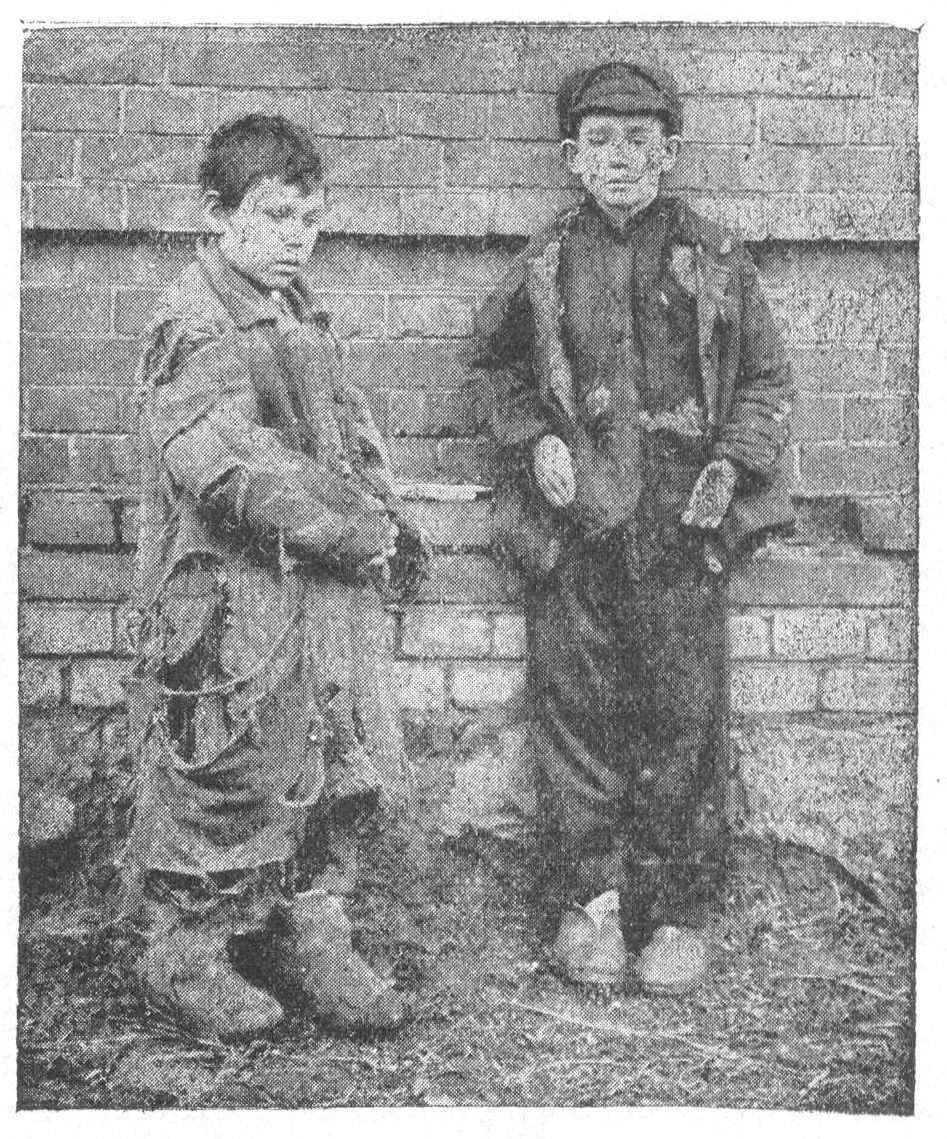
An image sourced to be of Russian street children in the 1920s. Source: Public domain, Журнал "Гость", 1927, №2 с.27 (Рига, Латвия), available here.
In December 1935, inspectors entered a Soviet children's home near Moscow and found a scene that looked, at first, like an ordinary story of shortage. The children had gone twenty-eight days without bathing. They had also gone twenty-eight days without a change of underwear or bed linen. Beds were packed tightly together. There were not enough cups, so tea was served in plates.
Then the inspectors opened the warehouse.
Inside were 1,100 clean sheets, 1,200 pillowcases, 1,300 towels and 300 coats. The institution had linen. It had towels. It had clothing. What it did not have was a functioning path from counted stock to children's daily lives.
That distinction matters. We often imagine scarcity as a simple absence: there is not enough of something, so people go without it. Soviet child-welfare records from the 1930s reveal a more complicated failure. Sometimes there genuinely was too little food, clothing, fuel or space. But sometimes the resource existed, had been purchased, entered into a ledger and stored - and still failed to reach the child for whom it was supposedly provided.
The Moscow inspection was not an isolated curiosity. In children's institutions in the Urals, records show that two internats had no toothbrushes at all, while children in another used toothbrushes collectively. At the same time, 300 new toothbrushes were sitting in a warehouse. Elsewhere, officials reported children remaining in dirty linen despite available funds and stocks of clothing.
A regional party resolution from 1934 described an even larger version of the same problem. Orphanages urgently needed clothing while coats, dresses and shirts were already lying in warehouses in their thousands. Some 16,000 metres of purchased cloth sat unused in Sverdlovsk. The document used an unexpectedly vivid expression: the cloth was, in effect, "marinating aimlessly" in the city.
The phrase is almost comic. The consequences were not.
By 1938, Ural records still showed severe deficits: thousands of children lacked winter coats, more than 11,000 pairs of shoes remained undelivered, and blanket provision covered only a fraction of recorded need. In one children's home, more than sixty children lacked coats while the director was accused of using warehouse leather to make himself a jacket and shoes for his wife. In another institution, children reportedly tore sheets into strips and wrapped them around their feet so that they could move through the snow.
The obvious temptation is to treat all of this as evidence that Soviet bureaucracy simply did not know what was happening. The archive suggests almost the opposite. The system often knew a remarkable amount.
The 1935 Moscow inspection recorded not only the children's living conditions but precise inventories. It also documented food losses: staff were accused of consuming provisions intended for children, and inspectors recorded a large gap between the official meat norm and what actually entered the cooking pot. The report travelled upward. Nikolai Semashko, the physician and former People's Commissar of Health who chaired the Children's Commission, personally forwarded the findings to senior political leaders.
The state could therefore see the failure. The problem was that seeing, recording and fixing were different administrative acts.
This becomes clearer when we follow the objects. A sheet could be purchased, delivered to a warehouse, counted in an inventory and reported as available. Every one of those steps generated evidence that the supply system was functioning. Yet none guaranteed that the sheet reached a bed, was washed, changed regularly or protected a child from cold and dirt. Administrative success could be registered before material provision was complete.
The same problem appeared in less spectacular objects. A spoon, a toothbrush or a pair of boots might seem trivial beside the grand themes of Stalinism. But they are useful precisely because they reveal where a system stopped working. In several children's homes, the absence of spoons and cups forced children to drink tea or soup directly from plates. A preschool orphanage in Perm requested twenty toothbrushes for forty children - effectively treating one brush for two children as an acceptable norm of shortage.
Sometimes improvisation became more desperate. In children's quarters at Ubozhenskoe in 1935, a lack of fuel reportedly drove children to burn coats, blankets, books and sheets in stoves to keep warm. The welfare system was literally consuming the goods intended to sustain the children.
Children's own words occasionally enter the administrative record. In August 1935, two boys in an orphanage in Sverdlovsk region complained that they were poorly fed, that lunch soup was "like water", and that basic hygiene was neglected. Their letter ended with a plea: "do not forget us in the deep taiga". An official examining the letter noted that it was useful material to work on.
That small bureaucratic response captures something larger. Distress became information. Information became a document. The existence of the document proved that the problem had entered the administrative system. What remained uncertain was whether the system could convert that knowledge back into food, heat, clothing or care.
This is why the history of Soviet scarcity cannot be written only from production totals or legal promises. The crucial question is often logistical: where did the chain break? A central authority could issue a norm. A factory could produce the goods. A warehouse could receive them. An inspector could certify their presence. Yet the child at the end of that chain could still be barefoot.
Nor should every failure be reduced to a single explanation. Some institutions faced genuine shortages so deep that no clever management could have solved them. Some records point to theft, corruption or incompetent directors. Others reveal failures of transport and distribution. The point is not that Soviet officials invented scarcity on paper. It is that their documentary machinery could sometimes treat an intermediate administrative achievement - allocation, stock, inspection, reporting - as if it were equivalent to successful provision.
The result was a peculiar form of bureaucratic abundance amid material deprivation. There could be more reports, more inspections, more tables and more precise inventories at exactly the places where children lacked basic things. Documentation did not necessarily conceal failure. Often it preserved the evidence of failure in extraordinary detail. But a record of a missing coat was not a coat.
That sounds obvious. Administratively, it is not. Large organisations routinely govern through proxies: a completed form stands for a completed process; an inventory stands for availability; a budget allocation stands for capacity. Usually those substitutions are useful. They allow institutions to operate at scale. The danger begins when the proxy becomes the endpoint - when the system proves to itself that something has happened because the paperwork says that an earlier stage has been completed.
The Soviet children's-home archive makes that danger unusually visible because the final test was so physical. A ledger might say that linen existed. A child's body could show that it had not arrived.
The most revealing Soviet shortage, then, was sometimes not an empty warehouse. It was a full one.
Author's note: This article draws on the author's archival research into Soviet child welfare and institutional provision in the 1930s. Translations from Russian archival documents are the author's own.
Ilias Konstantinidis is an independent researcher working on Soviet social history and institutional epistemology. His work includes a publication in Russian History (Brill), and he serves as a peer reviewer for an Elsevier journal. More at konstantinides.co.uk.
Found the piece of interest?
Join thousands of history readers getting occasional updates on new blog posts, books, and video releases — plus a free history book to get you started.
Join History Is Now here