
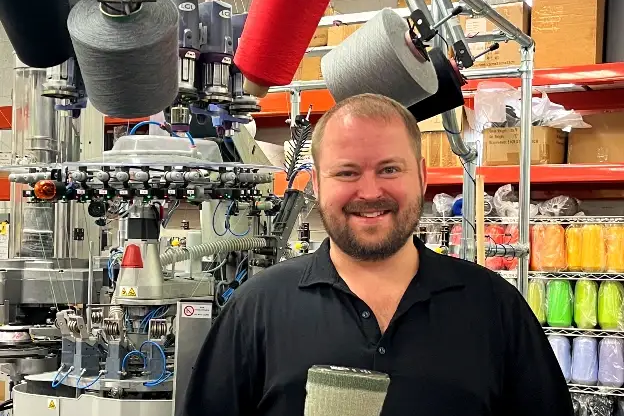
When Lawson Glidden gets back from a hike in the woods around Ashland, N.H., he doesn’t always head home. Sometimes he heads to the sock department.
“If my sock doesn’t fit just right, then when I get back from my hike, I go to the sock department, and I check in on our QC boards and make sure that the foot is fitting correctly,” he told Fortune.
Glidden, 39, is president of Minus33, a maker of merino-wool base layers, underwear and socks, and the latest incarnation of a textile business his family has run in Ashland since 1916. He wears what he sells, more or less head to toe. “We make this polo, we make the underwear I’m wearing,” he said on a video call. “… We don’t make the pants or the shoes. That’s all we don’t make right now.”
He also has opinions about what he sells.
“They are the best socks on the planet,” Glidden said. “I say that because not only am I incentivized to say it and I believe it, but also because it’s true.”
The numbers he cites aren’t modest either. Since he joined the company in 2018, Glidden said, profits have roughly quadrupled, and revenue is up about 2.5 to three times. The company’s PR pitch to Fortune billed this year as one of its highest-profit years. Minus33 is privately held, and Fortune could not independently verify the figures.
That’s a long way from where the family stood two decades ago. At its peak in the 1990s, Glidden said, the family’s mill was a $50 million operation with about 300 employees. By around 2002 it was, in his words, “a zero-dollar, three-person company.”
Glidden tells the story of how it got back up — and of nearly everything else — at length. At the end of the interview, he made an offer: “If you ever want to talk again, I can talk for days.”
‘If you put moose on it’When Glidden left tech consulting and came home in 2018, the first thing he did was buy sock machines and learn to program and run them. Minus33 started manufacturing in the U.S. in 2019. “I program and designed them all myself,” he said.
He thought socks were a solved problem. Then he got the machine.
“You’re like, wait a second, everybody else, they could have been making this good sock the whole time, and they just chose not to,” Glidden said. “I had the same sock-making machine as everybody else.”
There are a lot of ways to make a sock, he said. You can stuff it with synthetic material for durability. You can make it bigger, because a bigger sock looks meatier on the shelf and, he says, studies show it sells better. Or you can make it fit. His socks hug the foot “like a second skin that eliminates all the friction,” which lets him use less nylon and more wool, he said. He claims a pair has lasted the entire Appalachian Trail, worn every fourth day, without a hole.
The tradeoff is that they look smaller on the shelf, and plainer. Glidden is fine with that. The alternative, as he describes it, is some “business analyst sitting in New York, you know, saying, oh, if you put moose on it, it’ll be better. I don’t know.”
“We’re not as stylized or pretty as everybody else, but I think that’s fine,” he said. “I made them for myself. I’ve got sweaty feet, and I just kept making socks until I no longer got blisters and I was comfortable all day.”
His advice to other founders follows from that. “Use your product every single day,” he said. “If you use it every single day, then your customer’s complaints become your complaints. And therefore you’re just going to fix it yourself.”
‘I live where people go on vacation’Ask Glidden about his business, and he may start with the trees.
Ashland, a town of fewer than 2,000 people, sits roughly at the geographic center of New Hampshire, in the state’s Lakes Region. Squam Lake is five minutes away, he said. His favorite snowboarding mountains are 25 minutes away. Boston is an hour and a half down the highway. And the foliage, he informed Fortune in early October, is “the best foliage in the world right now.”
“Yes, I live where people go on vacation,” he said.
He spent about eight years in Worcester, Mass., including his time at Worcester Polytechnic Institute, and doesn’t plan on going back. Down there, he said, it’s houses, then some trees, then houses. “But up in New Hampshire, it’s a house, an entire forest of trees, another house, an entire forest of trees, and I just don’t know if I could go back,” he said. “I can’t give up on my trees.”
Before he came home, he was a senior technical consultant for a regulatory-software company, doing database work for big telecom companies that needed to report data to the government monthly instead of yearly after a change in the law. He was working 80-hour weeks. One year he did the math and figured he’d spent the equivalent of a full month — 24 hours a day, 30 days — on airplanes.
In 2018, his father called and asked if he wanted to come work at the family business.
He did. Two years later, he was president. Asked whether being a fifth-generation member of the founding family gave him an inside track, Glidden didn’t argue.
“I do have an inside track,” he said. “But like all generational companies, they start up here, and then they go down.”
Broadcloth, cashmere and a shotgunIn 1916, his “dad’s dad’s dad’s uncle,” as Glidden puts it, bought up buildings in Ashland and started the L.W. Packard Mill. For roughly 82 years it made wool broadcloth — in the same building where Glidden works today — and sold it to garment makers in New York who turned it into suits and overcoats.
In the 1990s, Glidden’s father, a textile engineer, took the business into cashmere, a fiber that cost about “a hundred dollars a kilo,” Glidden said, and that few companies were willing to risk processing. “We became a $50 million company in the ’90s because my father took the technology to basically make cashmere,” he said.
Then the bottom fell out. As apparel production moved overseas, the New York customers disappeared. “Everyone that bought wool from us … and sewed it into beautiful suits and pea coats and stuff, they stopped doing that, and therefore they stopped buying from us,” Glidden said. The suppliers that had processed wool and cashmere and shipped it in bulk to the U.S. pulled back too. The company was cut out from both ends.
Ashland had plenty of company. U.S. textile mills employed about 500,000 people in January 1990, according to Bureau of Labor Statistics data. By January 2002, that was down to about 298,000, and by early 2026 it was under 80,000. Apparel makers got hit harder: employment in apparel manufacturing fell more than 80% over two decades, from about 900,000 jobs to 150,000, the BLS reported in 2012.
Fortune asked Glidden why some American manufacturing towns reinvented themselves, and others didn’t. He credited his father’s classic New Hampshire-style bloody-mindedness. “He essentially just … took out the shotgun and shotgun five or six companies out there”: joint ventures overseas, a steam laundry, snowmobile jackets. One idea came from an overseas supplier who could make high-quality merino wool that held up in a washing machine. His father made some for his hunting buddies. They told him to sell it. Minus33 grew by word of mouth for about 15 years.
“The wool base layer, it just turned out, was something that we were really good at,” Glidden said. “I always say it’s better to be lucky than good, but it’s better to be lucky and good.”
‘Congratulations, you found us’Asked to name the three biggest things he did to prove himself, Glidden dodged the question. “Well, I won’t just say marketing three times because that’d be cheeky,” he said. “But I could and I’d still be right.”
When he arrived, he said, Minus33 had two textile engineers, five generations of wool knowledge, and a QC operation that shows partner mills how to do things its way. It was operating almost entirely as a B2B network, and almost nobody knew it existed.
“I like to say that our website could have just been, ‘Congratulations, you found us,'” Glidden said.
He built the marketing in rungs: pay-per-click advertising in 2019, a rebuilt website in 2020, more advertising on third-party marketplaces. On Amazon, he moved the company out of the program where the platform buys inventory and resells it, and into the one where Minus33 owns the inventory, and Amazon sells it. That change, he said, raised profitability “by a lot.”
“Instead of being at the whims of Amazon and Walmart and Target and whatever they decide for their purchase, you can decide what’s for sale, what the advertising is,” he said. “We took control of everything.”
Minus33 sells through about 700 independent retailers, but none of them can sell the brand on its own website. Glidden says that hurts the brand and leaves customers with nowhere consistent to go for help. “You have a centralized customer service,” he said. “That way, you can take care of your customers better and get that returning business.”
Social media was the last rung, and he admits the company is still climbing it. Minus33 has hired outside social-media firms. The problem, he says, is the product. “We just kind of make a life-saving, the best product you can wear in the wilderness to be comfortable,” Glidden said. “And it’s hard to just keep saying, ‘Hey, we still sell underwear. We sell underwear. We’ve been selling underwear. You love it.'”
He’d happily keep saying the socks are the best, but his marketing team has told him everybody hears that. “And I’m like, I don’t know,” he said. “Can we make them believe mine are the best? How do I say it in a different way?”
The PR push is part of the same ladder. Fortune pointed out that Glidden had recently talked to Forbes and was now talking to Fortune. “We did a little bit of PR, and then we did a medium amount, and now we’re doing a lot more.”
Better to be lucky and goodFor all the bragging, Glidden runs the company like someone who remembers 2002.
“We don’t do business where we have to borrow money ever,” he said. “Like, if you have an idea and we have to borrow money for it, we won’t do it.”
He prefers many small bets, sized so a miss never means a layoff. Plenty of them miss. One ad campaign tested whether a set of magazines could sell Minus33 gear. They couldn’t. “Let’s spend 20 grand on that and find out that we shouldn’t have done that,” he said. “But now we know.”
“I’m willing to be wrong, like 70% of the time, as long as on aggregate, we’re moving in the right direction,” he said.
His best-timed call was about inventory. In 2019 he set a rule: “You can’t double the size of the company if you don’t have … two years’ worth of inventory.” Then COVID hit, competitors ran out of product, and Minus33 doubled in size. “It just, it gets lucky,” he said.
Asked what has surprised him most about running the business, Glidden said it was how obvious everything turned out to be. “It just seems like every decision we make is just the logical one,” he said. “I thought it’d be hard.”
How does he decide? “Ah, gosh, I stare at a lot of walls, and I go for a lot of hikes, and I cannot make my mind be quiet,” he said. Then he moves things around and watches what happens. “It’s all kind of just a fun game that I play where you just kind of move things and watch the numbers go up, you know?”
72 shareholders and a rocket shipThere’s no venture capital board to answer to. 72 individual shareholders, most of them family, get dividends based on their stakes. Glidden owns about 5%, he said, after working to increase his share. Every year, the shareholders nominate him to the board, and the board elects the president.
“So, it’s old-fashioned,” he said. “But at the same time, you don’t make critical mistakes when you’ve got people watching over your shoulder.”
Twenty years ago, he said, many of those shareholders figured the company was going away. Now returning customers grow every year by “30% or whatever,” Glidden said, and the family is thrilled.
“I don’t believe I could do anything to lose their adoration and love at this point,” he said. “Now it’s coming back like a rocket ship, and they’re all just ecstatic that they get to hand off these shares to their kids again, as opposed to them just going away.”
His explanation for why old companies survive is a lot shorter than his answers usually are. “Make the product as good as you can, offer it for a fair price and a good value,” he said. “And then you’ll just have customers for the rest of your life.”
None of this has changed how he lives, Glidden said. He hunts, fishes, snowmobiles and snowboards. When the weather is bad, he plays video games and works on spreadsheets. “It’s really annoying how cheap all my hobbies are,” he said.
His tip for entrepreneurs who want to clear their heads: “I would recommend finding the trails that have almost no ratings.” His brother finds the best ones, little-known trails where, by the brother’s account, he has hiked a mountain 15 times with his two dogs without seeing another car or person.
Glidden wouldn’t name any of them.
“I can’t tell you that without betraying the trust of my brothers,” he said.
Generative AI was used for research assistance and/or transcription of this article. The reporter independently reported and verified the factual claims in this article, and a human editor reviewed it before publication.
This story was originally featured on Fortune.com