
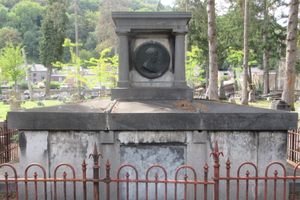
Angleur is a neighbourhood in the south of Liège. It is a one-hour-and-15-minute drive west of Brussels. The area itself is not particularly interesting; it is a residential neighbourhood located between Sart-Tilman Hill and the railway lines in the Ourthe Valley. However, visitors may be surprised to discover two castles amongst the houses: Château Péralta and Château Nagelmackers. The latter was purchased in the 19th century by the renowned Belgian banking family Nagelmackers. They also donated a plot of land in 1864 to create the town’s new cemetery, the Diguette Cemetery. It is therefore no surprise to find the family grave there.
The engineer and industrialist Georges Nagelmackers is among the family members buried there. He founded the Compagnie Internationale des Wagons-Lits and the original Orient Express. However, achieving this success was far from plain sailing. In fact, things got off to a rocky start: in 1867, his father sent him to the United States to hide away after he expressed his desire to marry his cousin. During his time there, he became interested in Pullman's night trains, and to develop the idea further, he also gathered feedback from passengers with a view to creating an improved version. He returned to Belgium convinced he had a brilliant idea. However, as soon as he returned, he was put in charge of the family's blast furnaces and mine. While working there, he developed his project and, in April 1870, published an explanatory brochure in which the term 'sleeper carriages' ("wagon-lit") appeared for the first time. Unfortunately, the Franco-Prussian War broke out in July 1870, dashing any hopes of bringing the project to fruition. Furthermore, his family were hostile to the project and cut him off financially.
However, Georges Nagelmackers did not allow himself to be discouraged. Thanks to the support of King Leopold II of Belgium, he managed to run the first sleeper carriage he had built between Paris and Vienna in November 1872. This inaugural journey was a success. However, after several advances, financial difficulties began to mount up once again.
While he was in London looking for funding, he had a fateful encounter with the American Colonel William D'Alton Mann. Mann had filed a patent for a 'sleeping carriage' that differed from the Pullman design, but this too had failed to catch on. The two men joined forces and founded the 'Mann’s Sleeping Carriage Company' on 4 January 1873. They invented a carriage whose compartments opened onto a side corridor, providing access to toilets at the end of the carriage — a design still used in sleeper carriages today. Mann persuaded the Prince of Wales — the future King George V — to travel to his brother's wedding in Saint Petersburg in one of these carriages. This publicity ensured the company's initial success.
On 4 December 1876, the two partners established the International Sleeping Car and European Express Company. As King Leopold II had contributed financially to this project, the two lions that flank the Belgian national coat of arms were added to the company's logo.
1883 was a turning point for the company. Mann returned to the United States and sold his shares to King Leopold II. Meanwhile, Georges Nagelmackers extended the Paris–Vienna line as far as Constantinople (which would not take the name 'Istanbul' until 1930). He named this new route the 'Orient Express' – and so began the legend.
Nagelmackers died on 10 July 1905 at his château in Villepreux, near Versailles, France. Following the funeral, his body was taken back to Belgium and buried in the family tomb at Diguette Cemetery in Angleur. His name has now been all but forgotten. Few people know that this grand tomb in a small, unassuming cemetery is the final resting place of the man who created the legendary Orient Express.