
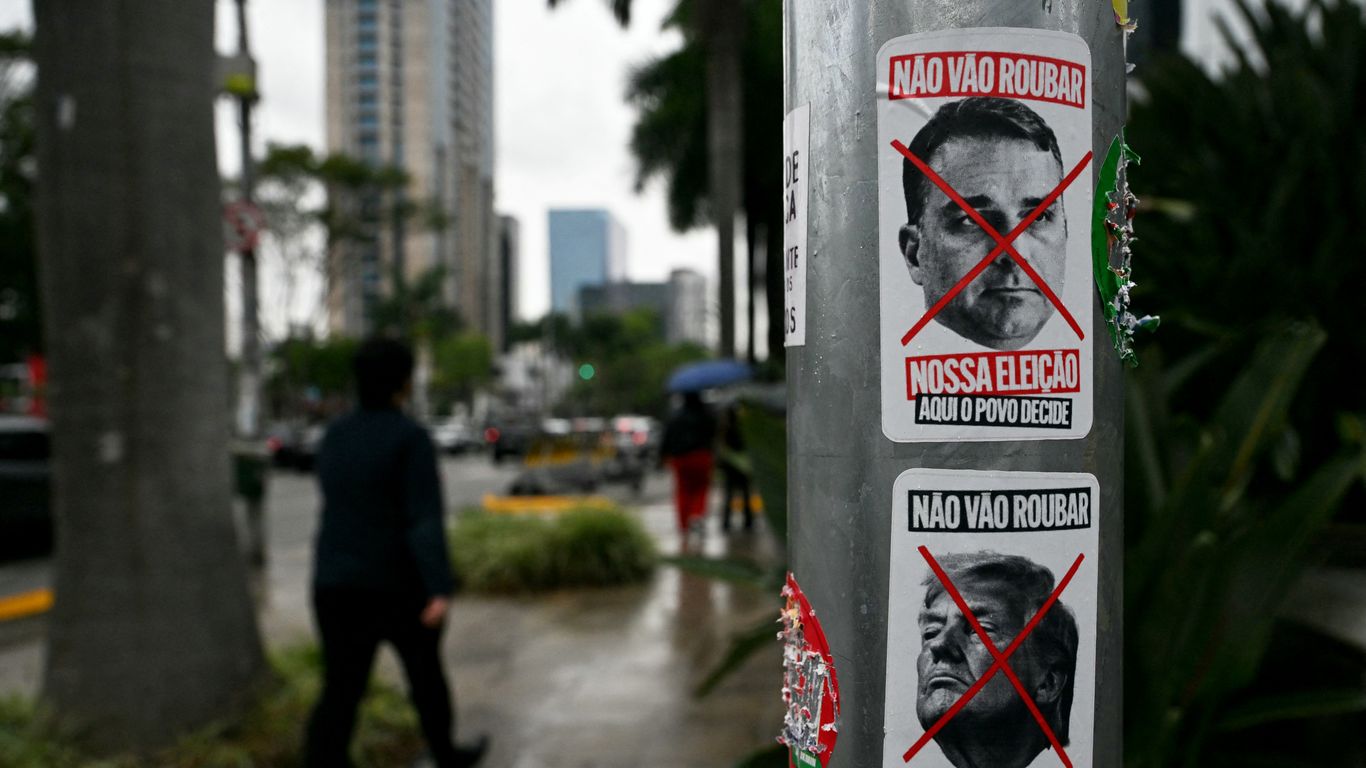
A pair of Trump-friendly right-wing populists took a one-two punch Sunday: Brazil rejected a Bolsonaro comeback, and Serbia toppled a strongman's ruling party.
The big picture: Brazil denied Trump a close ally at the helm of Latin America's largest economy, snapping a streak of seven straight conservative wins in the region. In Europe, Serbia and Hungary toppled leaders with close Trump ties who had dominated their countries for years.
- Now, another massively pivotal election looms Tuesday, when Trump ally, Israeli Prime Minister Benjamin Netanyahu, will face a battle for political survival.
- On the eve of the election, Netanyahi touted Trump's endorsement and his "friendship" with the American president. But as the global right has made gains, opposition forces proved this weekend that they still have fuel.
Driving the news: In Brazil, leftist President Luiz Inácio Lula da Silva staved off a challenge from Flávio Bolsonaro, the son of former President Jair Bolsonaro.
- The younger Bolsonaro, widely seen as the heir to his father's populist movement, refused to concede and called for the results to be annulled, according to translations.
- The elder Bolsonaro is serving a 27-year sentence after being convicted of plotting a coup to overturn his 2022 loss. Trump has called the prosecution a "WITCH HUNT."
- The White House did not immediately respond to Axios' request for comment on the race.
Between the lines: Brazil's election emerged as a test of Trump's political influence in Latin America, where right-wing and Trump-backed candidates have celebrated an uninterrupted series of wins.
- Those victories include Trump-endorsed Abelardo de la Espriella in Colombia, Nasry "Tito" Asfura in Honduras and José Antonio Kast in Chile.
- Trump did not formally endorse Flávio Bolsonaro, but he met with him earlier this year and imposed ignificant tariffs on Brazil as he protested the charges against Bolsonaro's father. Lula is a vocal Trump critic.
- In March, Flávio Bolsonaro told an audience at the Conservative Political Action Conference that America faced a "fork in the road" in the election: "Either you have the most powerful ally in the hemisphere, or an antagonist."
Zoom out: Meanwhile, across the Atlantic, a student-led opposition movement toppled the right-wing party of long-serving strongman Aleksandar Vučić, who was seeking to become prime minister.
- Unlike the Bolsonaros, Vučić conceded defeat Sunday.
- The Balkan leader had courted Trump's inner circle, including Donald Trump Jr., and described the president as a "kindred spirit."
- It reflects the shifting tides that also allowed next-door Hungary to oust Trump-allied Viktor Orbán, once one of the Western world's most entrenched populist leaders, in April after 16 years in power.
Yes, but: Europe's political upheaval is cutting both ways: While the populist right has fallen in Serbia and Hungary, it's gaining ground in two of the continent's largest economies.
- In France, far-right presidential frontrunner Marine Le Pen launched her 2027 campaign this weekend, seizing on nationwide unrest to pitch her tough-on-crime, anti-migrant agenda.
- In Germany, the far-right Alternative for Germany won a record 44% in a state election last month and continues to lead in national polls.
What we're watching: Trump's historic move of endorsing Netanyahu in Tuesday's Israeli elections will once again test his influence abroad.
- Tuesday's election in Israel is set to be tight for Netanyahu, who has sought to elevate Trump's endorsement as he jockeys with former Israel Defense Forces Chief of Staff Gadi Eisenkot.
- The 77-year-old Netanyahu has been prime minister for some 19 years in nonconsecutive terms. Analysts see the election as a referendum on the security failure of Oct. 7, 2023, that killed around 1,200 people.
- Whoever governs Israel could shape Trump's next moves in the Middle East — including whether to escalate the war in Iran.
Go deeper: Lula v. Bolsonaro: Brazil election unfolds in Trump's shadow