
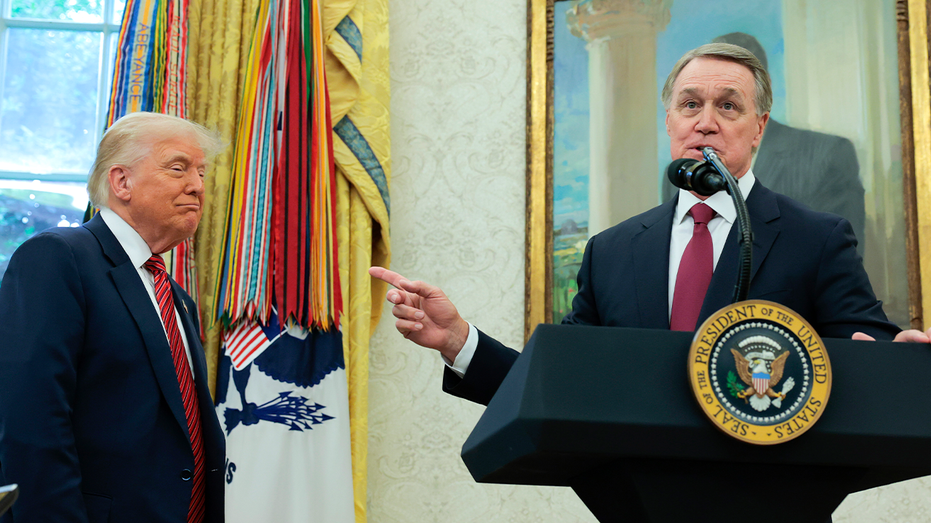
U.S. Ambassador to China David Perdue is warning that Beijing has "weaponized" its dominance over critical minerals, saying China has expanded its rules to the point that efforts to diversify supply chains away from the country could expose people to arrest, criminal prosecution and asset seizures.
"This is a single-source dominant position that China is weaponizing against the world right now," Perdue told "Fox News Sunday."
"We have committed to them that this is unacceptable."
GOV MIKE DUNLEAVY: CHINA IS HOLDING CRITICAL MINERALS HOSTAGE. ALASKA CAN HELP END THE THREAT
Perdue pledged that the U.S. will not kowtow to China to do business, arguing that America's dependence on Beijing for critical materials has been decades in the making.
"Twenty years ago, the United States had single-source dominant positions in rare earth magnets, commercial shipbuilding [and] pharmaceuticals," Perdue added.
"And all these have been absconded by China in a way that we allowed over the last 20 years."
Now, he said, the Trump administration is seeking to reverse that dependence and rebuild America's ability to operate without relying on Beijing.
WEST VIRGINIA UNIVERSITY RESEARCHERS TURN POLLUTED MINE WATER INTO CRITICAL RARE EARTH MINERALS
"President Trump has stood up now and said, ‘Enough. We're going to defend America now. We're going to be independent.’"
Perdue's warning comes as U.S. Trade Representative Jamieson Greer separately raised concerns about China's rare-earth deliveries, saying the U.S. wants the critical materials in "greater volumes" and in a "more timely way."
"That's something that we continue [to] work on. President Trump raised it with President Xi quite directly, and that's just one of many items that we're still looking at," he told Fox News' Jacqui Heinrich.
Greer said the Trump administration is treating the next two months as a "compliance period" to assess whether Beijing follows through on its commitments.
Separately, the U.S.-China Board of Trade recommended Sunday that each country identify $30 billion in nonsensitive goods that could receive more favorable tariff treatment, according to Greer's office. USTR said the administration would also continue working to ensure China complies with its agricultural and energy commitments.