
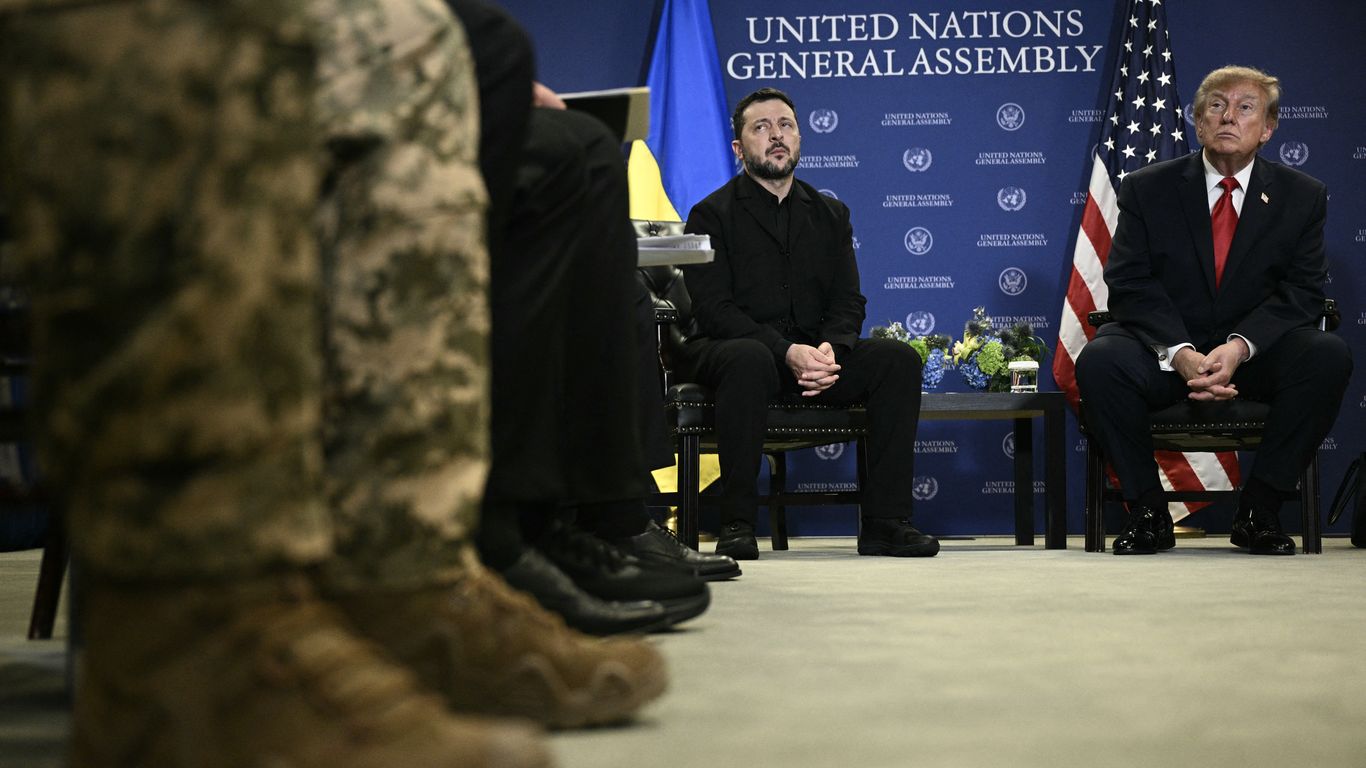
President Trump decided to make a diesel fuel deal with Russia after Ukrainian President Volodymyr Zelensky ignored half a dozen U.S. requests to stop attacking Russian oil refineries, a U.S. official with direct knowledge told Axios.
Why it matters: Trump's deal with Russian President Vladimir Putin sparked a new crisis with Ukraine and threatens to derail a new push by the Trump administration for a deal to end the war.
- "Zelensky is misreading the room. By continuing to hit refineries, he is eroding the good will that he has built with Trump over the last six months," the U.S. official said.
- Zelensky, in an interview with Axios after the announcement, said he was blindsided by the deal, which he called "not fair and not honest" and an unwarranted gift to Putin.
Driving the news: Ukraine's strikes on Russian oil refineries in recent months were highly effective and caused an energy crisis in Russia.
- Russia imposed a ban on diesel exports in response, which added more pressure to global diesel markets under strain from the war in Iran.
- Zelensky told Trump and his envoys Steve Witkoff and Jared Kushner that he was prepared to stop attacking Russian oil refineries if the Russians halted attacks on Ukrainian power plants.
- The U.S. official said Trump wanted Ukraine to unilaterally stop attacking Russian refineries because the strikes were contributing to high gas prices in America.
- Trump didn't see the attacks on refineries as equivalent to Russian strikes on Ukraine's power grid, the U.S. official said.
Inside the room: During eight hours of talks in Miami on Friday, Witkoff and Kushner told a Ukrainian negotiating team that the president was expected to speak to Putin and lift sanctions on Russian diesel exports.
- They were told that Trump decided to move forward after Ukraine ignored multiple requests to stop strikes on Russian oil refineries, which were directly affecting U.S. consumers.
- A Ukrainian official claimed that during the talks, Witkoff and Kushner threatened that Trump could cut off Ukraine from U.S. intelligence if it continued to ignore his requests.
- The U.S. official denied such a threat was made and said Witkoff and Kushner told the Ukrainians that the U.S. was a strong partner, providing munitions and intelligence. Ukraine therefore shouldn't take actions that hurt American consumers, Witkoff and Kushner said.
- "The attacks on the refineries cause pain in Russia, but it causes pain for the U.S., too," the U.S. official said.
Zoom in: The official said the new crisis over the diesel deal erupted after the U.S. mediators had constructive talks with Ukrainian and European diplomats in Miami on Friday.
- The main focus was on finalizing security guarantees that the U.S., Europe and NATO would provide to Ukraine as part of a deal to end the war.
- New proposals for territorial solutions were also raised.
- Witkoff and Kushner presented a postwar package for Ukraine that included ways to fund reconstruction and rebuild the Ukrainian military, as well as ideas on how to deal with budget deficits stemming from the war.
- The participants also discussed a roadmap for Ukraine's accession to the EU and the relationship Ukraine would have with NATO after the war ends.
- In addition, Witkoff and Kushner raised the possibility of a Europe-Russia postwar security framework that could appeal to both sides.
What to watch: Witkoff and Kushner briefed the Ukrainians and Europeans on potential energy deals with Russia that the U.S. hopes would bring down energy prices and induce Russia to make concessions in peace talks, the U.S. official said.
What's next: The U.S. official said Witkoff and Kushner are considering visiting Moscow and Kyiv next week to discuss peace proposals, but it's unclear how Friday's blowup will affect their plans.
- "Putin is hitting [Ukraine] hard but we think he is open to a discussion on ending the war. We want to work on a new proposal that will be good enough for him in order to get him to stop," the U.S. official said.
Yes, but: During his 90-minute phone call with Trump, Putin declined to commit to resuming peace talks with Ukraine, his foreign policy adviser Yuri Ushakov told reporters.
- He said that Ukrainian strikes on Moscow and other cities during the Russian parliamentary elections "thwarted the possibility of an immediate resumption of the negotiation process."
- "The president said, we will think about when these negotiations can be resumed," Ushakov added.