
“I think it’s great that so many other beauty categories are moving toward accessible design, but it feels like fragrance is a little late to the party,” says disability advocate and fashion creator April Lockhart.
While brands like Tilt Beauty are advancing accessibility in cosmetics and skincare with ergonomic packaging, the fragrance space has fallen short—with a few exceptions. I connected with Lockhart and fellow disability advocate and model Maya Moore, along with occupational therapists and brand executives championing these initiatives, to discuss how intentional inclusivity benefits everyone and which products are breaking the mold.
(Image credit: @onehandedoverdressed)Accessibility in Fragrance: The GapsAs a spokeswoman for accessibility in fashion, Lockhart notes the lack of inclusivity when it comes to outfitting her scent wardrobe: "As a disabled woman who was born with one hand, I’m used to adapting—and that’s no different with applying fragrance. But a truly accessible product [shouldn’t] require [a] workaround." Workarounds typically include assistive technology like a non-slip mat, grip tape, or custom attachments, which can be tedious, difficult to source, and often unattractive. "For me, [accessibility] means being able to put the perfume on with one hand. I can open it, hold it, and use it in one go, and it still looks like something I'd want on my dresser. Right now, that's rare.”
(Image credit: @aprillockhart)Disability also doesn't manifest in one way; it looks different for each person and can vary in level of capability at different times. For example, when it comes to fragrance application, "there are several potential barriers: picking up a smooth or heavy bottle, removing a tight cap, identifying which direction the nozzle faces, and pressing the spray button while maintaining a secure grip," notes New York–based occupational therapist Frank Lombardo, OTR/L. "Someone with weakness may struggle to generate enough pressure, while someone with reduced sensation may have trouble knowing whether the bottle is slipping from their hand. Limited shoulder movement or coordination can also make it difficult to position the fragrance where they want it,” he continues.
Intentional Inclusivity Over WorkaroundsWhile some brands do have inclusive features (more on this later), emphasizing intentional inclusivity is key. “When accessibility is considered from the beginning, people have more opportunities to use products independently and with less effort or frustration,” Lombardo says.
A shining example of this is Rare Beauty, which has inclusivity embedded in its foundation. Founder Selena Gomez has been vocal about her own dexterity limitations and desire for “packaging that’s easy to open, hold, and apply,” as Rare Beauty’s chief brand officer, Joyce Kim, puts it.
In 2024, the brand even launched its Made Accessible Initiative, which partners with the Casa Colina Research Institute to identify key design features that make a product easier to use. Months after this partnership began, Rare launched its first fragrance, which features "an oversize actuator that allows users to press down using multiple fingers, an entire hand, a fist, or even the forearm rather than a standard index finger, plus a twist-to-lock mechanism," describes Kim.
Despite the arduous process to hone the packaging, feedback from the disability community was overwhelmingly positive. Moore, for one, points out that Rare Beauty is in “a league of their own,” noting that it matters to see “disabled [individuals] not only at the table but in places of leadership.”
Moore also shares a good reminder: “It's not just perfume.” Fragrance is a ritual. Much like makeup and fashion, perfume is an expression of self. It is a mood changer. It is confidence-instilling. To put it dramatically, it is an act of free will. Today, I want to smell like roses in a meadow. Tomorrow, I wish to be windswept on a beach with notes of peach and vanilla.
When confronting a product that creates more barriers than it breaks, Moore questions whether she can participate in the ritual at all, asking, “Is it me?” This is when internalized ableism surfaces, and frustration gives way to disappointment in the industry and, misguidedly, in oneself as well.
(Image credit: @onehandedoverdressed)“A bottle that’s easier to use is simply a better bottle for everyone,” Kim continues. Disability drives innovation and in turn benefits the collective; this is evident in something as overlooked as the sidewalk slope—what some might take for granted is a necessity for others.
Atomizer vs. Roll-On vs. Solid PerfumeLet’s talk more about applications for a moment. A signature scent is found only through wear tests and experimentation, but, as Moore reminds me, if “getting it open is half the battle,” how do you discover that trademark?
“Each format places different demands on the user. Sprays avoid direct skin contact but require aiming and enough force to activate the pump," says Lombardo. “Roll-ons eliminate that pressing step. Although, the person still needs to remove the cap, maintain a grip, and reach the application site. Solid perfumes can reduce concerns about spilling liquid and allow controlled application, particularly in a stick format. However, a small tin, tight lid, or stiff twist mechanism can create a new barrier."
(Image credit: @ioziefina)It is a game of trial and error that, for Moore, often ends in frustration. Before you can even discover if you’re a gourmand girlie, it’s first a question of application. What if your favorite scent doesn’t come in your preferred application? For Lockhart, this is a directive to “offer each scent in more than one format, like a spray, a stick, or a roller.”
Brands to HighlightSo who’s doing it right? Rare Beauty takes the lead, no doubt about it, with a handful of brands on the horizon, all with the building blocks for change. In conversations with advocates and occupational therapists, these are the brands that dominated our discussion.
To be clear, no universal recommendation exists. How someone interacts with fragrance is unique to their needs. But consider this an invitation to rethink how you engage with perfume packaging and discover the next accessible addition to your scent wardrobe.
Rare Beauty
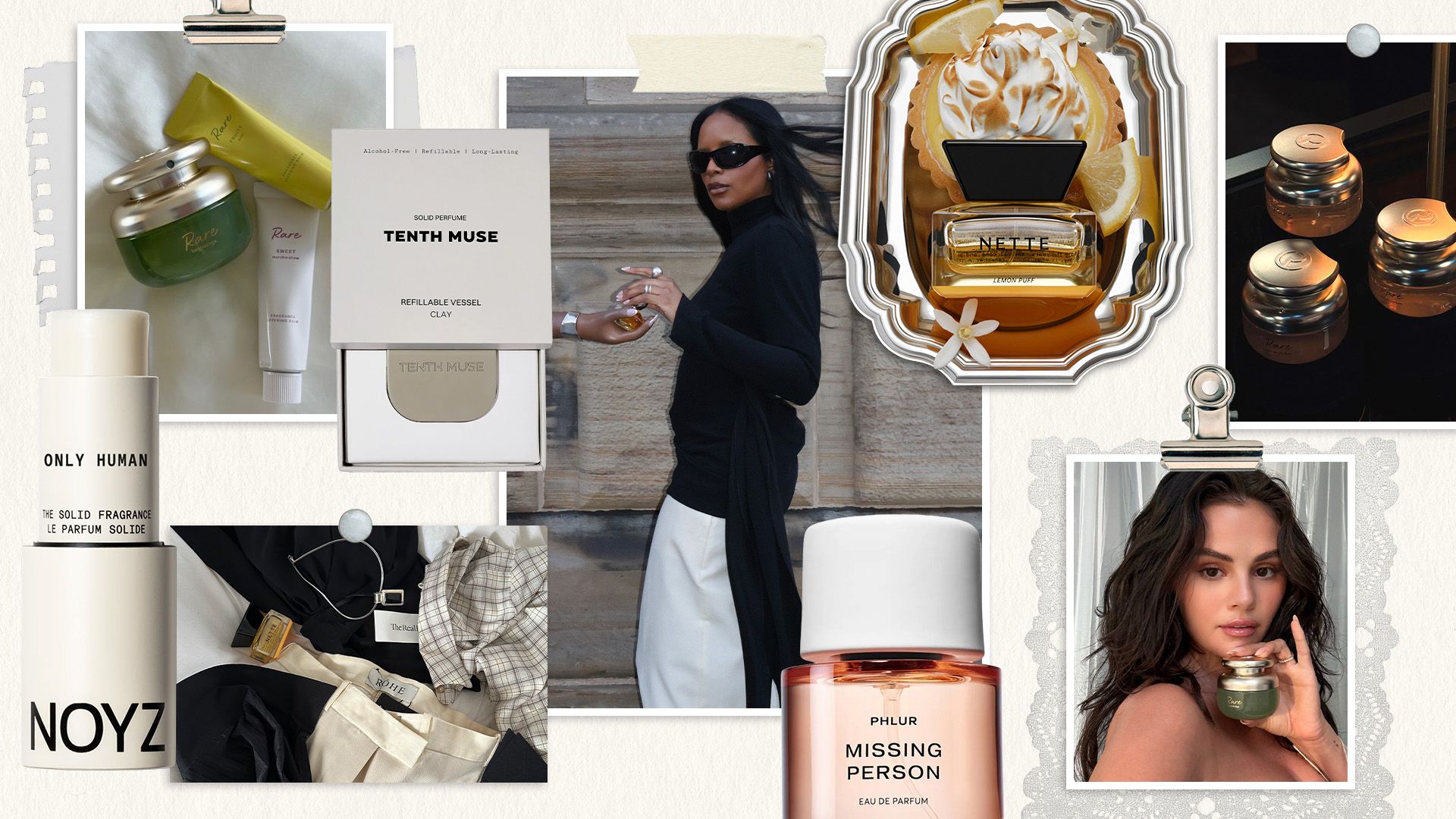
Rare Beauty Rare Eau de ParfumAccessible features: Ergonomic bottle, oversize pump, no decorative cap
Says Lombardo, “Rare Beauty by Selena Gomez is a strong example of intentional accessibility. The brand reports working with certified hand therapists and packaging engineers on its packaging and bottle, which features an oversize pump and a shape designed to support a secure grip. Those features address some of the specific demands I would assess clinically.”
The celebrated innovation now comes in two scent profiles with the vanilla and caramel Rare Eau de Parfum and Rare Beginnings with notes of pear and gardenia. Rare Beauty’s fragrance collection also features six layering balms that can be worn alone or used in combination with the eau de parfums.
Nette
Nette Lemon Puff Eau de ParfumAccessible features: Flat base, trapezoidal cap
Lemon Puff Eau de Parfum is the second Nette fragrance in Moore's collection, followed by Mochi Banane Eau de Parfum. She spoke highly of its stable base and trapezoidal cap, noting that she can “get a pretty good grip” compared to the many smaller, smooth caps on the market.
Cécred
CÉCRED Temple Oud Hair PerfumeAccessible features: Flat base, bowl-shaped cap
Pediatric occupational therapist and inclusive beauty educator Kailey Waskall, MOT, OTR/L, documents accessible beauty products and tools in what she calls the Accessify Database. The Cécred Temple Oud Hair perfume makes the list, as she calls out the “cap that looks like a bow,” which she describes as “easy to grasp and pull off” in the database.
Noyz
NOYZ The Solid Fragrance Only HumanAccessible features: Magnetic cap, solid stick formula
When discussing solid formats, Moore sent over Noyz The Solid Fragrance. Waskall also includes it in her Accessify Database and tells me, “I really like the Noyz solid perfumes.” While it features a magnetic cap and a solid stick formulation, it requires a twisting motion to expose the balm.
“Magnetic caps are a lot of times easier to get off. You don’t have to use as much strength, because that seal breaks a little bit easier” as opposed to a traditional friction-snap closure, Waskall points out.
Phlur
PHLUR Missing Person Eau de ParfumAccessible features: Magnetic cap, flat base
On the topic of magnetic closures, Phlur takes the cake. “They definitely deserve their props for the magnetic cap!” Moore tells me. However, after you remove the topper, you are left with the inaccessible press-and-spray nozzle.
Miss Dior
Dior Beauty Miss Dior Eau de Parfum Roller-PearlAccessible features: Flat base, engraved bottle, roller-ball applicator
Lombardo highlights how “its glass-bead applicator removes the need to press a spray button, and the engraved bottle provides a potential tactile landmark,” mentioning, “a patient of mine actually brought hers in, and obviously I was able to see it used in real time, so I started recommending it.” However, he is clear that this isn’t a universal recommendation—that it has “potentially useful features.”
Violette_FR
violette_fr Avec AmourAccessible features: Flat base, roller-ball applicator
When it comes to roll-on, “the one that comes to mind for me is the Violette_FR, which is Avec Amour,” shares Waskall. While it isn’t entirely accessible, it is a full-size roll-on. Waskall says it's an application where “you are just not using as much strength,” and the direct-to-skin application allows you to “almost use [it] as a guide of where to put it.”
'Ôrebella
'Ôrebella Vanilla's Touch Body & Hair Perfume MistAccessible features: No decorative cap, built-in actuator
In our conversation, Moore brought up Bella Hadid and her fragrance brand, 'Ôrebella. When looking at the brand, I noticed that, unlike its parfum, the body and hair perfume mists use no cap and include a wider-surface actuator—this is exactly what Lombardo asks of future packaging innovation: “I would like to see more low-force pumps with broad pressing surfaces, lightweight bottles with stable bases, and closures that can be managed with one hand.”
Lush
lush Sex Bomb Body SprayAccessible features: No decorative cap, flat base, pull-in trigger bottle spray
Another fragrance in Moore’s collection is the Lush Sex Bomb Body Spray, which features a squeeze trigger that makes it “incredibly easy to use,” she notes. It is also an example of no-cap packaging.
Waskall explains “that [the] pull-in dispenser is a lot easier because it’s positioning your hand in a way that increases the amount of strength that you can use and decreases the amount of dexterity you need to trigger [it].”
Tenth Muse
Tenth Muse Refillable VesselAccessible features: Magnetic closure, wide-lip lid, solid fragrance formula
Tenth Muse specializes in solid perfume formulas, with a refillable vessel and stick applicator. On the phone with Moore, we discussed various solid containers and their unique barrier. What intrigues her about the Tenth Muse one is its wide-lip opener, which she imagines would make it easier to access. We also discussed the limited independence of a refillable option, where you would need to rely on another person to help with the dropping and refilling process.
Glossier
Glossier Glossier You Solid PerfumeAccessible features: Swing top with hinge, solid fragrance formula
“I’ve heard that solid perfume is an accessible favorite in the disability community,” shares Lockhart, suggesting the “beloved” Glossier You Solid. “It is a flat kind of pebble that you push open, and you can open it with your palm,” shares Waskall, pointing out, “you are going to have to really rub that on your fingers and then get that on your body versus just going to stick to your body,” like you would with the Noyz solid product.” It is all about finding a balance and what works best for you.
The Future of Accessible FragranceFragrance is an experience, and right now, inaccessible design limits who can participate in the universal ritual of smelling good. Looking ahead, Lockhart points out a few packaging must-haves: “A cap I can get off with one hand. Magnetic is the dream. A big pump that doesn't need much pressure. A bottle with some shape to it so I can actually grip it. (A perfectly smooth glass cube is my nemesis.) And yes, I still want it to be beautiful.” Lombardo’s sentiments are similar. Though, he would add “a raised marker indicating spray direction" to the wish list.
(Image credit: @selenagomez)Accessibility in fragrance also takes other forms outside of its tactile experience. Marketing is one. Visual disability advocate Belle Bakst asks for large-print fonts and high-contrast color pairing in graphic design. Waskall also requests that product weight be included in descriptions and that visual aids showcase the full breadth of a product, from open to application to close.
For Caroline Ornst, senior director of fragrance development at DSM-Firmenich, accessibility also shows up in the scent profile itself. “This has been going on for a really long time in the niche and alternative perfumery space, where fragrance scents are more gender neutral,” Ornst shares. Notes labeled as traditional women’s, like florals and gourmands, are entering men’s fragrances. Woody profiles, commonly categorized as male scents, are growing in popularity among women. “What you like is what you like, so nobody needs to put a label on it,” she concludes.
Disability doesn’t present itself one way, and neither should inclusivity. Accessible design is about agency—giving options and fostering independence. And, well, it’s just good business. According to The Arthritis Foundation's 2024 Ease of Use Study, “more than half of consumers with arthritis and over a third of general consumers avoid repurchasing products due to packaging difficulties." Make a product that consumers enjoy and that's built for everyone—regardless of ability—and they'll return.