
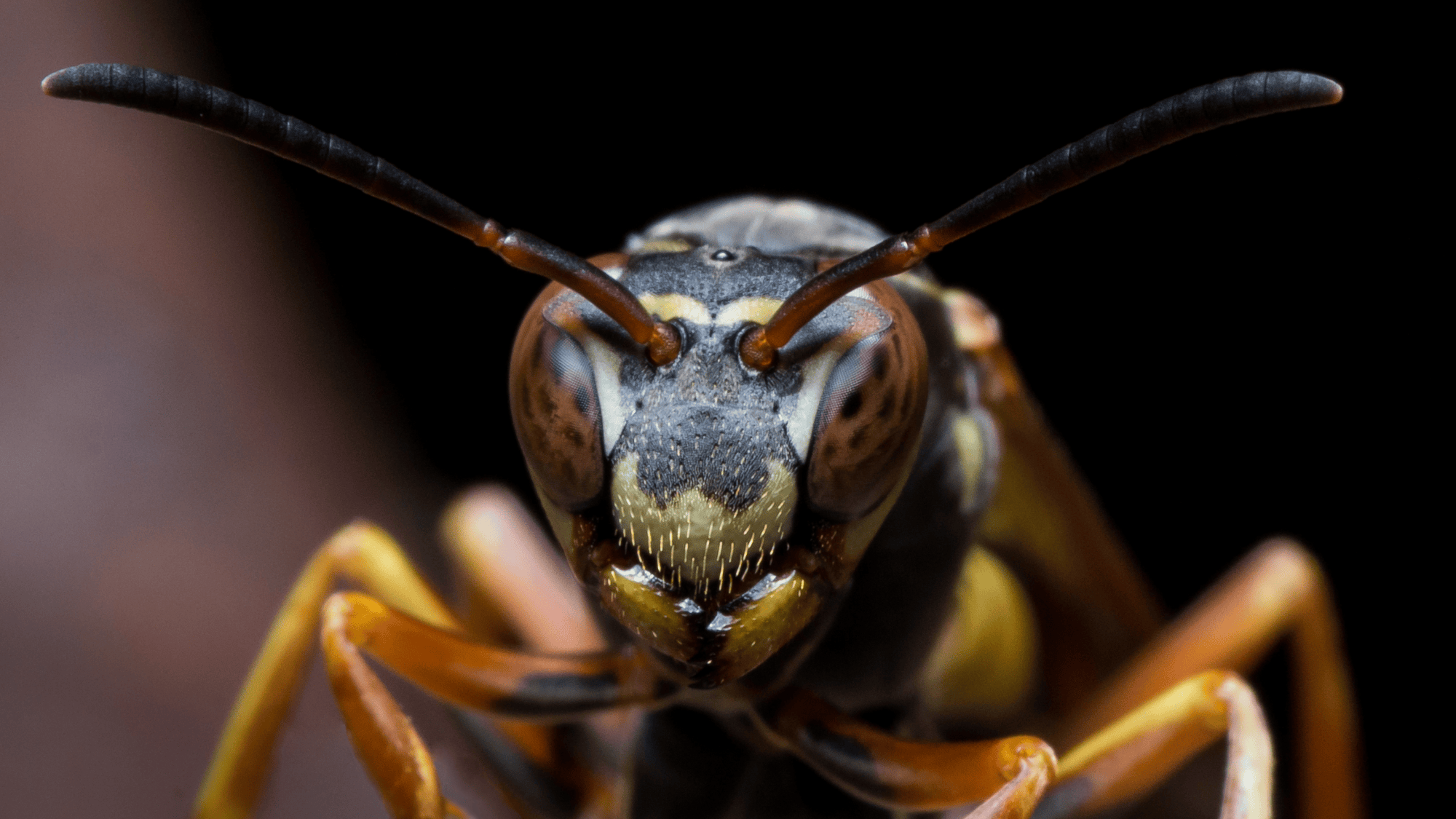
Wasps can recognize faces. But don’t worry. They may not be telling human faces apart the way that cows can. The stingy insects tell their nestmates apart by recognizing different color patterns on their faces, so they know the difference between mama wasp and papa wasp or a friend versus a foe. A study published today in the journal Cell details how they use specialized brain cells to pull this off.
“These wasps that perform facial recognition have neurons similar to those in our own brains that are doing very similar things,” Christopher Jernigan, a study co-author and neuroethologist at Wake Forest University in North Carolina, said in a statement. “These groups of neurons are all firing, and each neuron has a slightly different preference for one face or another.”
The team studied the northern paper wasp (Polistes fuscates). These roughly half-inch long bugs are found from southern parts of Canada through Florida and Texas. Their name comes from the paper-like nests made of hexagonal cells that they often construct under building eaves and on the ceilings of porches. Paper wasps also have silk that shine under UV light, giving these nests a secretive fluorescent glow.
Female northern paper wasps use facial recognition to remember another wasp’s place in the nest’s hierarchy. Once this hierarchy is established, recognizing faces helps maintain social order, without a constant battle for dominance.
New research from Wake Forest University shows how a group of neurons in the brains of female Northern paper wasps help the wasps recognize the faces of their nest mates. The complex process resembles that of primates, including humans. Image: Christopher Jernigan/Wake Forest University.Wasps may be using a method for facial recognition that’s similar to how primates (including humans) tell faces apart, even though both methods evolved independently. Even with brains about the size of a single rice grain, Jernigan said that wasps are “able to do this incredibly complex task of remembering and recalling individuals.” They do this by spotting the differences between the color patterns on one wasp face versus another, with the help of specialized neurons.
Wasps can also perform something called social eavesdropping. When two wasps fight to establish dominance in the nest hierarchy, one wasps can watch the two unknown wasps quarrel. Once that spectator wasp sees one of them, it will know whether or not it needs to fight for dominance.
“They will treat the winner of that fight independently in a third interaction differently than they would the loser,” Jernigan explained. “Despite having these small brains and relatively simple vision, they have these really complex social lives that revolve around this specialized ability to recognize each other.”
According to the team, understanding this facial recognition could help us understand human brain systems as well.
“This system, hopefully, holds the potential to help us understand our own brains as we study the circuit connections and the role of experience in giving rise to identity recognition,” Jernigan said. “It’s really remarkable that they have this kind of really human-like or primate-like ability that you wouldn’t typically expect for an insect. And I think it’s almost unbelievable that they have some of the similar kind of neural computations for doing a similar task as we do. It takes a tremendous amount of neural connections to do something similar in a primate.”
The post Wasps recognize faces—and it keeps them from killing each other appeared first on Popular Science.