
This piece comes to us from the Wildlife Conservation Society (WCS). Views and opinions expressed in blog posts are those of the individuals expressing them and do not necessarily reflect those of THIRTEEN Productions LLC/The WNET Group.
On October 19, governments will gather in Yerevan, Armenia, for the 17th Conference of the Parties (CoP) to the Convention on Biological Diversity (CBD). It is the second of this year’s three global conferences under the so-called “Rio Conventions.” The United Nations (UN) Convention to Combat Desertification (UNCCD) held its CoP in Mongolia in August; the UN Framework Convention on Climate Change (UNFCCC) will hold its CoP in Türkiye in November.
Why does it matter? Is it just a bunch of bureaucrats getting together, or industry-driven discussions leading nowhere? I don’t think so at all. These global “summits,” 34 years after they were conceived in Rio, have the opportunity to adopt strong actions and take important, interrelated decisions.
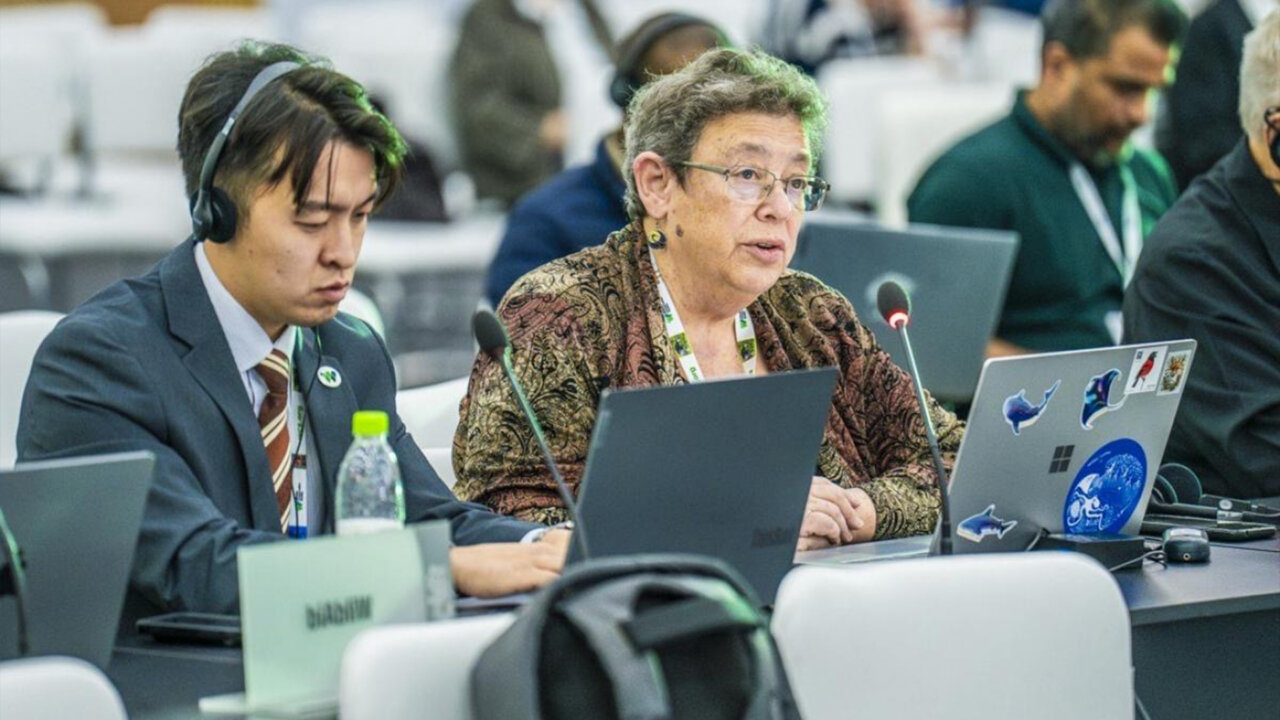
Dr. Susan Lieberman addressing a plenary of the Convention on International Trade in Endangered Species of Wild Fauna and Flore (CITES) in Samarkand, Uzbekistan in 2025. Photo credit: ©️WCS.
I lead the engagement of the Wildlife Conservation Society (WCS) with several international treaties that deal with biodiversity. We work to share our scientific and technical expertise, built on decades of field and policy work, to promote strong, evidence-based decisions on the conservation of wildlife and wild places.
The multilateral system, including the UN and international treaties that relate to health, wildlife, and biodiversity, largely dates from the post-World War II period. The UN was established in 1945, following the devastation and destruction of the war, with the mission of maintaining international peace and security.
The next wave of multilateralism came out of the environmental and conservation movements of the 1960s and 1970s, which helped motivate governments to agree to new biodiversity-related treaties, including the Convention on International Trade in Endangered Species of Wild Fauna and Flora (CITES) and the Convention on the Conservation of Migratory Species of Wild Animals (CMS).
Elepants in Mbeli Bai, Republic of Congo. Photo credit: Diane Detoeuf ©️WCS.
The three Rio Conventions grew out of the 1992 Rio de Janeiro Earth Summit.
All of these conventions meet regularly in a Conference of the Parties, or CoP, where the governments take decisions on implementation of the respective treaty and make commitments for action. Most governments belong to all three Rio conventions, and the overwhelming majority belong to all five.
The CBD incorporates all of biodiversity and is best known for its Global Biodiversity Framework, with its 23 targets, adopted in 2022. Its objectives include conserving biodiversity, using it sustainably, and sharing fairly the benefits arising from genetic resources. The UNFCCC focuses on climate change and greenhouse gases. The UNCCD is the only multilateral agreement specifically focused on land degradation, which is a critical issue for biodiversity conservation and human well-being across the globe.
A group of black-and-gold howler monkeys (Alouatta caraya) rest in the midday sun. Photo credit: Rob Wallace ©️WCS.
As governments prepare to meet in Yerevan, three priorities matter the most.
First, the Rio Conventions are close to universal in their membership by national governments, and together these CoPs can show that multilateralism is alive and well: that coming together, achieving consensus, building collaboration for the common good, and taking collective action is the right way to confront complex global challenges. Biodiversity conservation will never be achieved through unilateralism, confrontation, and militarism. These three major CoPs, all children of Rio in 1992, can and should take a stand for multilateralism.
Second, in a time of geopolitical tensions, governments must renew their collective attention to ecosystem integrity as a source of stability and resilience. Ecosystems with high integrity, whose composition (species), structure, and function (natural processes remain largely intact, provide globally important services, healthy nature, and keys to human health and well-being.
Strong ecological integrity also enhances the resilience of communities, economies, and supply chains to external shocks and weather events that can lead to increased migration or political instability. It is vital to design and implement policies across all three conventions that align around ecological integrity as a shared objective.
Third, we call on governments to not see each CoP in isolation, but rather coordinate their work across all three Rio Conventions to promote nature conservation in all their decisions, for the sake of wildlife and wild places across the globe, human well-being, and natural climate solutions. With the Mongolia conference behind us, the biodiversity and climate conferences must carry this work forward.
Solomon Islands mangrove. Credit: Björn Svensson ©️WCS.
I have been to more than 20 different CoPs in my career; some have been rewarding and energizing with good outcomes, and some have been discouraging and frustrating. But the overwhelming message I take forward, after a career of almost 40 years, is that multilateralism, where people, governments, and cultures come together to take actions for the common good, is the only way we will save our precious biodiversity.
This year, my approach to all three CoPs is to work with my WCS colleagues to help ensure a science-based approach to decision-making and make 2026 a year that—as they idealistically envisioned in Rio over 30 years ago—governments once again come together for the common good, embracing multilateralism and nature conservation, for the sake of all the inhabitants of planet Earth.
The post What Is the Global Biodiversity Summit and Why Does It Matter? appeared first on Nature.