
Humans have played with dolls for thousands of years, but it was not until the 18th century, when improved manufacturing rendered them more lifelike, that they started to be seen as sinister. Doll makers pivoted to porcelain skin, glass eyes, and wigs made of human hair, creating children and babies whose uncanniness to real people made them more unnerving than lovable. Later, in the Victorian Era, “mourning dolls” became a common way to remember deceased children, wearing their clothes and even sitting atop their coffins. Throw in Chucky, Annabelle, Slappy the Dummy, and numerous other evil dolls from pop culture, and boom: Dolls = creepy.
At these places around the world, dolls and other eerie toys are the main attraction. Some spots are happy-go-lucky art projects that, despite their creator’s intentions, still have the power to unsettle visitors. Others were always shrouded in darkness, created to showcase murders and mysteries. All of them are excellent examples of the creativity — and lore — that a single toy can embody, as well as our enduring fascination with the uncanny and ever-so-slightly “off.”
1. Tombées du Camion - Saint-Ouen, France
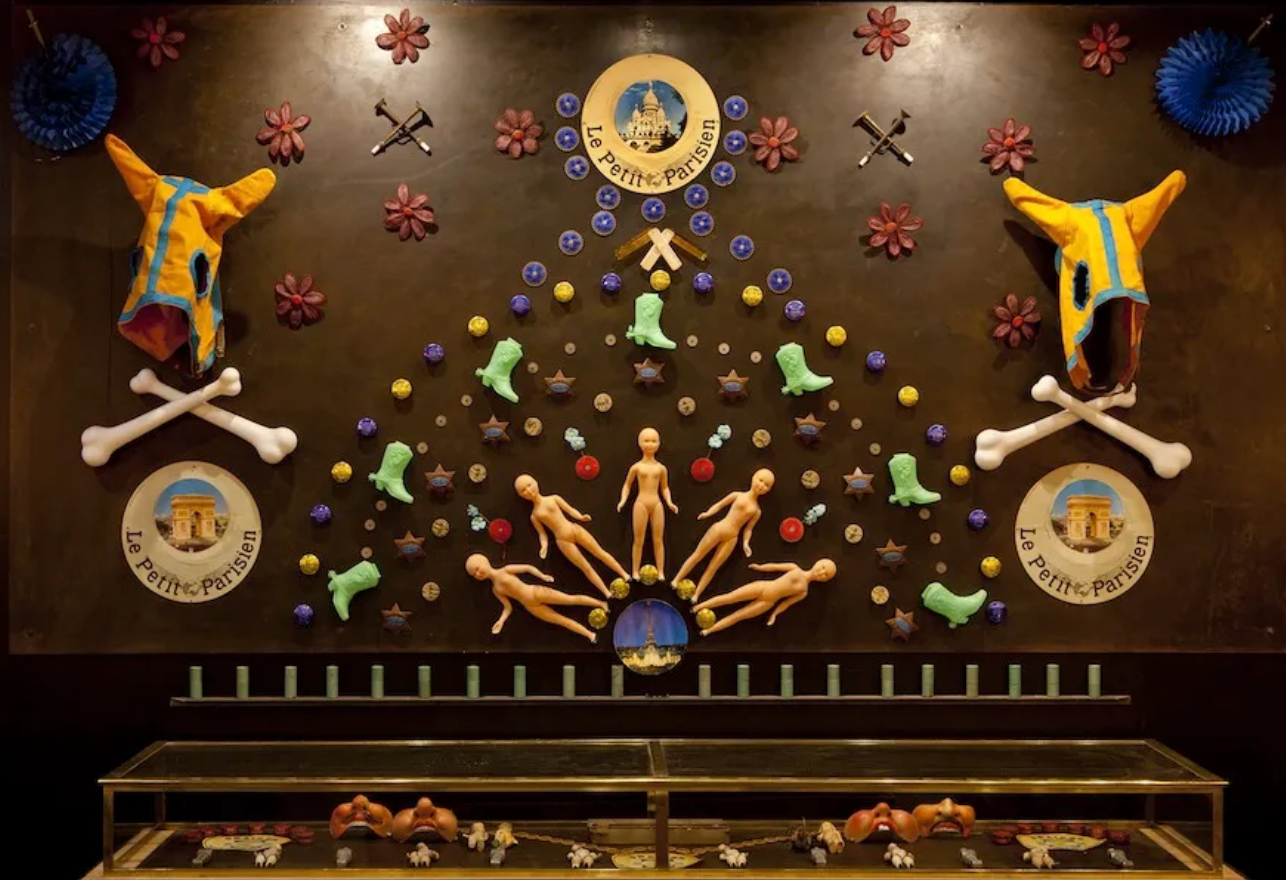
This tiny shop just outside Paris specializes in vintage objects from French factories, the odder the better. The name of the store (which translates to “goods that have fallen off the back of a truck”) is perhaps the first sign that this isn’t your average antique store; inside, you’ll find ephemera ranging from glass dolls’ eyes to coffin handles to bicycle-shaped sunglasses, with items sorted into small wooden boxes or attached to the ceiling.
The owner, sculptor and interior designer Charles Mas, wanted to give visitors the chance to find all the toys, tools, and trinkets they enjoyed as children. “I focus on objects that have no market value, but an emotional and nostalgic value,” he says. “Many things that, without imagination, are worthless.”
2. Ospedale delle Bambole - Rome, Italy
For close to 90 years, the Squatriti family has pieced broken dolls back together from this small shop in Rome’s Centro Storico. Inside, benches and shelves are cluttered with various body parts, while the work tables are filled with paintbrushes, twine, and plaster. Each year, the Squatritis save upwards of 1,000 period pieces: not only dolls, but also vases, statuettes, plates, and more. The shop’s owner, Federico Squatriti, says that the “hospital” has changed very little since his relatives first opened it. At that time, the Squatritis lived above the shop, and as a boy, Federico would drop in to say hello to his father, uncle, and grandmother while they worked. Locals have referred to the space as a “shop of terror,” but to the entire Squatriti family, it is a second home.
3. Nutshell Studies of Unexplained Death - Baltimore, Maryland
Back in the mid 20th century, when forensic science was still in its infancy, Chicago socialite Frances Glessner Lee created 20 dioramas of real-life crime scenes on a 1-inch-to-1-foot scale. To ensure accuracy, Lee attended autopsies for all the cases and re-created their settings with astonishing detail. (One even contains a hanging wall calendar for the year of the crime.) She called her project the Nutshell Studies because of the purported purpose of a forensic investigation: to “convict the guilty, clear the innocent, and find the truth in a nutshell.”
At Harvard’s Magrath Library of Legal Medicine, Lee led seminars in which she guided students through the dioramas, helping them draw conclusions about the crime based on the information displayed. After she passed away in 1962, the Nutshell collection was obtained by the Maryland Office of the Chief Medical Examiner and fully restored. Today, the models are still used for educational purposes by investigators.
4. The House of Dreams Museum - London, England
The lavishly designed home of textile designer and art director Stephen Wright also serves as a museum of his work, with Wright residing in his upstairs flat even while guests wander the halls below. The entire ground floor of the home (including its garden and exterior) exists as one exquisite sculpture of mosaics, collages, dolls, and handwritten “memory boards,” showcasing all of Wright’s loves and losses. He started transforming the home in 1992 as a side project, but after the death of his partner and his parents in quick succession, it became an outlet for his grief. Even today, the space is evolving, with Wright adding bits and pieces donated by visitors or discovered at flea markets.
5. Mary’s Gone Wild Folk Art and Doll Baby Museum - Supply, North Carolina
According to artist Mary Paulsen, God commissioned her to give her collection of 6,000 dolls a proper home, complete with painted windows, tin cans, glass shards, and whatever other scraps and goods neighbors have donated. Mary will gladly transform anything she’s given into “gonna-make-you-smile art” for the village, which consists of a little red schoolhouse, soda pop shoppe, library, and chapel (where she herself got married). She also sells some of her pieces, with all proceeds going to Feed the Children, a nonprofit fighting childhood food insecurity.
While the village may be a bit unsettling at first, most visitors quickly warm up to the cheerful whimsy of Mary’s vision. In fact, Mary is often around to greet visitors and will drop whatever she’s working on to give a tour and introduce you to the dolls. “Mary is a delight to talk with and her place is incredibly creative,” one visitor reflected. “A lot of junk…lovingly presented!”
6. Hospital de Bonecas - Lisbon, Portugal
Opened in 1830, this is one of the world’s oldest doll repair shops, and it has the collection to prove it. Over its nearly two centuries of operation, any doll that’s gone unclaimed has been kept by the shop proprietors in their “museum,” which also holds a slew of different body parts sorted in drawers, miniature furniture pieces, and costumes hung on a clothesline. The shop designs many of these doll clothes itself and also makes toy cars, planes, and carousels.
7. Lost Toys of the Nybohov Funicular - Stockholm, Sweden
This underground cable railway has connected Liljeholmen and the Nybohov hill since 1964, but no one knows exactly when dozens of toys started turning up there. Still, locals have grown quite fond of these colorful additions to the dark tunnel, so much so that when authorities tried to remove them in 2012, Stockholm residents protested, demanding the plushies be left in peace. Their efforts paid off: The nearly 30 toys still adorn the metal rails and concrete walls of the funicular, waving hello to any children who pass.
8. Doll’s Head Trail - Atlanta, Georgia
In Atlanta’s Constitution Lakes nature preserve, a strange pathway winds through the wetlands and forest. Doll arms rise from the ground holding toy cars, with a nearby brick reading “Giving daddy a hand.” Clothed dolls lean against tree trunks, their heads replaced by rusty tools. One baby’s face sits atop a board that says “fashion” in neon paint, while another is positioned among mossy bricks and pinecones.
This collection of oddities was created by Joel Slaton, a local carpenter who wanted to repurpose discarded materials he found in the area. Soon, others started contributing their own art pieces, with one caveat: Every work must be made of things from inside the park itself. Bringing things with you is strongly discouraged, with a sign at the trailhead explaining that “litter makes the angels cry.”
9. Robert the Doll - Key West, Florida
In the early 20th century, young Gene Otto received this straw-filled doll and, naming it Robert, started bringing it with him everywhere he went. It wasn’t long before Gene’s family heard him having full conversations alone in his room and screaming in the middle of the night. Later, when furniture was mysteriously upturned, Gene blamed it on Robert. Some visitors to the Otto family home even heard high-pitched giggling and spotted a doll-like figure in the window.
Gene has long since passed away, but Robert is still around, living happily at the Fort East Martello Museum in Key West, Florida. You can visit him here, but beware: He’s known to curse those who take his photo without asking permission first.
10. Burke & Hare Murder Dolls - Edinburgh, Scotland
Nearly a decade after “Anatomy Murderers” William Burke and William Hare terrorized Edinburgh, these 17 dolls were found in a city park, each one nested in a miniature coffin. Rumors arose that the figures were effigies of the duo’s victims, though other folks theorized they depicted local sailors who had never received a proper burial. Regardless of who they were meant to represent, the dolls were most likely crafted by a cobbler, as they’re made from the profession’s special hinges and nails.
11. Doll Garden of Sabile - Sabile, Latvia
Hundreds of straw dolls go about their regular lives in this large garden: cutting down trees, cooking meals, riding bikes, and sawing wood. They were all crafted by the garden’s owner, Daina Kučere, whose answer to why she made the village is more or less “Why not?” Residents wear all kinds of attire, from police uniforms to wedding dresses to baggy sweats (really just whatever Kučere digs up). Anyone can pass through the garden at their leisure and show their support by dropping a few coins in the central donation box.
12. Miyoshi Mononoke Museum - Miyoshi, Japan
Japan’s first public museum dedicated to yokai (the supernatural spirits and monsters of Japanese folklore) contains over 5,000 artifacts, including many dolls and action figures depicting the quirky creatures. There’s even an interactive room full of yokai-related activity stations, where guests can use light projections to make images move and change, or color their own yokai, which then appear as animations on a screen. The “yokai camera” is another fun element to try out, letting visitors take selfies inside a historic yokai picture scroll and transform into yokai themselves.
13. Aunt Claudia’s Dolls - Juneau, Alaska
Shortly after World War II, artist and toy collector Claudia Kelsey moved to Juneau with her family of dolls and figurines. By the time she passed away 60 years later, her collection had grown to number in the hundreds, and her close friend decided to open it up to the public as a gallery.
While Claudia was especially focused on finding handmade Alaskan Indigenous dolls, her collection included items from all over the world. Since the gallery opened in 2010, it has received donations from doll enthusiasts in Greenland, Scandinavia, Russia, and more, showcasing many different methods and materials used by doll makers. In fact, the gallery’s director and curator, Mary Ellen Frank, is a maker herself, crafting figurines of Alaska Native leaders and elders using traditional carving techniques.
14. Beaver Island Toy Museum - Beaver Island, Michigan
On a small isle in the middle of Lake Michigan lives this colorful (and slightly creepy) toy collection, with items ranging from doll heads in jars to midcentury action figures to a big jar of tacks. The space is small, so items are arranged creatively, with old bicycles hanging from the rafters and toy cars and planes glued to the walls. The toys also flow into the yard: an endearing hodgepodge of overgrown potted plants, colorful deck chairs, and stone animal sculptures. In the back shed, local artists’ work is exhibited, including a photo series of Bigfoot lounging about the toy museum and island.
Even in her 80s, the museum’s founder, Mary Rose, can be found greeting visitors most days and still maintains her expert eye for toy curation. Start chatting with her and she may just show you some of her son’s artwork, or steer you toward the perfect toy to take home.
15. The Troll Hole - Alliance, Ohio
Since 2014, owner Sherry Groom has shared her love of Scandinavia’s ugly, mountain-dwelling folk creatures at this elaborate museum, which features a grotto, waterfalls, and naturally, a 10-foot troll mountain. In 2012, Sherry took home the Guinness record for World’s Largest Troll Collection, and it’s pretty easy to see why: Everywhere you look are rows and rows of trolls, from the smiley, wild-haired dolls created in the 1950s to rare ninja trolls and a vintage Trollmobile. The Troll Hole also features a coffee shop, The Grumpy Troll Cafe, and hosts meet-and-greets with the “Trolls” movie character, Queen Poppy, every Sunday.