
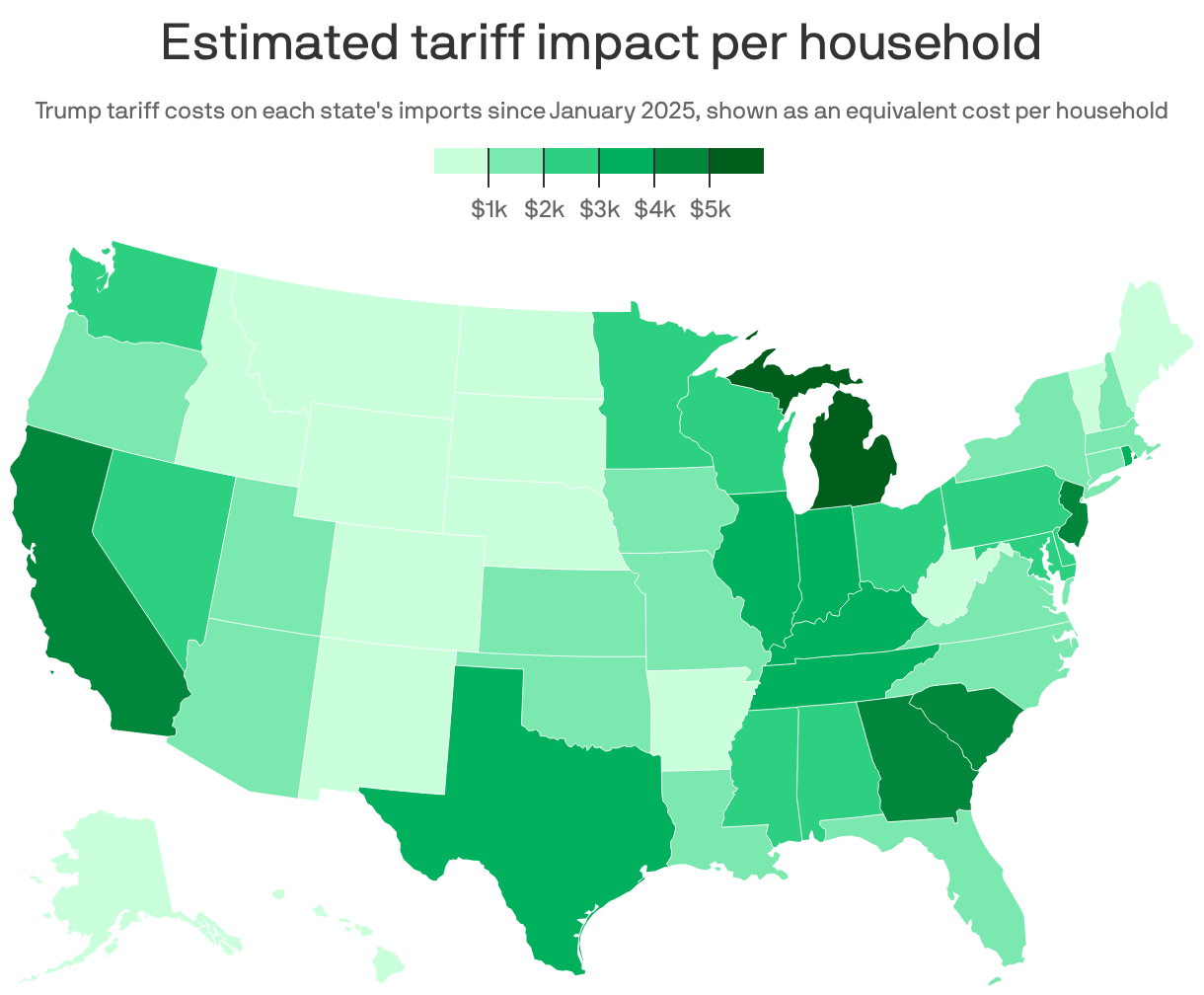
States bear wildly different estimated tariff burdens from President Trump's trade actions since the start of 2025, from California's $62.8 billion share to Wyoming's $107 million.
Why it matters: Local industries dictate how and how hard communities have been hit, from Michigan's auto industry to Virginia's aerospace sector.
By the numbers: California has absorbed the biggest chunk of the overall $342 billion estimated tab, according to National Taxpayers Union Foundation data.
- Michigan's $23.2 billion tab is smaller, but amounts to an estimated equivalent of $5,619 per household, the highest in the nation.
Zoom in: The primary industries driving states' tariff costs offer a glimpse into local economies.
- Vehicles dominate tariffs in Michigan, while auto parts lead in neighboring Indiana and Ohio.
- Toys and games were the leading tariff target in Minnesota, home to Target and several game companies.
- In Florida, food — think imported winter produce — is the biggest tariff-hit category.
Yes, but: The Supreme Court struck down Trump's sweeping emergency-power tariffs in February, and importers are now seeking refunds for billions of dollars in duties already paid.
- The data reflect tariffs collected through June 2026, including some costs that could ultimately be refunded, even as the administration explores alternative tariff approaches.
The fine print: Axios analyzed state tariff estimates from Trade Partnership Worldwide, compiled by the National Taxpayers Union Foundation. Per-household equivalents use Census Bureau American Community Survey data.
The bottom line: Trump's tariffs are international. Their economic impact is local.