
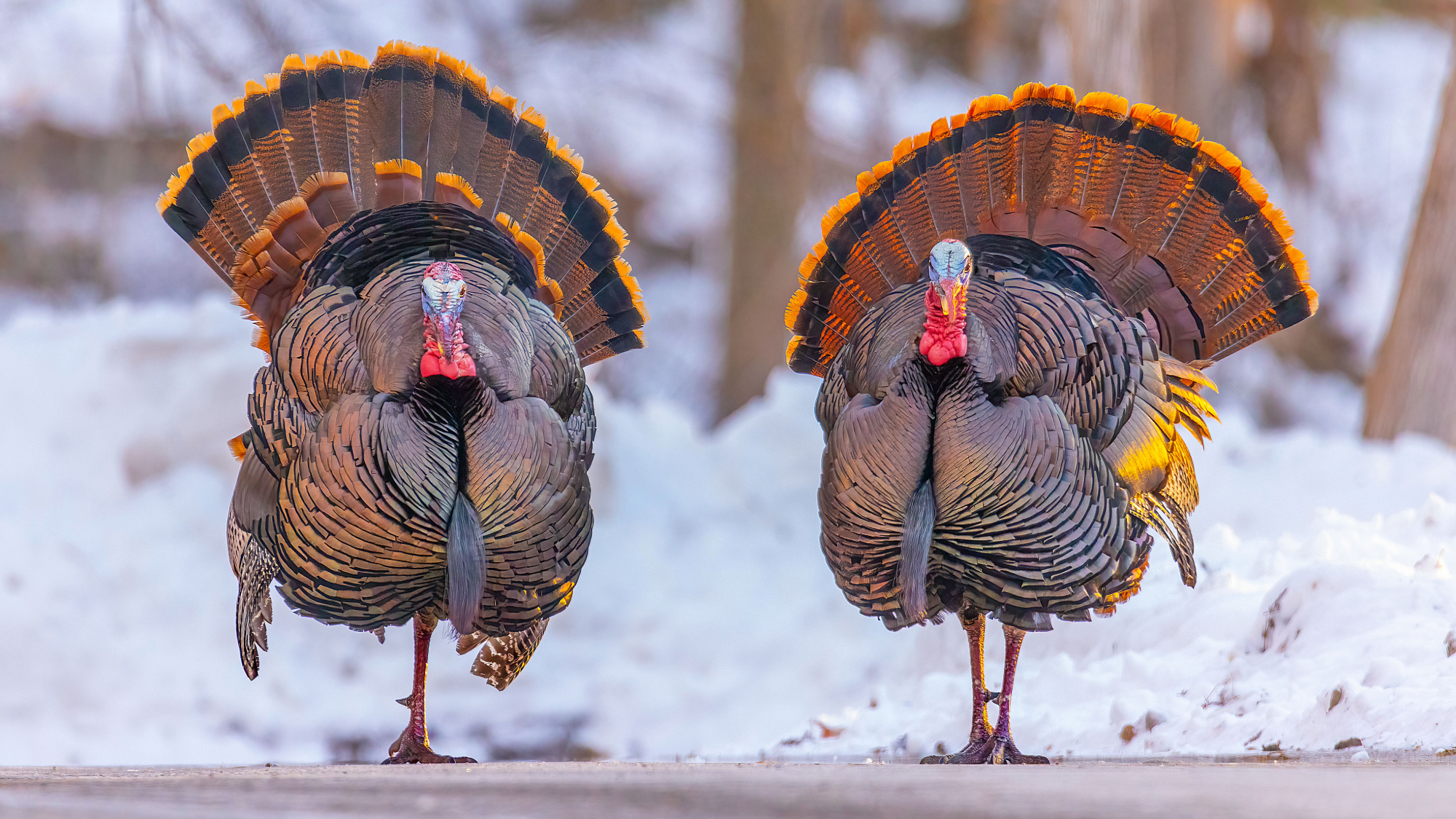
As most people in the United States know—especially around this time of the year—wild turkeys (Meleagris gallopavo) are large, broadly dark-colored birds with iridescent feathers and bald necks and heads. But not all turkeys are alike. Some of these boisterous birds have color phases, or non-traditional arrangements in their feathers, or plumage.
“Color phases are caused by genetic mutations that affect production of melanin, the pigment that causes the dark coloration in a wild turkey’s plumage,” Michael Chamberlain, National Wild Turkey Federation Endowed Chair, tells Popular Science.
There are four general turkey color phases: smokey gray, erythristic, melanistic, and leucistic. Smokey gray turkeys don’t have brown pigments in their plumage, and can look white from a distance. Leucistic turkeys have white feathers because they lack melanin production in their plumage, but their heads, beards, and legs appear more normal and red.
Melanistic birds are essentially the opposite. The genetic mutation causes an overproduction of melanin, so the turkey is darker-colored and almost totally black. Erythristic turkeys have an overproduction of carotenoids (types of pigments behind orange, yellow, and red colors) that prevent the production of melanin and also make their feathers more reddish.
How common these different color variations are is still a question, because experts have just started to track their occurrences. Leucistic birds appear to be present throughout North America, while melanistic birds—the completely black ones—seem to be more rare.
“It’s unknown how odd plumage affects survival or reproduction, but it’s logical to assume that lighter colored birds and particularly leucistic and smoke phase birds would be obvious to predators,” explains Chamberlain, who is also known as the Wild Turkey Doc. However, “the relationship between odd plumage and survival or reproduction has never been documented in the literature.”
But if you come across a picture of a gorgeously-colored bird that looks like a turkey-shaped peacock, chances are that you’re looking at the only other turkey species: the ocellated turkey (Meleagris ocellata). These fantastical looking animals are the wild turkey’s tropical cousin and only exist in the Yucatán Peninsula, and were domesticated by the ancient Maya.
Feel free to talk turkey with these and other fun turkey facts this Thanksgiving.
The post Wild turkey feathers can change color appeared first on Popular Science.