
Since WNBA player Sophie Cunningham said that biological men should not compete in women’s sports or enter women’s locker rooms, the WNBA’s legitimacy as a women’s league and nearly everything it once stood for have gone up in flames.
And every ounce of that damage has been self-inflicted. Faced with visceral backlash from radical gender activists over Cunningham’s comment, league officials, team owners, and coaches have either sat back and watched the chaos engulf their league, too afraid to challenge the small but loud minority driving it, or kowtowed completely.
They are treating Cunningham, her supporters, and anyone else who defends women’s spaces as heretics deserving of insults, threats, and public humiliation.
CLICK HERE FOR MORE OUTKICK SPORTS COVERAGE
In doing so, the very people charged with protecting the integrity of women’s basketball have abandoned the women and girls whose opportunities their league exists to protect. They have taken the torch passed to them by generations of women who fought for the rights they benefited from and promptly handed it to activists determined to burn those protections down.
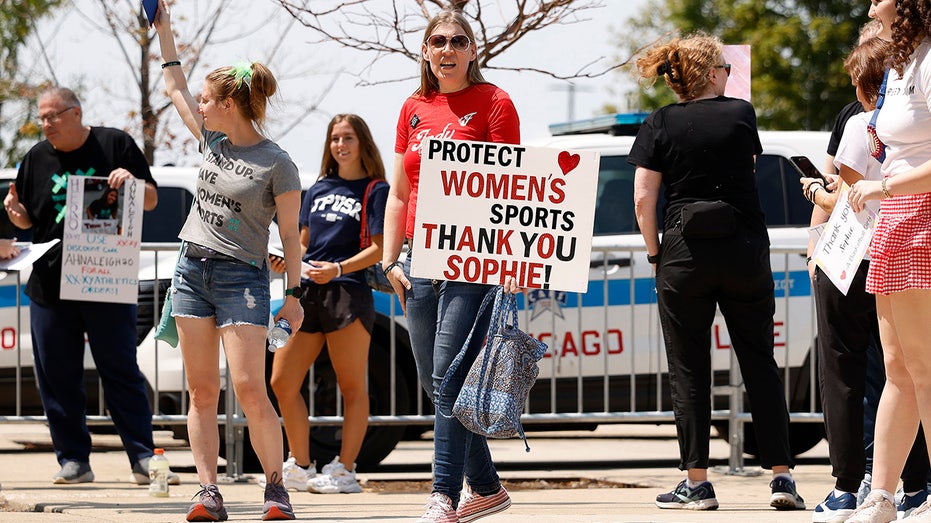
Predictably, a month of escalating absurdity has followed. Protests and counterprotests have erupted outside games, fans have been ordered to cover shirts acknowledging biological sex, a former NBA player wearing a shirt defining "woman" as "adult human female" was ejected from an arena, and two teenage girls holding a sign supporting Cunningham were berated by the co-owner of another WNBA team and told they were "f---ing insane."
League leaders have even devoted a "task force" to deciding who exactly qualifies as a woman under the league’s collective bargaining agreement, which states that "only players who are women" may compete. To this day, they have yet to emerge with a clear definition or eligibility policy, because determining whether men belong in a women’s league is apparently too "complex and nuanced" for the leaders of the Women’s National Basketball Association.
Cunningham’s own head coach, meanwhile, has claimed she is simply not "educated enough from a scientific standpoint" to take a position. Portland Fire head coach Alex Sarama said he had somehow never considered whether biological males should compete in women’s sports. He quickly added, of course, that he is "supportive of people from all communities," lest the mob turn on him next.
Golden State Valkyries head coach Natalie Nakase explicitly said women’s sports should include "trans women," meaning biological males, then somehow compared enforcing the biological distinction between men and women to discrimination she has faced over her Japanese-American heritage.
WNBA FOLLOWERS ENRAGED OVER THREE HEAD COACHES' COMMENTS ON PROTECTING WOMEN'S SPORTS IN TWO DAYS
Minnesota Lynx head coach Cheryl Reeve, seemingly the most eager to abandon the girls the WNBA was created to serve, used her team’s game against the Fever to make a political statement and wear a "Trans Kids Belong" shirt before denying in interviews that biological males entering girls’ locker rooms is a real concern.
She saved her most condescending response, however, for the two girls who were cursed at by the Seattle Storm co-owner for holding a sign reading "Thank you Sophie for speaking up for girls." According to Reeve, they are the ones who do not "understand" what the "real problems are."
Really? One of those girls was Ahnaleigh Wilson, who lost an eighth-grade championship race to a biological male and competed against a male athlete four times this past cross-country season. If Reeve had experienced this humiliation when she herself was a student athlete in New Jersey, she’d likely feel very differently.
Countless other girls across the country share Wilson’s story. Here in Maine, Kessa Benner saw her dream of winning a state pole-vaulting championship "unfairly shattered" when a biological male who had competed in the boys’ division just a year before took first place in the girls’ event.
When I, then a sitting member of the Maine House of Representatives, spoke up for Benner and girls with similar experiences, the male-led Democratic majority censured me and stripped me of my right to speak or vote until I apologized. Thankfully, the United States' Supreme Court intervened, and required my vote be counted. This same pattern that punishes girls and their defenders has now become entrenched at the professional level, the last place it should ever have taken hold.
Calling the WNBA’s response ignorance lets its leaders off far too easily. These officials, owners, and coaches know the difference between male and female athletes. They know why women’s basketball requires its own league and what happens to female players when that distinction is erased.
But acknowledging those facts would require them to stand up to the political, media, and institutional forces that now police every word spoken inside women’s sports. So, instead, they genuflect at the altar of a nonsensical political agenda and leave girls such as Wilson to pay the price.
The tragic irony is basketball is one sport where women can thrive professionally. Women play baseball, hockey and other sports but professional leagues in those endeavors are nowhere near as far along as the WNBA.
But its descent from a serious professional sports league into an unserious, weekly sitcom crushes the hopes of both those who’ve worked so hard to get there, and the generations of girls in middle school, high school and college right now who hope one day to wear a WNBA uniform.
The league would not exist without generations of women who fought for female athletes to have their own opportunities to compete fairly. Its leaders inherited everything those women fought to create. By refusing to preserve those protections for the girls coming behind them, they are abandoning the league’s purpose and destroying its future.
Laurel Libby is a member of the Maine House of Representatives and founder of Lead Maine.